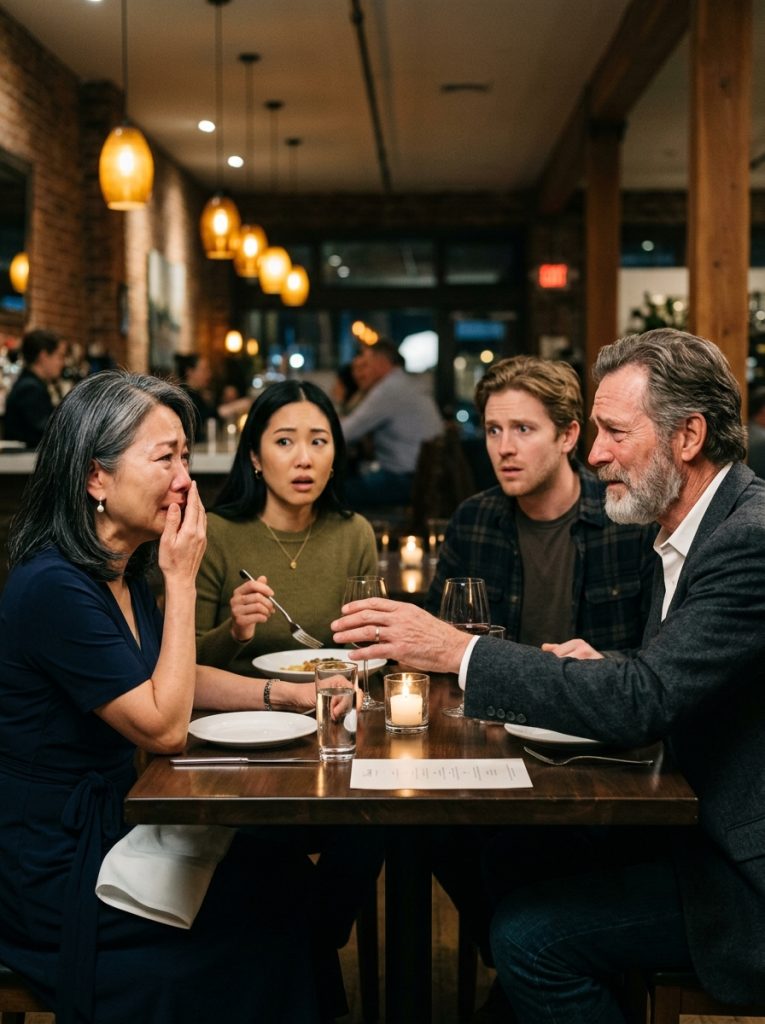
Robert’s fingers closed around my mother’s hand across the restaurant table.
And for several long seconds, nobody at that table moved.
Jake and I sat frozen on either side of a moment we had accidentally created — two adult children who’d planned a casual dinner and stumbled into something neither of us had the emotional vocabulary to process.
My mother was crying. Not the polite kind. Real tears — the kind that surface from a place so deep you didn’t know it still held water after thirty-five years.
Robert’s thumb moved slowly across her knuckles. Back and forth. Like muscle memory from another life.
“I looked for you,” he said. “After. For months.”
Linda shook her head slightly. “My parents moved us to Sacramento in a week. I didn’t have your number memorized — we didn’t have cell phones then. I had nothing of yours except memories they tried to make me forget.”
“I drove to your apartment. Empty.”
“I wrote you a letter. They intercepted it.”
“I went to your campus office—”
“Cleared out.”
“Three letters. All returned.”
“I never saw them.”
Jake looked at me across the candlelight. I could see in his face the same vertigo I felt — the ground beneath our understanding of our parents shifting in real time.
“My parents,” Linda said, turning to me with tears still falling, “told me Robert had moved on. Found someone more suitable. That I was embarrassing myself by hoping.”
“And my mother,” Robert said to Jake, “told me Linda was engaged to someone her family approved of. That pursuing her would only cause more pain.”
“None of it was true,” Linda whispered.
“Not a word.”
They looked at each other across that small table like two people standing on opposite sides of a bridge they’d both spent three decades believing was ash.
“I married your father a year later,” Linda told me. Her voice was steady now, though her eyes were still wet. “He was a wonderful man. I loved him genuinely. But—”
She stopped.
“But what?” I asked gently.
“There was always a room in my heart I kept locked. A room with a door I told myself didn’t exist anymore.”
Robert nodded. “Same. Exactly the same.”
“My wife Margaret,” he told Jake, “was remarkable. Thirty years of a good marriage. But she knew.” He paused. “Near the end, she told me — ‘Find her, Robert. After I’m gone. Find the one you lost and don’t waste whatever time you have left.'”
Jake went pale. “Mom said that?”
“Six months before she passed. She’d seen your mother’s photo once, years ago. I don’t know how she knew. But she did.”
The restaurant continued around us. Waiters passing. Glasses clinking. Jazz playing from hidden speakers. The ordinary machinery of a Friday evening in Portland. And at our table, thirty-five years of buried history being carefully exhumed.
“So what happens now?” I finally asked.
Robert and Linda looked at each other.
“I don’t know,” Linda said. “I never imagined this was possible. I’d made peace with it. Or I thought I had.”
“You moved to Portland?” Robert asked.
“Two years ago. After your father passed,” she said to me.
“I’ve been here eight years.”
The same city. For two years. Without knowing.
“We were probably in the same grocery store,” Linda said — a fragile, disbelieving laugh.
Robert smiled. Sad and warm and full of something that looked remarkably like hope for a man of sixty-one.
“The universe is patient,” he said. “Even when people aren’t.”
He looked at Jake. Then at me.
“I want you both to understand — I’m not replacing anyone. Not your mother, Jake. Not your father, Maya. What Linda and I had was before. A different lifetime.”
“But it’s still here,” Linda said softly.
“It’s still here,” he confirmed.
Their hands hadn’t separated since they first touched.
Jake cleared his throat. “So we accidentally reunited our parents who were already in love thirty-five years ago?”
“Apparently,” I said.
“That’s either the worst matchmaking in history or the best.”
Robert’s smile widened — the first real, full smile of the evening. It made him look twenty years younger.
“It’s the best,” he said.
Over the following weeks, Robert and Linda saw each other every single day.
Coffee first. Then walks along the waterfront. Then dinners that lasted until the restaurant closed. Then entire evenings where Jake and I would call and neither parent would answer because they were too occupied with rediscovering what had been stolen from them at twenty-three.
They talked about the years between. The marriages. The children. The careers. The grief. All the living done in the gap between what was and what could have been.
Three months later, Robert moved into Linda’s apartment.
“Not because we’re rushing,” he told Jake. “Because we already lost thirty-five years. We’re not losing another single day.”
At the small dinner where they told us officially, Linda wore the same navy wrap dress from that first night. Robert wore the same charcoal blazer.
And when he reached across the table — palm up, waiting — and her fingers interlocked with his like a gesture practiced in another century, I understood something that reframed my entire concept of love.
Not every love story begins and ends within a single lifetime.
Some are interrupted.
Torn apart by people who think they know better. Buried under years of silence and separate lives and children and grief and the slow accumulation of time.
And the ones that survive all of that — the ones that hold their shape across three decades of separation — those are the stories that were always meant to continue.
My mother is happy now.
Advertisement
Genuinely, visibly, radiantly happy.
For the first time in four years, she doesn’t pause in doorways.
She walks straight through them.
Because someone is finally on the other side.
Six months after that dinner, Jake and I stood in Linda’s kitchen helping prepare for Robert’s sixty-second birthday.
The apartment was warm. Music playing softly. The table set for four — the same four people who’d sat at that restaurant on Hawthorne, except now we were family in a way we hadn’t been when the evening began.
Robert came through the door and Linda met him with a kiss so natural, so unhurried, that it was impossible to believe they’d been separated for thirty-five years. They moved around each other in the kitchen like two halves of a system that had always been designed to work together.
Jake nudged me at the counter.
“You think they’re making up for lost time?”
“I think they already have.”
After cake, Robert stood and raised his glass.
“I want to make a toast,” he said. “To two meddling children who thought they were being clever.”
Everyone laughed.
“And to thirty-five years that couldn’t kill what was real.”
He looked at Linda.
“And to however many years we have left. Which I intend to spend within arm’s reach of you.”
Linda raised her glass. “To second chances.”
“To second chances,” we all repeated.
Later that night, after Jake and I had cleaned up and said our goodbyes, I sat in my car in the parking lot for a few minutes before driving home.
I thought about my father. About how much he’d loved my mother. About how their marriage was real and good and full of its own beauty.
And I realized something that made the whole complicated history feel less painful and more human:
Love doesn’t work in competition.
One love story doesn’t diminish another.
My father loved my mother completely. And thirty-five years before that, Robert loved her completely too. Both were true. Both were real. Both left something permanent in the architecture of who she became.
And now, at fifty-eight, she had one more chapter waiting.
A chapter she’d been too afraid to even hope for.
Until two meddling children — who didn’t know what they were doing — accidentally gave her the only gift that actually mattered.
A second beginning.
With the person she’d lost.
In the city they’d both chosen without knowing the other was there.
Some things aren’t coincidence.
Some things are just patient.