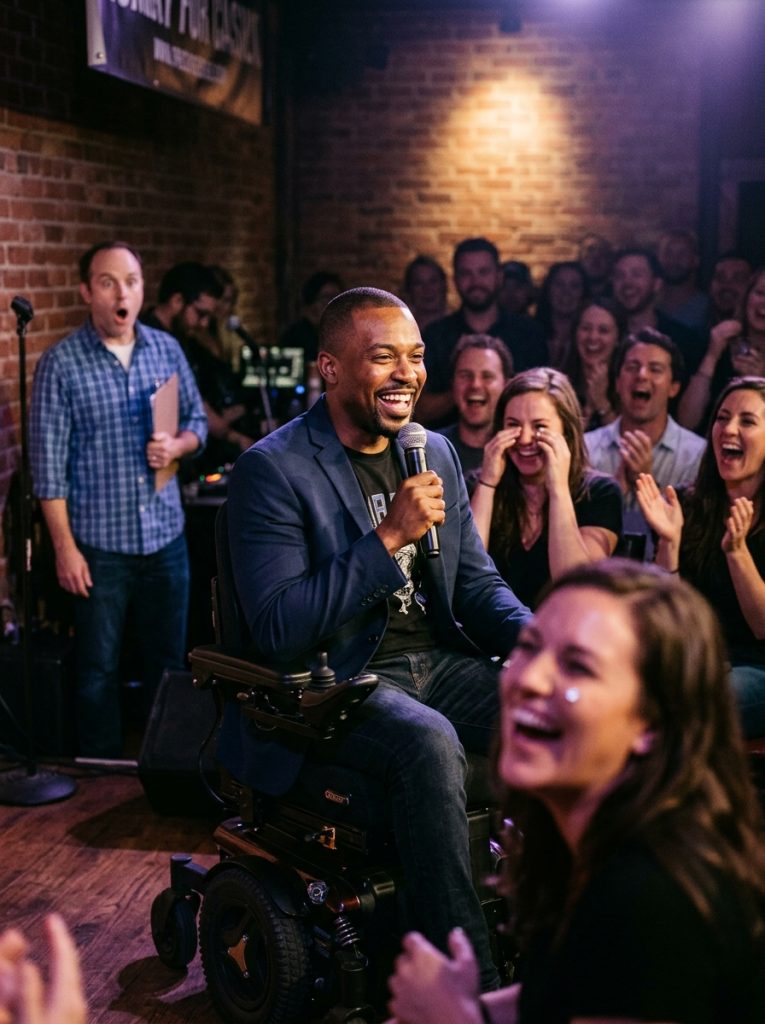
The lights came up and the room was still ringing.
I stood backstage — if you could call the hallway behind the curtain “backstage” at Marley’s Comedy Lounge — and I could still hear them. Not polite laughter. Not the courtesy chuckle you give a mid-card act. The real thing. The sound that starts in someone’s belly and comes out before they can stop it.
Seven minutes on stage. My best set in three years. Maybe ever.
I toweled off my face. My hands were shaking. They always shake after a good set but this was different. This was the kind of shake that means something shifted. Something cracked open.
The door to the hallway swung open. Greg stood there.
He looked like someone had slapped him with a fish. Mouth slightly open. Eyes doing that rapid-blink thing people do when they’re recalculating something they thought they understood.
“Marcus.” He stepped forward. Extended his hand. “Man, that was — I had no idea you could — “
I looked at his hand. This man who’d booked me exactly once in four years. Who’d put me on at 8:15 on a Tuesday — the death slot — and told me I should be grateful for the stage time. Who’d passed me over seventeen times for headliner spots that went to guys with half my material and twice my complexion advantages.
“Thanks, Greg.” I didn’t take his hand. Not out of anger. Out of clarity. “Book me because I’m funny next time. Not because you feel something right now.”
His hand dropped. His face did something complicated. “I always thought you were funny — “
“You thought I was diversity-slot funny. ‘Let’s put the Black guy on early so the crowd feels progressive before the headliner.’ That’s not booking. That’s set dressing.”
He opened his mouth. Closed it. Opened it again. “That’s not — I don’t — “
“It’s fine, Greg. It’s not a fight. I’m just telling you what I need if we’re going to work together. Book the act, not the optics.”
I turned and walked back down the hallway toward the bar. Behind me, Greg said nothing. Good.
The bar was still humming with post-show energy. People finishing their drinks, replaying jokes to each other, doing that thing where they quote the punchline and laugh again. I loved that sound. It meant the material landed deep enough to remember.
I ordered water. Leaned against the bar. Let the feeling settle.
That’s when I noticed her.
Back booth. Corner table. A woman in her fifties, maybe. Silver-streaked hair pulled back. Black blazer over a simple shirt. She had a notebook open in front of her and she was writing. Not on her phone — actually writing, with a pen, in fast confident strokes.
She looked up. Caught me looking. Smiled like she’d been waiting for me to notice.
She stood, tucked the notebook under her arm, and walked over. Direct. No hesitation. The walk of someone who knows exactly what she wants.
“Marcus Webb.” She extended her hand. Firm grip. “I’m Diana Cortez. I’m a talent coordinator for The Late Set with Calloway.”
The Late Set. Eleven-thirty on NBC. The show I’d watched every night for a decade. The show that launched four careers I admired and buried none.
“I was in the back booth the whole time,” she said. “I saw every minute of your set.”
“And?”
“And I haven’t written that fast in years.” She tapped her notebook. “You have something most comics don’t. Precision. Every word is doing work. No filler. No vamping. And the callback structure in that third bit — the one about the DMV and your mother’s expectations — that’s architecture. That’s not just jokes. That’s craft.”
I didn’t know what to say. So I said: “Thank you.”
“I’m not here to flatter you. I’m here because we’re looking for someone for a recurring segment. Four appearances to start, with potential to expand. Comedy that’s sharp without being shock-value. Smart without being exclusive. You check every box.”
She pulled a card from her blazer pocket. Heavy cardstock. Embossed lettering. Real. Not a maybe. Not a “let’s stay in touch.” A card with a direct number and a title that meant something.
“Think about it,” she said. “Or don’t think about it. Call me Monday either way.”
She left. Just like that. No lingering. No small talk. Professional. Clean.
I stood at the bar holding her card and feeling like the floor had tilted slightly under my feet.
Monday came. I didn’t call. Not because I was playing it cool. Because I was terrified. Because I’d been in comedy for eleven years and the biggest thing that had ever happened to me was a corporate gig in Plano, Texas where I’d opened for a motivational speaker and the audience was mostly asleep.
Tuesday morning, my phone rang. Diana.
“You didn’t call,” she said.
“I was — “
“Nervous. I know. That’s fine. Here’s the offer: four segments over the next two months. You write your own material. We give notes but we don’t rewrite. The slot is three minutes each. The pay is good. The exposure is better.”
“When do you need an answer?”
“I needed it Monday. But I like you, so you have until end of day.”
I said yes at 11 a.m.
The first taping was a Thursday night in November. Studio audience. Real cameras. Real lights. A green room with my name on a card on the door.
I did three minutes about being the only Black guy at a Colorado ski resort. The audience lost it. Calloway — James Calloway himself — leaned back in his chair during the interview segment afterward and said, “Where have you been hiding?”
“I wasn’t hiding,” I said. “I was just booked at 8:15 on Tuesdays.”
He laughed. The audience laughed. America laughed. I know because my phone exploded afterward.
The second segment did better. The third went viral — four million views on the clip alone. By the fourth, Diana called to tell me they were extending. Eight more appearances. A development deal for a potential special.
Greg called me after the third segment aired. Left a voicemail. “Hey man, just wanted to say congratulations. Always knew you had it. If you ever want to come back and headline at Marley’s — “
I didn’t call back.
Not because I’m petty. Because I don’t owe him a homecoming. The stage at Marley’s wasn’t a gift he gave me. It was a box he kept me in. An 8:15 Tuesday slot so he could tell himself he booked diverse acts without ever actually investing in one.
Diana understood something Greg never did. Comedy isn’t charity. It’s not a favor you do for someone. It’s not a slot you fill to balance a lineup. It’s a craft. A discipline. Eleven years of open mics and bad rooms and silent audiences and sets that bombed so hard I wanted to quit.
I didn’t quit.
I got better. Sharper. More precise. Every dead room taught me something. Every silent audience showed me what didn’t work until all that was left was what did.
And now I’m not the diversity slot.
I’m not the 8:15 opener.
I’m not the guy Greg books to feel progressive.
I’m the headliner.
Not because someone gave me a chance out of guilt. Because a woman in a back booth with a notebook recognized craft when she heard it. Because the work was undeniable. Because eleven years of grinding in rooms that didn’t want me built something that a real stage couldn’t ignore.
Comedy isn’t charity. It never was.
It’s craft. And craft doesn’t need permission.
It just needs a room that’s finally ready to listen.