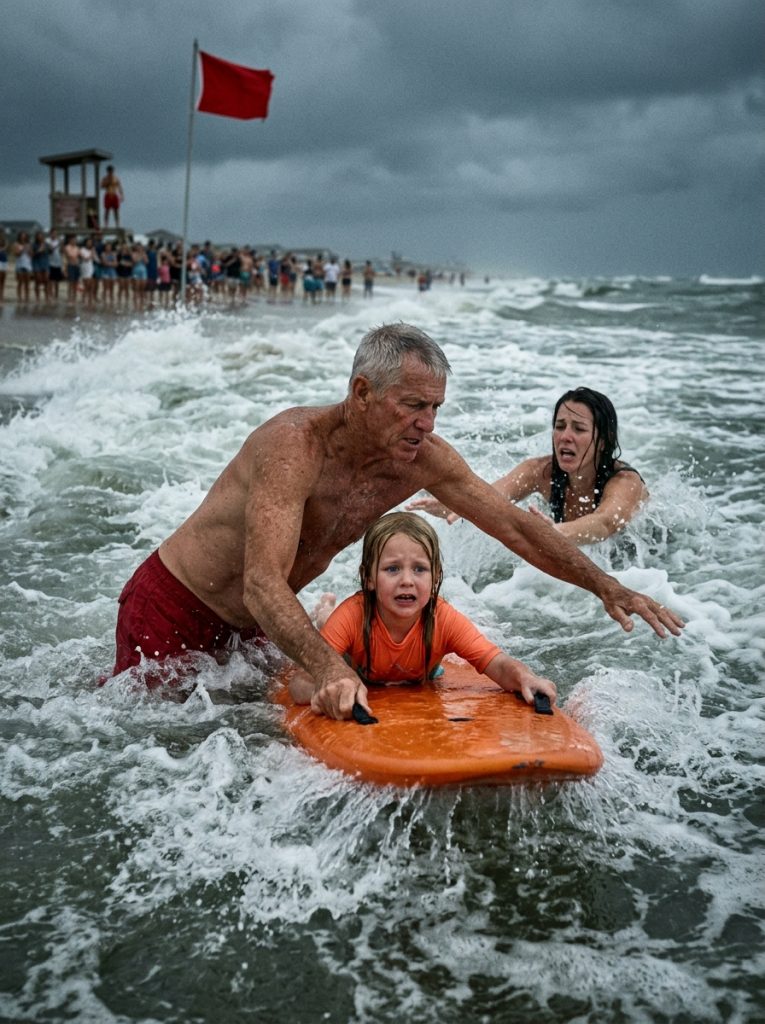
The mother was done. I could see it. She’d spent everything she had keeping her daughter’s head up, and now she had nothing left for her own.
That’s how it takes the strong ones. They burn it all on the person they love and forget to save any for themselves.
“Look at me,” I told her, getting an arm across her chest, turning her onto her back. “Don’t fight me. Don’t fight the water. We’re going for a ride.”
The little girl was crying on the board, screaming for her mom, and I made the only promise that matters out there.
“I’ve got her. I’ve got you both. Nobody’s getting left.”
I couldn’t put them both on the board and tow it — not in that current, not with these knees, not at sixty-four. The board would only carry one and let me move. So the girl rode, and I carried the mother the old way, the way they teach you and pray you never have to use, swimming on my side, her chin in the crook of my arm, kicking diagonal to the rip, talking the whole time so she’d know a voice was still there.
It is a long way back when the ocean doesn’t want you to have it.
I counted strokes the way I’d taught a thousand kids to count them. Not to the beach — the beach is too far, the beach will break your heart. You count to the next breath. Just the next one. Then the next. The shore takes care of itself if you keep making breaths.
The mother stopped struggling, which is the dangerous part — when they go quiet and heavy in your arm. So I talked louder. I told her about her daughter, safe on the board just ahead of us. I told her she did not get to quit twenty yards from her own kid. I don’t know if she heard the words. People don’t, sometimes. But they hear the voice. The voice says: someone has you. Keep your face to the sky.
The girl on the board never let go. Seven years old, white-knuckled, doing exactly what I’d told her — lie flat, hold the handles, don’t sit up. Braver than half the grown men I’ve pulled out of calmer water than that.
My shoulder was screaming where it carried her mother’s weight. I’d feel that shoulder for a month. I didn’t care. A month of a bad shoulder is a cheap price for two people who get to keep having birthdays.
Halfway in, my body tried to quit. I won’t lie about that. There was a moment — gray water, gray sky, my legs full of fire — where some cold accountant in my head added up my age and the distance and the cold and presented me with a number I didn’t like.
I told the accountant to shut up. I’ve been telling him to shut up for forty years. It’s most of the job.
And then the water got shallower, and there were hands.
The young guard. Tyler. He’d finally come off that tower. He hit the water hard and ugly and graceless, but he came, and he took the board with the little girl on it and ran it up onto the sand while I brought the mother the last twenty feet.
We went down together in the wash, the mother and I, both of us on our hands and knees in the foam, coughing up half the Atlantic. People were running. Somebody had a towel. Somebody had already called it in.
The little girl got to her mother and they folded into each other in the surf, and the mother looked up at me over her daughter’s head with an expression I have been paid in exactly twice in my life and would not trade for any salary on earth.
I didn’t have the breath to say anything. I just nodded.
That’s the whole transaction. That’s the only wage that ever mattered.
It was a while before I could stand.
Tyler knelt down next to me in the sand, soaked, shaking, his whistle still around his neck. The bravado was gone. He looked about twelve.
“I froze,” he said. “Sir, I — I froze. I’ve trained for that a hundred times and I just stood there.”
“I know,” I said.
“How’d you — you knew which one to put on the board. You didn’t even think about it. How?”
So I told him the only thing I know that’s worth passing down.
“The board goes to the weakest first,” I said. “Not the strongest. Not the closest. Not the one who’ll thank you. The weakest. Every time. You decide that before you ever hit the water, so you don’t have to decide it when your brain’s screaming. You decide it now, on dry land, with me, so that next time your body already knows.”
He nodded like a man taking a vow.
“And the freezing,” I said. “Everybody freezes once. The ocean introduces itself to all of us. What matters is you came. Ugly and late and scared — but you came. That’s the part you keep.”
The thing about a beach is that everybody saw.
They saw who waved the old man off the stand that morning, and they saw who went into the water when it counted. People don’t forget a thing like that. By the time the ambulance pulled away — the mother and daughter both fine, just shaken and cold — half the beach knew my name, and the other half was asking.
The county found out, of course. The same county that had aged me off the stand with a mandatory-retirement letter and a handshake.
They wanted to give me a commendation. A plaque. A little ceremony with a folding table and a banner.
I told them I’d take it on one condition.
I wanted them to let me teach again. Not guard — my knees made that decision and I respect it. But teach. The rookies. The Tylers. The kids with all the training and none of the water yet.
They said yes.
So that’s what I do now, three mornings a week, June through August. I stand on the sand in front of a row of nineteen-year-olds who think they’re immortal, and I make them say it back to me until it’s stitched into them the way it’s stitched into me.
The board goes to the weakest first.
Tyler’s a senior guard now. Good one. Calm in the water in a way you can’t fake. Last summer he pulled three people off a sandbar in a squall and put the smallest on the board without a half-second of hesitation, and afterward he found me on the beach and didn’t say a word, just nodded.
I knew exactly what the nod meant.
It meant the lesson took. It meant the line holds. It meant that on some beach I’ll never see, long after I’m gone, a kid in a red suit is going to look at two people in trouble and know, without thinking, which one rides.
The mother wrote me a letter that winter. Her daughter had drawn a picture on the back — a stick figure with silver hair standing in blue crayon waves, an orange rectangle I understood to be the board, a smaller figure safe on top of it. Above it, in the careful letters of a kid just learning to write: THE MAN WHO DID’NT LEAVE US.
I’ve guarded beaches for thirty years. I’ve got medals in a drawer and a name on a plaque and a stack of thank-you cards gone soft at the folds.
That crayon drawing is on my refrigerator. It’ll be there until I’m not.
Because that’s the whole job, once you boil it down past the training and the whistles and the saves. You don’t leave people. Not the weak ones, not the tired ones, not the ones the current already has.
You go get them. You bring them back. And you make sure the next person who stands where you stood will do the same.
I went back to that beach for my wife. To stand where we used to stand.
I ended up giving the ocean three more people who get to go home.
She’d have liked that. She always said I never could sit still in a folding chair.
The water doesn’t care that you retired.
Turns out neither do I.