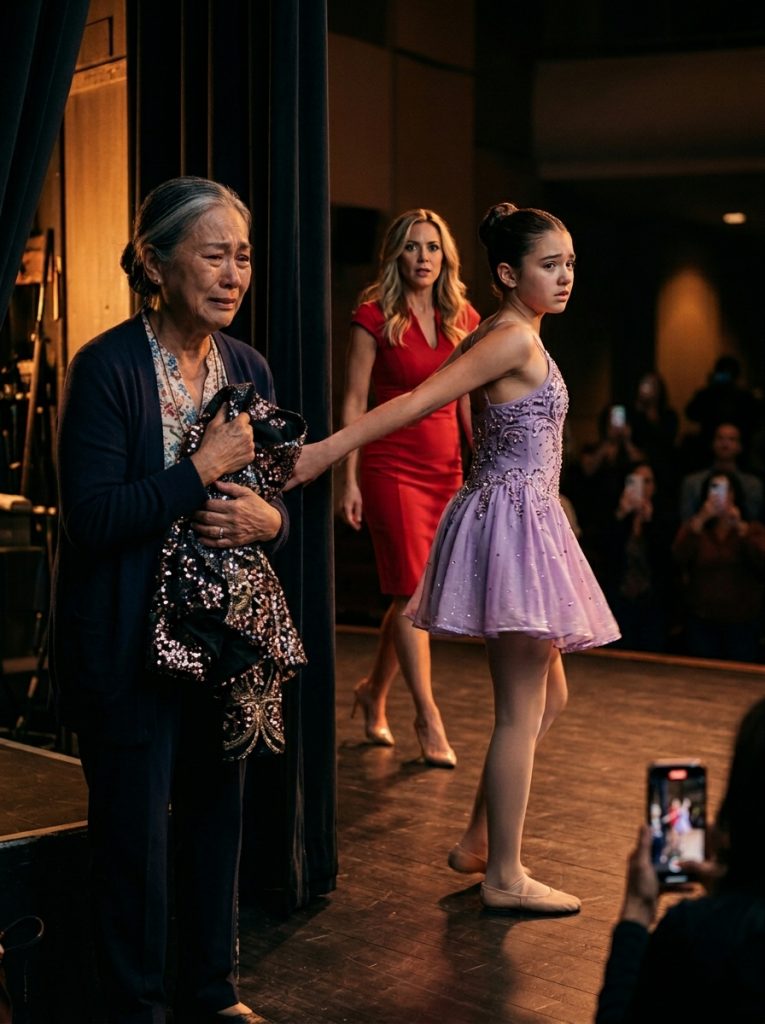
Rosa stepped into the spotlight and the entire theater held its breath.
She was still clutching the sequined costume against her chest like a shield. Her reading glasses swung on their chain. Her navy cardigan was buttoned wrong and she hadn’t noticed because her hands hadn’t stopped trembling since Lily turned away from Camille and extended her hand toward the wings.
Lily crossed the stage. Barefoot on the hardwood. Tears streaming freely down both cheeks. Arms opening.
Three hundred people in the Austin Performing Arts Center made not a single sound. Not a whisper. Not a phone notification. Not a program rustling. Just the soft pad of bare feet and the held breath of an audience that understood, collectively and instantly, that they were witnessing something no choreographer had planned and no director had scripted.
Camille Voss stood frozen center stage with one arm still extended toward the granddaughter who had just publicly, unmistakably, walked away from her. In front of cameras she had brought herself. In front of three hundred witnesses. Her polished smile had cracked down the center like dropped porcelain. The camera crew behind her kept rolling — they couldn’t stop now — and every single operator knew this footage would never become the feel-good lifestyle segment their producer had pitched.
“Abuela,” Lily whispered, reaching Rosa’s trembling hands. “Put the costume down. This was always supposed to be our dance. Yours and mine.”
Rosa’s fingers loosened. The sequined dress — four hundred hand-sewn beads, three sleepless nights — slipped onto the wing table behind her.
And then the music changed.
The accompanist began playing something new. Not the rehearsed waltz. Something slower. A melody in three-quarter time that Rosa recognized in her bones before her conscious mind caught up.
The lullaby she hummed while sewing. The melody her own mother had carried from Guadalajara. The tune that traveled through the thin wall between their bedrooms every single night for fourteen years.
Lily placed one hand on Rosa’s shoulder and the other in her grandmother’s calloused palm.
And they danced.
Not perfectly. Not gracefully. Not in any way that judges would score.
Rosa’s knees protested with every step. Her movements were small and uncertain on a stage she had never once stood on in ten years of bringing her granddaughter to this building. She’d always been in the back row. Backstage adjusting a hem. In the parking lot waiting with the engine running. Never center stage. Never under a spotlight. That wasn’t where women like Rosa Delgado were supposed to stand.
Until tonight.
Lily guided her. Gently. Patiently. With the same quiet devotion Rosa had used to guide Lily through homework, heartbreak, first days of school, and every impossible thing for fourteen years running.
The audience didn’t applaud.
They couldn’t.
They were crying too hard.
Three hundred people watching a sixty-eight-year-old seamstress in a wrongly-buttoned cardigan dance with the girl she’d raised completely alone — and every one of them understanding, without a single word being spoken, what unconditional love looks like when nobody is filming it and nobody posts about it and nobody gives you credit.
From the wings, the dance instructor quietly wheeled out a garment rack.
This was Lily’s real surprise. Planned weeks before Camille appeared. Before tonight’s drama existed. A decade of invisible labor, made suddenly and undeniably visible.
Ten costumes hung on the rack. Each one hand-sewn by Rosa. Each labeled with a small card: the year and the show title. Butterfly Wings 2016. Snowflake Tutu 2017. Forest Sprite 2018. Velvet Cape 2019. Gold Star 2020, sewn perfectly for a virtual recital no live audience ever saw. Woodland Fox 2021. Starlight Gown 2022. River Spirit 2023. Phoenix Feathers 2024. And tonight’s lavender beadwork masterpiece.
Ten years of costumes. Thousands of hours. Fingers that bled and cramped and never stopped. A sewing machine held together with duct tape and prayer.
Rosa saw the rack.
Her knees buckled.
Lily caught her before she hit the floor.
“Every show,” Lily whispered into her grandmother’s silver hair. “Every costume. It was always for you. It was always about you.”
The audience rose. All at once. Not a gradual wave but an instant eruption — three hundred people standing simultaneously because sitting had become physically impossible in the presence of this much truth.
The standing ovation lasted four full minutes.
Rosa sobbed into Lily’s shoulder. Fourteen years of being invisible ending in a single, deafening roar of recognition from strangers who suddenly felt like family.
Camille tried to leave through the side aisle.
A parent named Margaret — whose daughter Rosa had altered prom dresses for, free of charge, for three consecutive years — stood and blocked her path.
“Not tonight,” Margaret said firmly. “You do not get to leave first tonight.”
The camera crew powered down their equipment. The producer removed his earpiece. There was nothing left to capture that could save this story for Camille Voss.
After the ovation finally faded, the dance instructor took the stage microphone.
“For ten years,” she said, her own voice breaking, “I have watched Rosa Delgado arrive early, stay late, alter costumes for other people’s children without charge, and sit in the cheapest seat in this theater without a word of complaint. Tonight I want the world to know — we have always seen her. Even when she believed nobody did.”
She announced that next year’s mother-daughter number would be permanently renamed: The Rosa Delgado Dance. For any child raised by a non-parent caregiver. For every grandmother, aunt, foster mother, neighbor, or stranger who showed up every day when biology walked away.
Rosa couldn’t speak. She held Lily’s hand and let the tears fall freely.
In the lobby afterward, a national morning show producer handed Rosa a card.
“I never wanted attention,” Rosa said quietly. “I just wanted her to have what I couldn’t give her mother.”
“That’s exactly why people need to hear this.”
Three weeks later, the segment aired coast to coast. Rosa sat on national television and showed America the costumes. She talked about skipping winter coats so Lily could afford pointe shoes. About holding a crying nine-year-old until midnight when Camille promised to come for a birthday and never appeared. About the year the sewing machine broke and Rosa stitched an entire costume by hand because there was no money for repairs and the show was in four days.
Twelve million views by Friday.
A college scholarship fund was established in Lily’s name by viewers who had never met her. The dance studio received enough donations to offer twelve new tuition-free spots.
Camille posted a social media statement calling it “a private family matter taken out of context.”
Nobody shared it. Nobody believed it. Because the video — filmed by her own crew — had already shown the world exactly what happened.
Every single comment said the same thing:
“Rosa is the real mother.”
Lily never danced with Camille again.
But every year after that — every recital, every showcase, every curtain call — one person sat in the front row.
Navy cardigan.
Reading glasses on a chain.
Calloused hands folded quietly in her lap.
Finally seen.
Finally in the light.
Where she had always belonged.