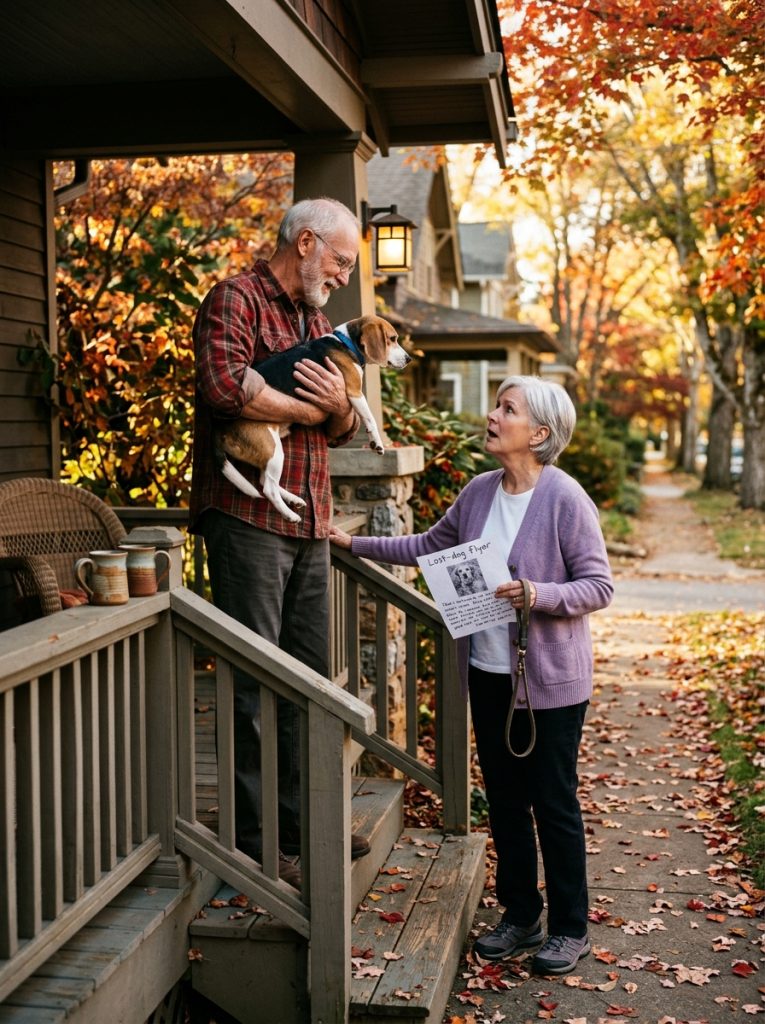
He was older. Of course he was. Fifty-three years will do that to a person.
But his eyes were the same. That warm brown with the gold fleck in the left one that I’d noticed the first time he looked at me across Mrs. Callahan’s history class in 1971. Those eyes hadn’t changed. The rest of him had — thinner on top, broader through the middle, lines mapping every decade I’d missed — but those eyes were still Tommy Weaver’s.
“Helen.” He said my name like he was testing whether it was real. “Helen Marsh.”
“Helen Pritchard now. Well. Helen Pritchard then. Back to Marsh after Don passed.” I was rambling. I pressed my hands together to stop them from shaking.
“Can I — would you like to sit down? I could make coffee.”
“I’d like that very much.”
We sat on the porch because the morning was mild. October in Savannah. The kind of day that couldn’t decide between summer and fall. I brought out the good mugs — the ones with the blue flowers that I never used for just myself.
Biscuit settled between our chairs, his tail thumping against the floorboards, looking up at Tommy like he’d known him forever. Dogs are like that. They know good people.
“I saw your flyer,” I said. “At the hardware store on Pemberton.”
“That dog.” Tommy shook his head, smiling at Biscuit. “Took off after a squirrel three days ago. I’ve been putting up flyers all over the neighborhood.”
“He showed up on my porch yesterday morning. Just sat there like he belonged.”
“Maybe he did.” Tommy looked at me over his coffee. “Maybe he knew something I didn’t.”
I felt my face get warm. Seventy-one years old and blushing like I was eighteen. Ridiculous.
“Where did you go?” I asked. The question I’d carried since 1971. Since the summer after graduation when he’d simply disappeared and nobody could tell me where or why. “You just vanished, Tommy. One day you were there and then — “
“Army,” he said. “My father signed me up the day after graduation. Didn’t ask. Didn’t tell me until the night before I shipped out. I tried to call you. Your mother said you weren’t home.”
“I was home. She never told me.”
We sat with that for a moment. Fifty-three years of silence explained by a father’s decision and a mother’s lie.
“I came back in ’74,” he said. “Looked for you. Your family had moved.”
“Daddy got transferred to Atlanta.”
“I figured something like that. No internet back then. No way to find someone who didn’t want to be found.”
“I wanted to be found.” My voice came out smaller than I intended. “I wanted to be found, Tommy.”
He set his coffee down. Reached across the space between our chairs and took my hand. His palm was rough. Warm. Real.
“I moved to this neighborhood eleven years ago,” he said. “Eleven years, Helen. Four streets over. On Magnolia.”
“Eleven years?”
“Eleven years.”
I stared at him. Four streets. I walked past Magnolia on my way to the pharmacy. I’d probably passed his house a hundred times. A thousand. While he was inside, living his life four streets from mine, neither of us knowing.
“Were you — did you marry?” I asked.
“Patricia. Forty years. Lung cancer took her in 2016.” His voice was steady but his eyes went somewhere far away for a moment. “You?”
“Don. Thirty-eight years. Heart attack. 2019.”
“I’m sorry.”
“Me too. For yours.”
We sat in that shared understanding. Two people who’d loved and lost and ended up alone. Four streets apart. Eleven years. A dog and a flyer the only things that bridged the gap.
“Tell me everything,” he said. “From 1971 to now. All of it.”
So I did. And he told me. We sat on that porch until the coffee went cold and I made more, and that went cold too. We talked through lunch. Through the afternoon. Through the golden hour when the light hit the porch just right and made everything look like a painting.
Kids. His two boys, my daughter and son. Careers. His thirty years at the shipyard, my twenty-five years teaching third grade. Grandchildren. Losses. The small daily things that make up a life — the things you can’t summarize but try to anyway because someone is finally asking.
The sun was setting when he stood to leave.
“Helen.”
“Yes?”
“I’m not going to wait another fifty-three years. I want you to know that.”
I laughed. Really laughed. “I’d hope not. We don’t have another fifty-three years, Tommy.”
“Then let’s not waste the ones we’ve got.” He paused on the porch steps. “Can I take you to breakfast tomorrow?”
“You can.”
“The diner on Oak Street? Eight o’clock?”
“I’ll be there.”
He walked down my front path, turned left, and headed toward Magnolia Street. Four blocks. I watched him until he turned the corner. Then I sat back down in my chair, Biscuit’s head in my lap, and cried.
Not sad crying. Not grief. Something else entirely. Something that felt like mourning and celebration at the same time. All those years. All that distance that wasn’t really distance at all. All the mornings I walked to the pharmacy past his street and didn’t know. All the evenings he sat on his own porch and didn’t know I was sitting on mine.
Biscuit licked my hand.
“You did this,” I said to him. “You ridiculous, perfect dog.”
He wagged his tail like he understood. Maybe he did.
Tommy came to breakfast the next morning. And the morning after that. And the morning after that. By the end of the week, he just started coming to my house instead. I’d make eggs and toast. He’d bring the paper. We’d sit on the porch and drink coffee and talk like we were making up for lost time. Because we were.
By November, Biscuit stopped going back to Tommy’s house. He’d sleep on my porch, wait for Tommy in the morning, then spend the day moving between us like a shuttle between two ports. Eventually Tommy brought over Biscuit’s bed and his food bowls and that was that. Shared custody without the paperwork.
My daughter called on a Sunday. “Mom, who’s the man Mrs. Keller says she sees on your porch every morning?”
“His name is Tommy. We went to high school together.”
“High school? Mom, that was — “
“Fifty-three years ago. Yes.”
Silence. Then: “Are you happy?”
I looked out the window. Tommy was in the yard, throwing a tennis ball for Biscuit. Both of them moving slow. Neither of them caring.
“Yes,” I said. “I really am.”
There’s a particular kind of bittersweet that comes with finding something you lost half a century ago. You can’t get the years back. You can’t unlive the separate lives. You can’t undo your mother’s lie or his father’s decision or the thousand small turns that kept you four streets apart for eleven years without knowing.
But you can sit on a porch on a Saturday morning with coffee and eggs and a dog that brought you back together. You can read the paper side by side and not need to fill the silence. You can reach over and hold someone’s hand and feel like you’re eighteen again, even though your knuckles are swollen and your back aches and you take four pills every morning just to keep the machinery running.
Advertisement
Saturday morning. Eight o’clock. Tommy’s truck in the driveway. Biscuit on the porch between our chairs. Eggs getting cold because we’re talking too much. The oak tree dropping leaves like confetti.
A new beginning at seventy-one.
Not the one I expected. Not the one I planned for. But maybe the one that was always waiting. Four streets away. Eleven years patient. Just needing a runaway dog and a flyer on a bulletin board to close the distance.
Some love stories start at eighteen and end at eighteen.
Ours started at eighteen and picked back up at seventy-one.
And I’m not wasting a single morning of whatever comes next.