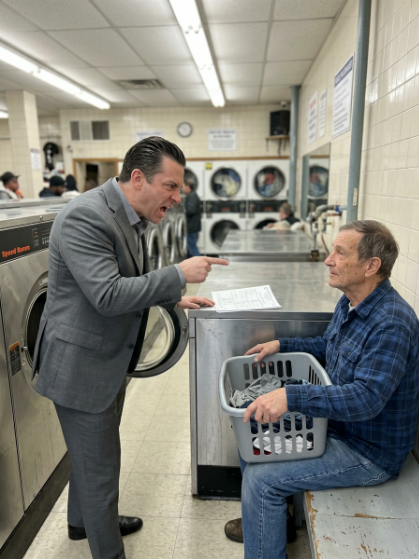
The humming laundromat in East Boston was supposed to be a place of quiet routine, until a man in a tailored designer suit pointed a finger at me and demanded I leave, completely unaware of who actually owned the building.
My name is Thomas Jenkins. At sixty-eight years old, with weathered skin and wearing a simple blue flannel shirt, I sat calmly on a plastic chair, holding my laundry basket. The harsh fluorescent lights overhead buzzed quietly, reflecting off the long row of metal washers. I had lived in this East Boston neighborhood for forty years, but to the arrogant man standing in front of me, I was just an eyesore that was ruining his shop’s image.
Roger Miller, forty-two years old, stood next to the washers. His dark hair was slicked back with heavy gel, and he wore a tailored grey designer suit that looked ridiculous in a neighborhood laundromat. He had been pacing the floor for the last ten minutes, complaining about the ‘clientele’ to his assistant, before finally targeting me. Now, he was pointing mockingly and shouting, his voice echoing off the tile walls.
“I’m telling you for the last time, old man,” Roger yelled, pointing at the door. “Pick up your plastic basket and get out of my shop. We are upgrading this facility to cater to a higher class of clients, and you’re ruining the aesthetic. You’re cluttering up the space.”
I looked down at my simple blue flannel shirt and my clean, worn jeans. I had just wanted to wash my weekly load of towels. “I’ve been coming to this laundromat since before you were in high school, Mr. Miller,” I said quietly, my voice calm and steady. “I pay my quarters just like everyone else.”
“I don’t care about your quarters!” Roger sneered, stepping closer. “I’m the regional manager, and I have the authority to refuse service. People like you—low-class, weathered, dressed like you just came off a construction site—are the reason this block is struggling. I’m cleaning up this street, starting with this store.”
I looked at him, feeling a wave of pity rather than anger. He was so consumed by his own self-importance, so convinced that his expensive suit gave him the right to treat others like dirt. He had no idea that I had spent the last forty years quietly investing in the very community he was trying to gentrify.
Without saying another word, I reached into the front pocket of my blue flannel shirt, pulled out a folded white document, and unfolded it. I laid the property ownership certificate sheet flat on the metal surface of the washing machine between us.
“What is this trash?” Roger scoffed, barely glancing at it. “You think a piece of paper is going to stop me from having security drag you out of here? I don’t have time for this.”
“I suggest you look at the address listed at the top, Mr. Miller,” I said, my voice remaining perfectly calm. “And then look at the name of the holding company at the bottom.”
Roger rolled his eyes, but he leaned forward, his polished designer shoes clicking on the tile floor. He squinted at the paper resting on the metal washer.
I watched his face. The mocking smirk on his lips slowly began to twitch, then froze completely. The color drained from his face, leaving him a pasty, sickly white. His slicked-back hair seemed to stand out against his pale forehead as his eyes darted from the paper to my face, then back to the paper.
The property ownership certificate showed twelve commercial street addresses on this very block—including the building this laundromat was housed in. And the sole owner of the holding company was listed as Thomas Jenkins.
“You…” Roger whispered, his voice suddenly cracking, all his arrogance evaporating in an instant. “You own the block?”
Before he could say another word, the glass door of the laundromat swung open, and the franchise president walked in, looking around nervously. He spotted me sitting calmly with my laundry basket, and his face lit up. He walked straight past Roger and bowed slightly.
“Mr. Jenkins,” the president said respectfully. “I apologize for the delay. We are ready to review the lease renewal terms for this location.”
Roger stood frozen, his pointing finger still hovering in the air, his face pale with horror as he realized that the quiet man in the flannel shirt he had just tried to humiliate was his new landlord.
The franchise president, Mr. Harris, looked at Roger’s pointing hand, then back to me, his brow furrowing. “Roger, what is going on here? Why are you shouting at our landlord?”
Roger swallowed hard, his Adam’s apple bobbing nervously as he lowered his hand. He tried to speak, but the words seemed to catch in his throat. “Mr. Harris… I… I was just… I had no idea this was Mr. Jenkins. I thought he was just… a customer who was cluttering up the machine row during our transition. It was a complete misunderstanding, I assure you.”
“A misunderstanding?” I said, standing up and smoothing down my blue flannel shirt. “You told me I was ‘low-class’ and ‘ruining the shop’s image’ because of the clothes I wear, Roger. You said you were cleaning up the street, starting with this store.”
Mr. Harris’s face turned a furious shade of red. He turned on Roger, his voice dropping to a harsh whisper. “Are you out of your mind, Roger? You were trying to kick out the man who owns the property for all six of our East Boston locations? The man who has kept our rent frozen for five years so we could keep our staff employed?”
“Mr. Harris, please!” Roger pleaded, his hands shaking. “I was just trying to enforce the new branding guidelines. I wanted to make the store look premium! I’ll apologize, I’ll do whatever it takes!”
I looked at Roger. He looked so small now, stripped of his shouting voice and his arrogance, trembling in his expensive suit. It would have been easy to demand his immediate firing, to watch him walk out the door ruined and empty-handed. But I had spent too many years watching families struggle in this neighborhood to take pleasure in someone else’s ruin.
“Mr. Harris,” I said quietly, drawing the president’s attention. “I bought this block because I wanted to make sure East Boston remains a place where regular, hardworking people can live and work. I won’t have a manager who treats customers like second-class citizens because of the clothes they wear. I will renew the lease for this laundromat, but only on two conditions.”
Mr. Harris nodded quickly. “Name them, Mr. Jenkins. We will accommodate whatever you need.”
“First, Roger is removed from his management position,” I said. Roger winced, his eyes closing. “But I don’t want him fired. He has a family, and he needs to work. I suggest you transfer him to one of your warehouse locations. Let him work the front counter, cleaning the machines, folding the clothes, and talking to the customers. A year of honest, hard labor will teach him what dignity really looks like.”
Roger opened his eyes, staring at me in disbelief. He had expected to be thrown out, but instead, I was giving him a job—even if it was the very job he had mocked.
“And the second condition?” Mr. Harris asked.
“You will raise the wages of the store workers at all six of our locations by four dollars an hour,” I said. “They are the ones who do the actual work here, and they deserve to be paid fairly. If you agree, I will sign the lease renewal today.”
Mr. Harris smiled, a look of genuine relief on his face. “We can absolutely do that, Mr. Jenkins. Thank you for your generosity.” He turned back to Roger, his tone turning cold once more. “You heard him, Roger. Report to the central warehouse tomorrow morning at six a.m. Your salary is adjusted to counter wage. And you will be working the floor.”
“Yes, Mr. Harris,” Roger muttered, his voice barely a whisper. He looked at me, a mixture of shame and a strange, quiet gratitude in his eyes. “Thank you, Mr. Jenkins. I’m… I’m sorry.”
I nodded to him, then turned and began loading my clean towels back into my plastic laundry basket. I didn’t need a designer suit to feel powerful, and I didn’t need to ruin a man to show him he was wrong. I had my community, my dignity, and the knowledge that the people of East Boston would continue to have a place where they were treated with respect.