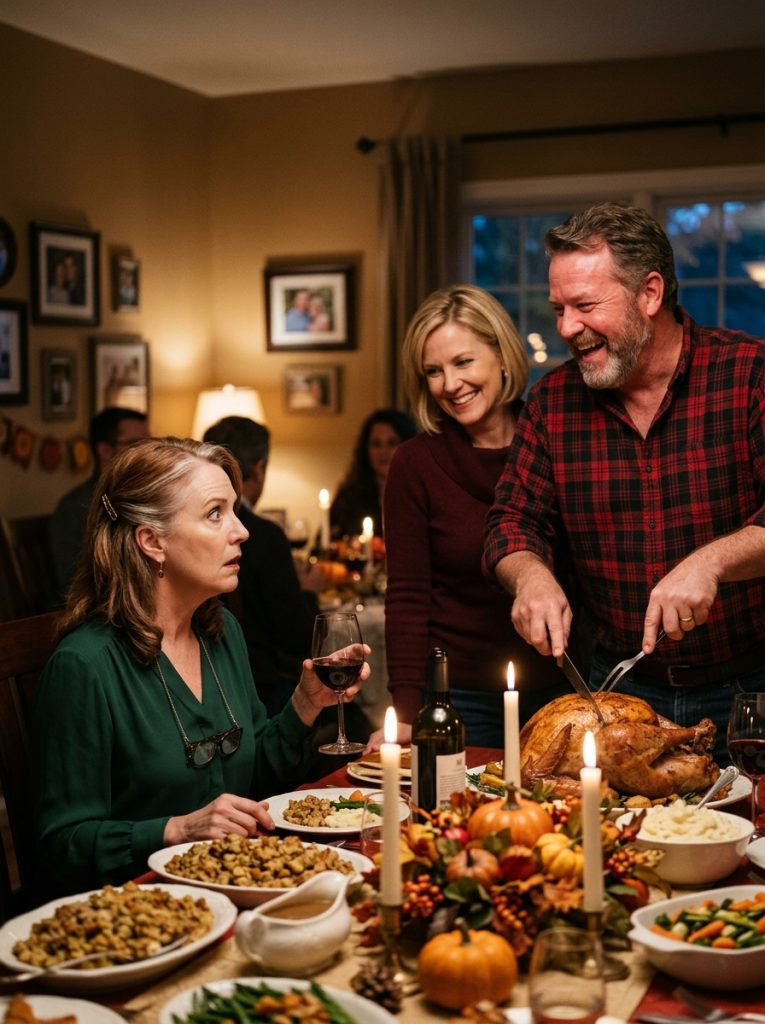
I got through dessert. I want that on the record, because it was the hardest thing I’ve ever done with a fork in my hand.
I ate Diane’s pumpkin pie and told her it was the best I’d had in years, and I meant it, which made it worse. I laughed at Greg’s stories. I helped clear the table.
Every nerve in my body was screaming to stand up and point and name him in front of his wife and his guests. I didn’t. I’d learned the hard way that the satisfying thing and the smart thing are almost never the same thing. A scene would feel wonderful for about four seconds and then he’d know, and a man who has vanished four times already knows exactly how to vanish a fifth.
So I memorized everything instead — the layout of the house, the work truck I’d glimpsed in the open garage with a magnetic sign on the door, the framed business license I spotted in his little home office off the hall when I excused myself to the bathroom and took the long way back.
The license was under a different company name. But the photo on it was Greg. And the license number, I’d learn the next morning, traced through a chain of dissolved businesses straight back to the one that had taken my kitchen and my twenty-four thousand dollars.
I thanked them warmly at the door. Diane hugged me and made me promise to come for Christmas. Greg shook my hand — the hand with the half-moon scar, the hand I’d watched take my check two years before — and said, “So glad you’re on the street, Marian. Good people are hard to find.”
“They certainly are,” I said.
I drove home, and I did not sleep, and at eight the next morning I walked into the licensing-board hearing I’d nearly given up on with a folder two years thick and a phone full of photographs taken the night before.
I’d assumed, all this time, that he wouldn’t show. That’s how it had always gone. A complaint, a notice, a hearing, an empty chair, a man who’d already changed his company name and moved on to the next kitchen.
But this time the board had something they’d never had before. This time, thanks to a Thanksgiving invitation, I could tell them exactly where he lived, exactly what he looked like now, exactly which truck sat in his garage and which new company name he was operating under one town over.
The investigator I’d been emailing for months met me in the hallway. I’ll never forget her face when I showed her the photos — the license on his office wall, the truck, the man himself carving a turkey. She’d been chasing a ghost for two years too. I’d just handed her a home address.
“Mrs. Foster,” she said slowly, “do you understand what you’ve done? We can serve him. We can actually serve him.”
They did. That afternoon.
The rest moved faster than two years of silence had any right to. With a verified identity and a current address, the board could finally compel his appearance. The chain of shell companies came apart under a real investigation — same phone numbers, same equipment, same bank patterns, a trail of homeowners across three counties who’d each given a deposit to a charming man and gotten a hole in their house and a disconnected number. I was not the only one. I was just the one who happened to move onto his cul-de-sac.
There were eleven of us, in the end. Eleven deposits. A retired couple who’d lost their bathroom remodel. A young family whose nursery he’d gutted and abandoned. A widow like me, in the next county, who’d cried on the phone when the investigator finally called her back after two years.
The board revoked the license he was operating under and referred the pattern — eleven victims, a quarter of a million dollars, a deliberate scheme of dissolving and renaming — to the county prosecutor as contractor fraud. Restitution was ordered. I won’t pretend I got every dollar back; money that’s been spent is hard to squeeze from a man, and these things grind slowly. But the court put a number on what he owed me, with my name on it, in a judgment that doesn’t dissolve when he changes a company name. And for the first time in two years, the hole in my house had a paper trail leading somewhere other than a dead phone line.
Here is the part I didn’t expect.
Diane called me. The wife.
She’d had no idea. I believed her then and I believe her now. She’d married Greg eighteen months ago, after his “previous business struggles,” which is how he’d described leaving a trail of ruined kitchens across the state. She found out what her husband was when investigators came to their door — the same door I’d been welcomed through over pie.
She was destroyed. And she did something that told me everything about the difference between the two of them. She called me, and she apologized, and she asked if there was anything she could do. Then she handed the investigators a box of his business records from the garage — every shell company, every burner phone, organized in a way only a spouse with full access to a home office could organize — and became the witness that turned a strong case into an airtight one.
“I made you pie,” she said on the phone, crying. “You sat at my table. You knew, and you still let me hug you, and you were kind to me anyway.”
“You didn’t take my kitchen, Diane,” I told her. “He did. You’re a victim too. You just live with him.”
She’s leaving him. Last I heard, the divorce and the criminal case are moving through the system side by side, and she’s testifying in both.
People ask me how I sat through that dinner. How I ate the pie and cleared the plates and shook the hand of the man who’d nearly broken me, all without tipping him off.
The truth is, two years of being treated like a fool taught me patience I never wanted to learn. I’d spent those years being told to let it go, that contractors like him are untouchable, that I’d never see him again let alone my money. I had stopped expecting justice. I had started expecting to swallow it.
So when I looked across that candlelit table and saw the ghost I’d been chasing carving a turkey in a flannel shirt — I didn’t make a scene. A scene would have warned him. A scene would have sent him running to dissolve another company and vanish into another town the way he always had.
Instead I made it to dessert. I got the address. I took the photographs. And I let the system that had failed me for two years finally do its job, because for the first time I’d handed it something it couldn’t lose: a face, a name, a place to knock.
I think about the cruelty of it sometimes. That he invited the lonely new widow to Thanksgiving out of what looked like kindness, and the lonely new widow turned out to be the one client who’d never stopped looking for him. He thought he was being neighborly. He was actually sitting down to dinner with the end of his run.
I did go back for Christmas, in a way. Diane and I spent it together — two women he’d lied to, eating a quiet meal in my half-finished kitchen, the one he never came back to fix. We laughed, eventually. You have to.
If a charming man ever takes your deposit and vanishes, and everyone tells you to let it go: keep the folder. Keep every receipt, every text, every photo. You don’t know which Thanksgiving you’ll look up from your wine and find him carving the turkey.
And when you do — finish your pie. Then bury him in paper.