The badge caught the fluorescent light, gleaming like a beacon in the sterile hallway. It wasn’t just any badge. It was a Chicago Police Department badge. Gold. Polished. Real.
My brain couldn’t process what I was seeing. The dirty overalls. The mop bucket. The hunched posture I’d mistaken for weakness. None of it made sense anymore.
“Who are you?” I whispered. My voice cracked.
Frank—no, not Frank—zipped his overalls back up slowly. His hands didn’t shake. His movements were deliberate, practiced. The kind of movements you only develop after decades on the force.
“My name is Frank Callahan,” he said. His voice had changed. The gravelly rasp was still there, but underneath it was authority. Command. “Twenty-eight years CPD. Homicide Detective. Retired.”
I took a step back. My polished boots squeaked against the freshly mopped floor. The metal lockers seemed to close in around us. The hallway stretched endlessly in both directions, empty except for us and the scattered cleaning supplies.
“Then why…” I couldn’t finish the sentence. “Why are you mopping floors at Lincoln High?”
Frank bent down and picked up the mop. He set it carefully against the wall, leaning it at a precise angle. Then he reached into his overall pocket and pulled out a folded piece of paper. He handed it to me.
It was a letter from the school district. Dated three months ago.
“Read it,” he said.
I unfolded the paper. My eyes scanned the official letterhead. My stomach twisted tighter with each line.
Dear Mr. Callahan, We are pleased to offer you part-time employment as night custodian at Lincoln High School…
“I don’t understand,” I said. “You’re a retired detective. You should be collecting your pension. Playing golf. Whatever retired cops do.”
Frank’s face darkened. The tired eyes suddenly burned with intensity. “My pension was revoked six months ago. Administrative error, they said. Paperwork mix-up. I’ve been fighting it ever since.”
The hallway went dead silent. The fluorescent lights buzzed overhead, casting harsh shadows across his weathered face.
“But that doesn’t explain why you’re working here,” I pressed. “Why not work security? Why mop floors?”
Frank reached into another pocket. This time he pulled out a photograph. Faded. Worn at the edges. He handed it to me without a word.
It showed a young woman in a graduation gown. She was smiling. Behind her, the Lincoln High School sign was clearly visible. She looked maybe eighteen. Nineteen.
“My daughter, Sarah,” Frank said softly. “She graduated from here in 2019. Three months later, she was killed in a hit-and-run. Right outside the school.”
My breath caught. The photograph trembled in my hands.
“The case went cold,” Frank continued. His voice was steady, but I could hear the pain underneath. “They assigned it to a rookie detective who barely looked at the evidence. No witnesses. No cameras. Just a scared girl and a driver who never stopped.”
He paused. His eyes drifted down the empty hallway, toward the main entrance.
“I couldn’t let it go,” he said. “So I took this job. Night custodian. I have access to every corner of this building. Every file. Every security camera. Every student who walks these halls.”
The pieces clicked into place. The way he moved through the building like he owned it. The way he noticed everything. The way he never spoke unless spoken to.
“You’re investigating her death,” I whispered.
“I’m solving her death,” Frank corrected. His eyes locked onto mine. “And I’m close. Real close.”
He reached into his overalls one more time. This time he pulled out a small notebook. Leather-bound. Worn. He flipped it open to a marked page and showed me.
Names. Dates. Times. License plate numbers. A pattern emerged from the chaos of notes.
“Three students were involved,” Frank said. “They were drinking that night. Joyriding. One of them was driving his father’s car—a black BMW. They hit Sarah and kept going.”
My mouth went dry. “Do you have proof?”
“I have everything I need,” Frank said. “I’ve been building the case for three months. Gathering evidence. Interviewing witnesses who were too scared to talk before. Tomorrow, I meet with the State’s Attorney.”
He closed the notebook and tucked it back into his pocket. Then he looked at me, really looked at me, with those tired but burning eyes.
“You have a choice to make, Officer Morrison,” he said. “You can write me up for impersonating an officer. For violating school policy. For whatever else you think I’ve done wrong.”
He paused. The fluorescent lights flickered overhead.
“Or,” he continued, “you can help me make sure my daughter’s death wasn’t in vain. You can help me bring three killers to justice.”
The hallway was completely silent. No footsteps. No voices. Just the hum of the lights and the distant sound of traffic outside.
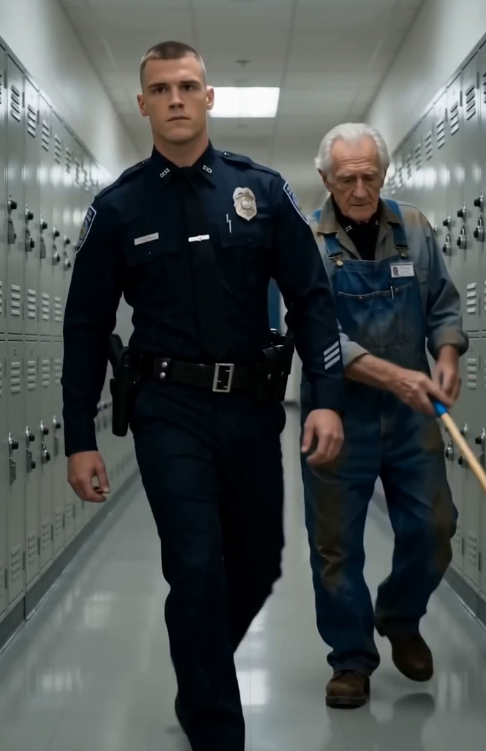
I looked at the badge under his overalls. I looked at the photograph of his daughter. I looked at the notebook filled with three months of obsessive detective work.
Then I made my choice.
“What do you need me to do?” I asked.
Frank’s face didn’t smile. But something in his eyes softened. Just a fraction.
“I need you to be at the State’s Attorney’s office tomorrow at 9 AM,” he said. “I need a sworn officer to verify my evidence. To witness my statement. To make sure this case doesn’t get buried like the last one.”
I nodded. “I’ll be there.”
He picked up his mop again. The handle looked natural in his calloused hands. He dipped it into the bucket and continued mopping the floor, as if nothing had happened. As if he hadn’t just revealed his entire world to a rookie cop who’d yelled at him for leaving a bucket in the hallway.
I stood there for a moment longer, watching him work. Watching a retired detective mop floors to get closer to his daughter’s killers.
Then I turned and walked down the hallway, my boots clicking against the freshly cleaned tile. The morning sun was just starting to stream through the high windows, casting long shadows across the gray lockers.
Tomorrow, everything would change.