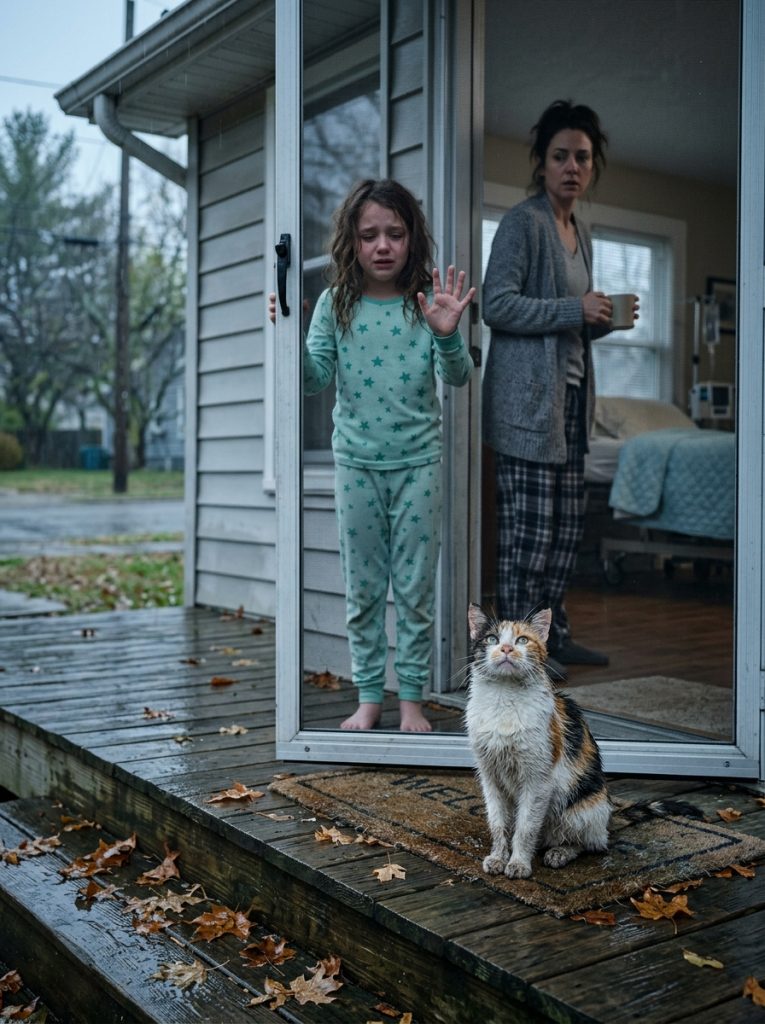
By Thursday, the hospice nurse stopped writing days on the whiteboard and started writing hours.
My grandmother had maybe one left. My nine-year-old hadn’t spoken in three.
And then something scratched at the front door.
My name is Dana Hayes, and that autumn I was watching the two people I loved most disappear in different ways.
My grandmother Lorraine was at the end of a long illness, here at home in our little rented bungalow in Knoxville, in a hospice bed we’d squeezed into the living room so she could see the maple tree out front. My daughter Wren, nine years old, had simply gone quiet. Grief does that to kids sometimes. She stopped talking. She sat by the bed and held Lorraine’s hand and watched the slow tide of it go out.
There was only one thing on earth that might have reached either of them.
Marigold.
Lorraine’s calico cat. Seventeen years they’d had each other. That cat slept on her chest through every hard night, kneaded her shoulder when the pain was bad, purred her to sleep when the medicine couldn’t.
But six months earlier, when we moved Lorraine from Cleveland down to Tennessee to be near us, Marigold bolted. Slipped her carrier at a gas station off the interstate and vanished into a field at dusk. We searched for two days. We posted signs at every truck stop. We drove the back roads calling her name until our voices cracked.
Six hundred miles ago.
We never told Lorraine the truth. We said Marigold was staying with a kind neighbor while she settled in. In her clearer moments she’d ask, “Is my girl okay?” and I’d smooth her hair and lie. “She’s wonderful, Gran. She misses you.” It was the only lie I’ve ever been glad to tell.
That Thursday at dawn, I stood at the kitchen counter with cold coffee I couldn’t drink, listening to my grandmother’s breathing change into the slow, spaced rhythm the nurse had warned me about. Wren was asleep on the floor beside the bed, one hand still resting on Lorraine’s blanket.
And I heard it.
A scratch, low on the front door. Then a thin, broken little cry I would have known anywhere.
I thought I was imagining it. Grief makes you hear what you’re missing.
But Wren heard it too. My silent girl was off the floor and at the screen door before I could move, her small hand flat against the mesh.
On the welcome mat, soaked through from the overnight rain, ribs showing, one ear torn, paws caked in mud, sat Marigold.
She had come home. The same week. The same dawn. As if she’d been running the whole way to make it in time.
For a second none of us breathed. Then Wren turned around, and for the first time in three days, my daughter spoke.
“Gran,” she whispered. “Gran, she came back.”
I scooped the cat up — she was all bone and matted fur, but she pushed her head into my collar like she knew exactly whose house this was — and I carried her to the living room.
Here is the part I have to tell carefully, because it isn’t the clean miracle the start of it promises.
My grandmother was already past speaking by then. The nurse had told us the night before that she likely couldn’t see us anymore, that hearing is the last thing to go.
We didn’t get the movie ending. Lorraine didn’t sit up and smile and hold her cat one last time. By the time Marigold came home, the woman who’d loved her for seventeen years was hours past being able to hold anything.
But hearing is the last thing to go.
So I laid that muddy, exhausted cat down on the blanket beside my grandmother’s hand, the way she’d slept a thousand nights. And Marigold did the thing she’d always done — she climbed up, settled against Lorraine’s side, tucked her nose under that frail arm, and began to purr.
I swear to you, Lorraine’s breathing eased. The tight lines around her eyes let go. Whether she knew, in whatever country she was already traveling toward, I can’t prove. But Wren leaned right up to her ear and said, “Marigold’s home, Gran. She found us. You can rest now.”
My grandmother died a little after seven that morning, with her cat purring against her ribs and her great-granddaughter’s voice in her ear, telling her the one thing she’d been waiting to hear.
It was too late by hours for the reunion I’d prayed for. I’ll always carry that. If the cat had come one day sooner — if I’d searched one more road — Lorraine might have felt that fur under her fingers and known.
But grief is strange about what it decides to call grace.
Because Wren came back to us that morning too. The cat that crossed six hundred miles didn’t reach my grandmother in time to be held. But she reached my daughter. Wren started talking again over Marigold’s purring, and she hasn’t stopped since — she tells anyone who’ll listen about the cat who loved someone so much she walked across three states to say goodbye.
Marigold’s an indoor cat now, fat and brushed and spoiled, and she sleeps on Wren’s chest every single night.
Some love runs out of time. And some love just runs — through rain and highways and impossible distance — until it gets where it was always trying to go.
Comment “MARIGOLD” if you believe some love finds its way home. 🐾