I reached him in maybe twelve seconds.
Eight months of being called a troublemaker, and my body didn’t hesitate for one of them. That’s the thing about doing a job long enough — it stops being a decision and becomes something your hands do before your brain catches up.
Gerald was gray. He wasn’t breathing right. I pressed two fingers to his neck and felt the worst thing you can feel: nothing steady. A flutter, then a stutter, then a heart that was quitting on him.
“Call 911,” I told his wife. “Right now. Tell them cardiac arrest, tell them there’s a nurse on scene starting CPR.”
She just stood there, frozen.
“NOW,” I said, in the voice I use in the unit when there’s no time left to be polite.
She ran.
I laced my hands over his sternum and started compressions. Hard. The way you actually have to do it — the way that cracks things, the way that looks violent to people who’ve only ever seen it on television. I counted out loud. I breathed for him. I counted again.
His golf polo was still crisp. His clipboard lay scattered across the grass, all those violation notices with my address printed on them fluttering in the wet morning air.
I didn’t think about a single one of them.
I thought: don’t you dare die on me. Not like this. Not when I’m right here and I can stop it.
The neighbors came out then. The same ones who’d watched me from behind their curtains for eight months. They stood in a loose ring on the lawn, useless, watching the troublemaker keep their HOA president alive with her bare hands.
Two rounds of compressions. Three. My arms were screaming. And then — a cough. A ragged gasp. A pulse under my fingers that meant it.
The ambulance took over from there.
Here’s the part Gerald didn’t know.
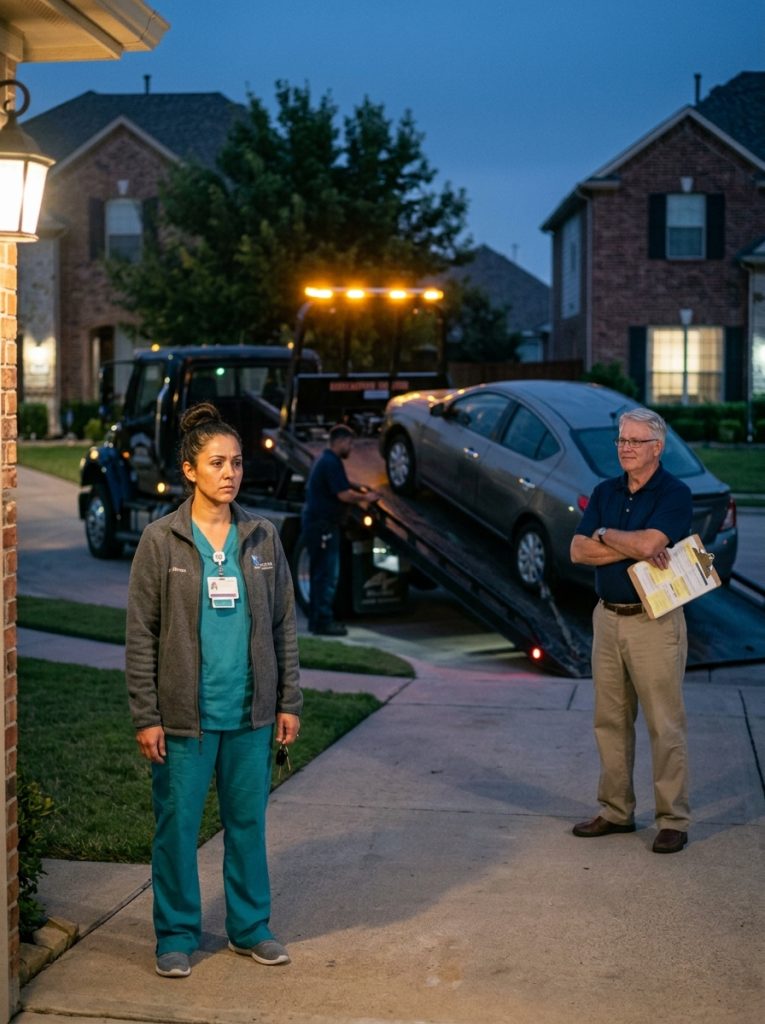
I’m not just a nurse. I’m the charge nurse of the cardiac ICU at the regional hospital. The exact unit they rushed him to. The one I had clocked into at the end of every single shift he’d ever had my car towed for.
So when his gurney rolled through my doors that afternoon, I was the one who met it.
He was awake by then. Pale, frightened, an IV in his arm. He saw my face and his eyes went wide.
“You,” he said.
“Me,” I said. “You’re in good hands, Mr. Whitfield. The best on this floor, actually. Try to rest.”
And then I took care of him. For nine days. The same way I’d care for anyone. I adjusted his medications at three in the morning. I explained his stents to his terrified wife in plain, slow words. I was the one who walked him — shuffling, humbled, gripping an IV pole — on his first slow lap around the unit.
He cried once, on the sixth day. “Why are you being kind to me?” he asked. “After everything I did to you?”
I told him the truth. “Because kindness is the job. It was always the job. Even on the nights you towed my car off my own street.”
He was quiet for a long time after that.
A doorbell camera across the cul-de-sac had caught all of it. The collapse. The neighbors freezing. The woman in scrubs sprinting across the street and bringing a man back from the dead on his own front lawn.
Somebody posted the clip in the neighborhood group with the caption: “The nurse Gerald kept towing just saved his life this morning.”
It got more than four hundred comments.
I didn’t make it to the next HOA meeting — I was on shift — but my neighbor told me everything.
Gerald stood up. Slow and careful, a man who’d been rebuilt from the inside. He didn’t say one word about parking enforcement. He read from a sheet of paper.
He apologized. By name. To me. Into the very same microphone he’d once used to call me the woman who thought the rules didn’t apply to her.
Then he proposed two changes to the bylaws. The first created permanent overnight parking exemptions for shift workers — nurses, firefighters, paramedics, anyone who keeps the world turning while the rest of it sleeps.
The second retired the position of “parking enforcement officer” entirely.
Both passed unanimously.
My car has sat in front of my own house every night since.
Gerald waves at me now when I pull in at dawn. Sometimes there’s a coffee waiting on my porch step. He never says much. Neither do I. We don’t need to.
But last month a young couple moved in across the street. Both of them ER doctors. Both working nights.
I watched Gerald walk over with a plate of his wife’s cookies and a single sheet of paper.
“Just so you know,” I heard him tell them, “you park wherever you need to on this street. We protect the people who take care of us.”
He caught me watching from my window.
And the man who’d spent eight months trying to run me off this block tipped an imaginary hat in my direction, and went home.