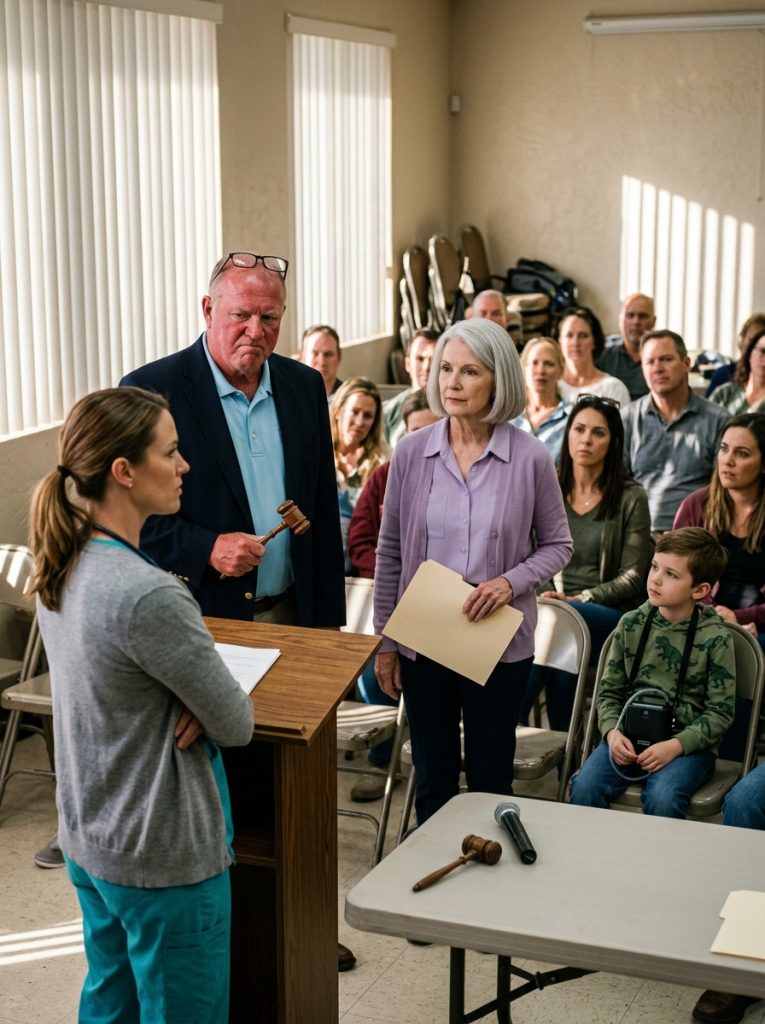
Eleanor opened the folder, slid on her reading glasses, and said, in the mildest voice you’ve ever heard, “Roger, are you familiar with the bill the state passed last spring? The one about residential solar access?”
Roger said he didn’t see what that had to do with anything. The covenants were the covenants.
“Well,” Eleanor said, “I spent thirty-one years as a real estate attorney before I retired to this lovely cul-de-sac, so let me help. Last spring the legislature passed what’s commonly called a solar-rights or solar-access law. I have it printed here. The relevant section says that any covenant, restriction, or condition that effectively prohibits or unreasonably restricts the installation of a residential solar energy system is — and this is the statute’s word, not mine — void and unenforceable.”
You could hear the air conditioner. That’s how quiet it got.
“Void,” Eleanor repeated, gently, like she was explaining it to a child she was fond of. “Not ‘subject to a variance.’ Not ‘allowed with board approval.’ Void. As in: it was never enforceable to begin with. Which means every fine you’ve levied against Mrs. Whitfield for her panels — and I’ve added them up, Roger, it’s a tidy sum — was assessed under a rule that the State of Arizona had already made unenforceable before you wrote the first one.”
Roger’s face went a shade I’d describe as monsoon-sky purple. He started to say something about aesthetic standards, and Eleanor held up one finger — not rudely, just the way a teacher does — and kept going.
“Now, the law does allow an association to impose reasonable restrictions. Reasonable. So I went and looked at what you’ve actually approved and denied over the years, because ‘reasonable’ has a legal meaning and it includes ‘applied consistently.'” She turned a page. “You approved a satellite dish on the Coleman roof in 2019. You approved three different rooftop AC units, two of which are frankly enormous. You approved your own pergola, Roger, which casts a shadow on the Nguyens’ yard half the afternoon. But you denied solar panels — the one rooftop installation the state has specifically protected — and only after the homeowner was a single mother who couldn’t afford to fight you. That’s not an aesthetic standard. That’s selective enforcement, and a court would call it exactly that.”
I want to tell you I said something powerful in that moment. I didn’t. I just stood at the podium with my folder of medical letters that I never even had to open, and I watched a seventy-three-year-old woman in a lavender cardigan dismantle nine years of small-time tyranny with a printout and a calm voice.
But Eleanor wasn’t done, and this is the part that turned the whole room.
“While I was reviewing the records,” she said, “I requested the association’s financial statements. As any member is entitled to do, Roger, under the same bylaws you’re so fond of quoting.” She laid down another page. “I have some questions about the ‘landscaping and beautification’ line. It’s grown rather a lot over three years. And several of the payments appear to go to a vendor whose address is the same as your son-in-law’s lawn care business. I’m sure there’s an explanation. I’d love to hear it. So, I suspect, would everyone here who’s been paying their dues.”
That was the moment the room turned. Because the neighbors who’d been too scared of Roger to back me on a “your panels are ugly” fight were suddenly very interested in where their dues had been going. A man in the third row stood up and said he’d been asking about the landscaping budget for two years and getting stonewalled. A woman near the back said her variance request for a wheelchair ramp had been “pending” for eight months while Roger’s pergola sailed through in a week.
Roger banged the gavel. Nobody cared about the gavel anymore. The gavel was over.
The meeting ended with a motion — made by the quiet man in the third row, seconded by half the room — to suspend all fines against my property immediately, to bring in an independent accountant to review three years of association finances, and to schedule a recall vote on the board presidency. All three passed. Roger sat there with his gavel and his golf polo while the community he’d run like a small kingdom voted, in about four minutes, to take it back.
Micah, who is eight and had been sitting very still in the second row with his oxygen line, leaned over to me on the drive home and asked if “void” was a bad word — because the lawyer lady said it like a bad word, and everybody got quiet. I told him void means something never really counted in the first place, even if somebody acted like it did. He thought about that the way eight-year-olds do, and then he said, “So the mean notes on our door were void the whole time?” Yeah, baby. The whole time. He nodded like that was the most reasonable thing in the world, because to a kid, it is. It’s only adults who need a retired attorney and a printout to believe that a rule can be wrong from the very beginning.
Here’s where I have to be honest, because I promised you a mixed ending and not a fairy tale.
The recall passed three weeks later. Roger is no longer president. But he still lives two doors down, and he still glares at my roof when he walks his dog, and the HOA still exists, with all its rules and its folding chairs and its capacity to make someone’s life small. We didn’t burn the system down. We just got it off my back, this once, because one neighbor happened to be a retired attorney who happened to care.
That’s the part that keeps me up, honestly. What if Eleanor hadn’t lived two doors down? What if the quiet powerful person in the room had been somewhere else that night? How many Danas are out there right now getting “void and unenforceable” fines nailed to their doors with nobody in the folding chairs who knows the law by heart? The system didn’t protect me. A person did. And persons are not evenly distributed.
The accountant’s review, by the way, found enough irregularities in the landscaping line that the matter got handed to people with more authority than a folding-chair meeting. I’ll leave it there. Roger has his own road to walk now and it’s not my business to narrate it.
What is my business: my panels are still on my roof. The fines are gone, refunded with interest the bylaws actually require. My electric bill in July was a number I could look at without my stomach dropping. And Micah’s oxygen concentrator hums along day and night, powered in no small part by the Arizona sun that Roger Pruitt spent a year trying to declare ugly.
Eleanor and I have tea on Thursdays now. She’s teaching me which parts of the bylaws have teeth and which are just theater, “so the next time,” she says, “you won’t need to wait for an old woman to stand up.” She brings the lemon cookies. Micah calls her “the lawyer lady” and she pretends to be offended and is clearly delighted.
I came home one afternoon to a notice nailed to my door, and I learned how far a small man will go to win a war over sunlight.
But I also learned this: sometimes the most dangerous person in the room is the one who’s been sitting quietly in the third row for nine years, watching, waiting, and reading every single rule — and you never find out which neighbor that is until the day somebody finally needs them to stand up.