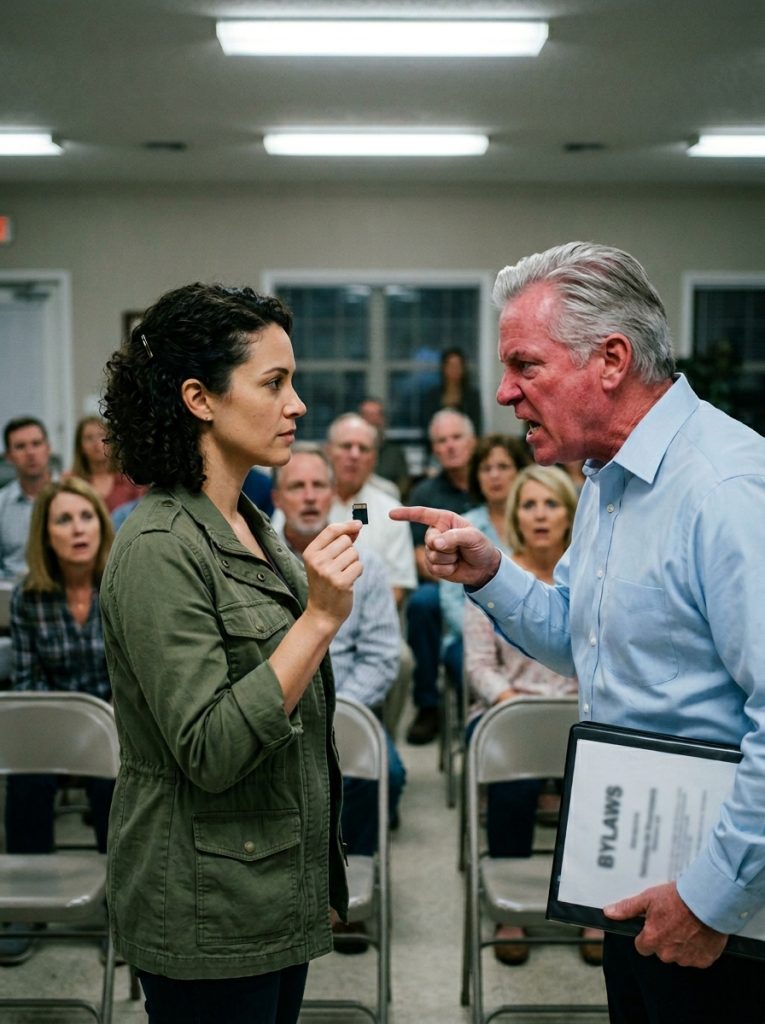
Gerald Voss demanded that we follow procedure, and for once, I was happy to.
“Procedure,” I said, “is exactly what I want.”
Because procedure meant the dashcam footage got played, right there, on the clubhouse projector Gerald himself had bought with our dues.
I’d come prepared. I handed the SD card to the secretary, a soft-spoken man named Errol who’d spent eleven years being bullied into taking the minutes Gerald wanted. He plugged it in with slightly shaking hands.
The video filled the wall.
You could hear the ordinary afternoon. Birds. A lawnmower. My own turn signal. And then, off Hollis Road, the silver sedan — the engine winding up, the tires, the blur of it. And then Cody Reyes in his little red rain jacket, chasing a ball off his driveway, and the scream. His mother’s scream. The car missing him by the length of a kitchen table.
The whole room flinched at once.
Somebody said, “Oh my God.”
Cody’s mother, Renata Reyes, put her face in her hands, because she’d lived it once and now she was living it again on the wall in front of her neighbors.
“That was three days ago,” I said quietly. “On the curve where I asked for a speed bump. Four times.”
Gerald recovered fast. Men like him always do.
“A near-miss is not data,” he announced. “One reckless driver doesn’t justify devaluing every home on this street. I won’t be emotionally blackmailed —”
“Errol,” I said, “would you open the HOA shared drive? The maintenance folder. Sort by date.”
Errol did. On the wall, the file list appeared. And there it was — a scanned PDF titled with my name and the words speed bump petition, uploaded March third.
By the administrator account. Gerald’s account.
“You told all of us you never received my petition,” I said. “You told me to resubmit ‘through proper channels.’ But you scanned it into the system the day I handed it to you. You didn’t lose it, Gerald. You filed it, and then you lied for three months, because approving it would have meant admitting the curve was dangerous — and you’d spent years telling buyers this was the safest street in Raleigh.”
His face had gone the color of putty.
“This is a coordinated ambush,” he sputtered. “She’s clearly been planning—”
“Of course I planned it,” I said. “You left me no other way to be heard.”
And then the thing happened that Gerald Voss never saw coming.
The room started talking.
Not to me. To each other, and then to him.
A man named Dev stood and said Gerald had fined him four hundred dollars for a “non-compliant” mailbox that matched three others on the street that were never touched. A retired teacher said Gerald had quietly blocked a wheelchair ramp request for her husband for “aesthetic consistency.” Renata said he’d told her, when she’d complained about speeding months ago, that “people who can’t control their children shouldn’t live in a community like this.”
Eleven years of small cruelties, each one swallowed alone, all of them suddenly spoken out loud in the same room.
Old Mr. Abernathy’s motion was still on the floor. To approve the speed bump, and to consider whether Gerald Voss should remain president.
Errol, the secretary who’d taken eleven years of dictated minutes, cleared his throat and said, in a voice nobody had heard him use before, “I’ll second that.”
The bylaws — Gerald’s beloved laminated bylaws — allowed for a recall vote by a two-thirds majority of present members. There were thirty-eight residents in that clubhouse.
The vote to approve the speed bump was thirty-seven to one. You can guess the one.
The vote to remove Gerald Voss as president was thirty-six to two; someone’s husband apparently felt bad.
Gerald stood up, gathered his binder, and for a moment I almost felt sorry for him — a man whose entire self was a title forty neighbors had just taken back. Almost. Then he looked at Renata Reyes, whose son he’d called uncontrollable, and said, “You’ll regret turning this into a circus,” and walked out, and the almost evaporated.
Officer Lena Ortiz, who’d come as a favor to take a report on the near-miss, had quietly watched the whole thing from the back. On her way out she stopped by my chair.
“For what it’s worth,” she said, “that footage is exactly what we needed. We’d already flagged that curve. Now we’ve got a reason on paper to put a patrol on it until the bump goes in.” She almost smiled. “Nicely done, Mrs. Pruitt.”
The speed bump was installed eleven days later.
Here’s the part Gerald would have hated most.
When the county engineer came to confirm the request, he asked for an updated petition — fresh signatures, current residents. I printed the same form I’d carried door to door three months earlier, the one Gerald had “lost.”
I didn’t have to knock this time.
People came to me. The new petition came back with not thirty-one names but fifty-two — every occupied house on the street, plus a few from the next block over who used the playground. The same document Gerald had buried came back carrying the whole street’s names, like the neighborhood had decided to sign its answer to him in ink.
Errol became interim president. His first act was to approve the wheelchair ramp. His second was to refund Dev’s mailbox fine. His third was to take the laminated bylaws out of the locked cabinet and put them on the open shelf where anyone could read them.
The curve is different now. Cars come off Hollis Road and feel the bump and slow, every single one, a hundred times a day. It’s the least dramatic thing in the world — a hump of asphalt — and it is the most dramatic thing I have ever fought for.
Cody Reyes turned eight last month. He had a party at that playground. I watched a dozen kids tear back and forth across that street on bikes and scooters, and for the first time in two years I didn’t hold my daughter’s wrist like a hawk, because the cars were crawling, because of a piece of paper with fifty-two names on it.
Renata hugged me at the party and cried a little. “You were the only one who wouldn’t let it go,” she said.
“I almost did,” I admitted. “A dozen times.”
And it’s true. A year ago, a man in a crisp blue shirt called me an anxious, incompetent mother in front of my neighbors, and a younger version of me would have gone home and believed him. The difference between that woman and this one wasn’t courage. It was a dashcam, a timestamp, and the stubborn refusal to be talked out of what I’d seen with my own eyes.
My daughter asked me, the week the bump went in, why I’d spent so many nights at the kitchen table with papers and the laptop, looking tired.
“There was a curve in the road that wasn’t safe,” I told her, “and a man who didn’t want to hear it. So I made him hear it.”
“Did he get in trouble?”
“He lost his job that he gave himself,” I said. “But that wasn’t the point. The point is the road is safe now.”
She thought about that with the seriousness only a seven-year-old can manage. “So you’re like a superhero, but the superpower is not giving up.”
I’ll take that over any title Gerald Voss ever printed on a name badge.
Gerald Voss moved away that summer. The HOA newsletter — which Errol now writes, badly and kindly — didn’t mention it.
These days when I drive onto my street, I slow down at the bump like everyone else.
And every time the car dips and rises, I think the same small, fierce thought: that’s the sound of a street that decided a child was worth more than a property value.