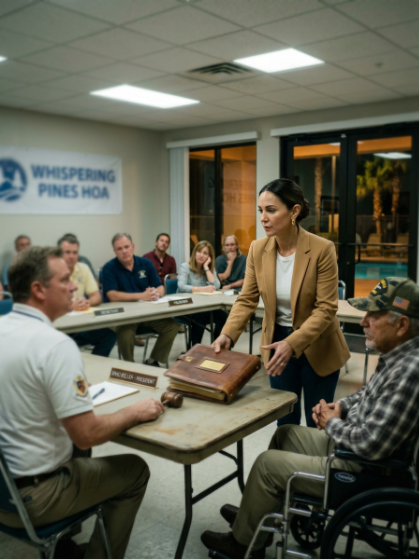
The folder slid to a stop in front of Brad’s gavel.
He didn’t open it right away. He looked at me the way he’d looked at me for two years — like I was a code violation that had somehow learned to talk.
“Mrs. Castellano, this is a formal proceeding,” he said. “If you have a hardship request, there’s a form for that.”
“Open the folder, Brad.”
He opened the folder.
The top page was a deed. Then another. Then a whole stack of them. Forty-one parcels — every unsold lot the developer of Whispering Pines had been sitting on, the greenbelt, the clubhouse we were standing in, and the empty acre they kept threatening to pave into “additional guest parking.”
“This spring,” I said, to the whole table and not just to him, “the developer decided to exit. He sold off the remaining lots and the common areas. He also sold the management contract for this association — the contract that pays the company that prints your violation notices, Brad. I bought all of it. As of the first of this month, that management company answers to me.”
The two board members on either side of him had gone the color of the drop ceiling. In the folding chairs, a few neighbors leaned forward; old Mrs. Pruett, who’d watched Brad fine my ramp from her kitchen window for two years, put a hand over her mouth and started, very quietly, to laugh.
“Which means,” I went on, “the fifty-dollar-a-day fine you’ve been running against a permitted, code-compliant wheelchair ramp is now mine to review. I’ve reviewed it. It’s vacated. Every dollar. I’ve also pulled the file on the van you had towed out of my own driveway on a Sunday morning. You’ll be refunding the impound fee, because the citation behind it doesn’t actually exist anywhere in the bylaws. I read all four hundred pages of them. Did you ever?”
Brad’s mouth worked. “You can’t — there’s a board. There’s a process. You can’t just walk in here and—”
“There’s a board,” I agreed. “It serves at the pleasure of the association. The association is now under new management. And the new management has a very different idea of what this place is for.”
I set one last page on top of the pile. I didn’t announce what it was, because my father was sitting beside me in his veteran’s cap, and there are things you don’t do in front of a man with his dignity, even when the other man has thrown his away.
It was the mortgage note on Brad Keller’s own house. In default. Bought, like everything else, when it came up quietly for sale.
He recognized it. His face told the whole room he recognized it.
I did not foreclose on Brad. I want to be clear about that, because for a year I had pictured doing exactly that, and picturing it was sometimes the only thing that got me past the notices taped to my door.
But my father raised me on a porch he built with his own two hands, after twenty-two years of taking orders that cost a great deal more than a fine, and he taught me that you measure a person by what they do the moment they finally hold the power they were once denied. So I let Brad keep his house. I simply made sure he understood, all the way down, who it was that had decided he could.
He resigned as president that night.
The new board — three neighbors who had quietly left groceries on my step during the worst of it — voted unanimously to adopt an accessibility-first policy, and to name the clubhouse’s new front ramp after the man who’d inspired it. We refunded two years of fines to a half-dozen families Brad had been quietly bleeding, an elderly couple and a single dad among them. It turned out I wasn’t the only one he’d decided didn’t belong.
My father cut the ribbon on that ramp himself, from his chair, the scissors shaking a little in his hands.
I run the association differently now. The notices we send out are about broken streetlights and overflowing storm drains — the things an association is actually for. We haven’t fined a single ramp, planter box, or veteran’s van since, and we never will, not as long as my name is on the deed.
The ramp I built at my own house is still standing.
Nobody has come to measure it in a very long time.