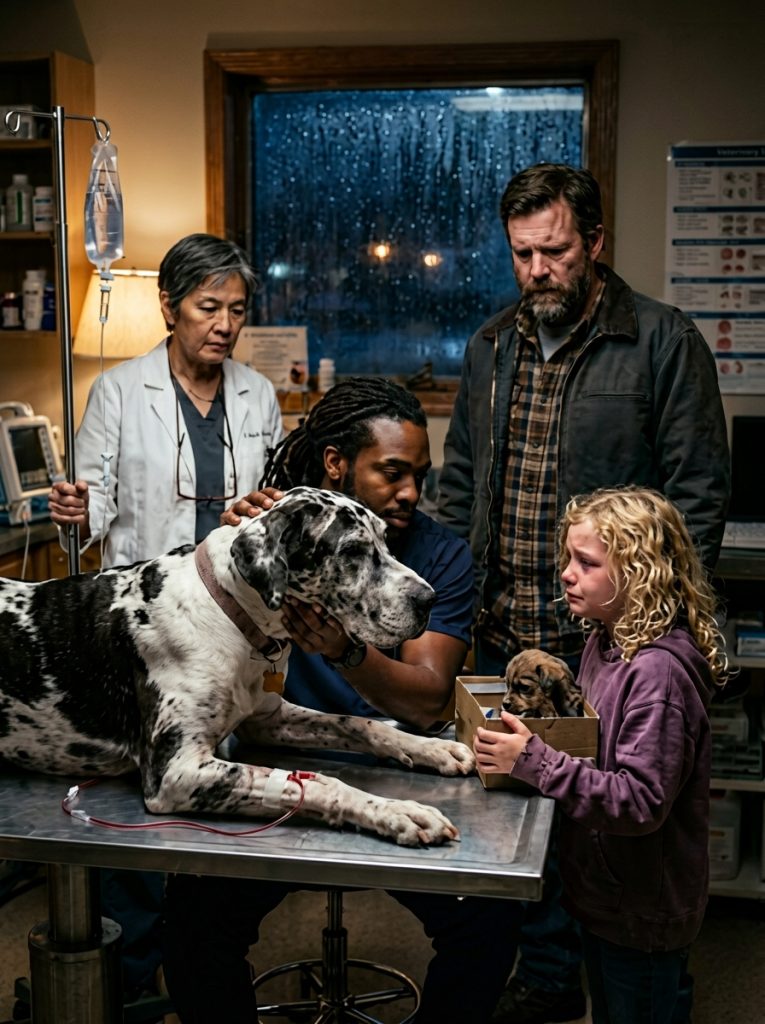
In the back room, with the door closed and the transfusion still running on the other side of the wall, Dr. Reyes showed me Atlas’s bloodwork and the echocardiogram we’d run the week before “just to be thorough.”
His heart was failing.
Dilated cardiomyopathy — the quiet killer of big breeds. His heart muscle was stretching thin and giving out, a little more every month. She’d been waiting for the right moment to tell me. There is never a right moment.
“He shouldn’t be donating anymore, Sam,” she said gently. “Tonight should be his last. His heart can’t spare it.”
I looked through the small window in the door at my dog, lying calm on the table, thumping his tail while his blood saved a stranger’s puppy.
His last donation. And he’d spent it on the family that threw him in a ditch.
“How long?” I asked.
“Months. Maybe a good year if we’re careful and lucky. He’s not in pain now. He won’t be, for a while. But this is the beginning of the last chapter.”
I went back out and knelt by Atlas and put my forehead against his big gray muzzle, and he licked my ear like I was the one who needed comforting.
Which, of course, I did.
People think a vet tech gets used to this. You don’t. You just learn to cry quietly and on your own time. Atlas had been my own time for six years — the dog who slept against my back, who rode shotgun on grocery runs, who’d turned a thrown-away puppy into the steadiest presence in my life. Hearing the clock start on him broke something in me that I’m not sure has fully healed.
By the time I came back out, the puppy had turned a corner.
Biscuit’s gums were pink. Her breathing had steadied. Dr. Reyes checked her over and said the words every terrified family prays for: “She’s going to make it.”
Sophie Bauer sobbed with relief into her father’s side. And Tom Bauer stood there staring at Atlas like a man looking at a ghost he’d hoped never to meet again.
“It’s him,” he said. “Isn’t it. It’s Brutus.”
“His name is Atlas,” I said. Again. Because it mattered.
“I know what I did,” Tom said, very low, so Sophie wouldn’t hear. “You don’t have to tell me. I think about that highway every time I see a Dane.”
I wanted to be furious with him. I’d rehearsed being furious with him for six years, in the abstract, every time I looked at that frayed blue collar in the drawer.
But the man in front of me wasn’t an abstract. He was gray-faced and shaking and ashamed, and his little girl was alive in his arms because of the dog he’d failed.
So I let him talk.
He’d lost his job the year he gave up Atlas. Then the apartment. Then more. He’d had a puppy that ate like a horse and grew like a weed and a family he could no longer feed, and one terrible night he’d made the worst decision of his life on a dark county road and driven away from it as fast as he could.
“I told myself somebody would find him,” Tom said. “I told Sophie he went to a farm. I’ve been lying to her for six years to keep from telling her what kind of man her dad was that winter.”
“Somebody did find him,” I said. “And he turned out to be the best dog in three counties.”
It wasn’t forgiveness. Not quite. But it was the truth, and the truth was kinder than I expected to be.
Here is the question that hung in the room, unspoken: did Tom want him back?
He didn’t ask. To his credit, he never asked. I think he knew he’d given up that right on a dark road in winter, and I think he could see that Atlas was mine now — that the dog leaned into my hands, watched the door for me, had a whole life that had nothing to do with the family that left him.
But I made a different choice than the one I’d planned.
I told them about his heart.
I told Sophie — gently, in words an eight-year-old could hold — that Atlas was a hero, that he’d just saved Biscuit’s life, and that his own big heart was getting tired and wouldn’t keep going forever.
And then I did the thing that surprised even me.
I invited them to be part of his last good months.
Not to take him. To know him. Because a dog who’d given his whole life to saving others deserved to be loved by as many people as possible in the time he had left — and because a little girl who thought her dog had gone to a farm deserved to learn the truth in the gentlest possible shape: not abandoned, but found; not gone, but here, and dying loved.
They came on Saturdays. Sophie would lie in the grass with her head on his side. Biscuit grew up chasing his slow, patient tail. Tom would sit on the clinic steps with me and not say much, and that was all right.
Those last months, I made a list of everything Atlas had never gotten to do, and we did all of it.
He’d spent his whole life on a steel table giving pieces of himself to strangers. So I took him to Lake Elmo and let him wade into the shallows up to his chest, watching the water with that same calm wonder he gave everything. I bought him an embarrassing amount of rotisserie chicken. I let him sleep on the bed, all hundred and forty pounds of him, snoring like a freight train, and I didn’t move him once.
Dr. Reyes put a framed photo of him on the clinic wall, in the room where he’d donated for years. Underneath it she wrote how many transfusions he’d given and how many animals were alive because of him. The number made people stop and stare. Dozens of families never knew the name of the dog whose blood saved their cat, their terrier, their old arthritic tabby. His name was Atlas, and he carried the sky for all of them.
We started a donor registry in his honor — the Atlas List. When owners ask now what it means, the techs tell them about a Great Dane who was thrown away and spent the rest of his life giving back anyway.
I thought, when his heart started to go, that the unfairness of it would eat me alive. That a dog who’d saved so many couldn’t be saved himself. That it was, in the language of these things, simply too late.
And it was too late, in a way. I can’t pretend otherwise. There’s no version where Atlas gets the long, lazy old age he earned.
But there was still grace in it. He got months of lake water and stolen chicken and a little girl’s hand in his fur. He got to die known and loved and named, by more people than most dogs ever meet. He got to save one last life — and of all the lives in the world, it was the one that let a frightened man finally tell his daughter the truth.
Atlas died in October, on a warm afternoon, on a blanket in the sun, with my hand on his chest and Sophie’s small hand on his paw and Biscuit asleep against his belly — the puppy his blood had saved, keeping him company at the end.
His heart simply finished. No pain. Just tired, and then still.
We buried the frayed blue collar with him, and the new one, too. Brutus and Atlas, the same gentle giant, going into the ground under both his names.
I kept the empty drawer empty for a while.
But Biscuit is full grown now, and last week the Bauers asked if I’d help them sign her up — when she’s old enough, when she’s healthy — to be a blood donor at the clinic.
To give back what was given to her.
I said yes, of course. Some debts you can only pay forward, and some hearts, even after they stop, keep right on saving lives.