Margaret Reilly placed the heavy vase of lilies on the table with the care of someone who had arranged flowers for a thousand funerals. The white petals caught the soft light coming through the tall windows of the funeral home. Below the flowers lay Sergeant Michael Reilly’s dress uniform—badges polished, hat resting beside it.
Officer Daniel Fraon approached politely. “Ma’am, family flowers go up front.”
Margaret kept her hands on the cool glass. “These are for me.”
Fraon frowned, confused. The woman looked familiar in the way longtime community members often did, but he couldn’t place her.
Margaret lifted her eyes. “Do you know my husband?”
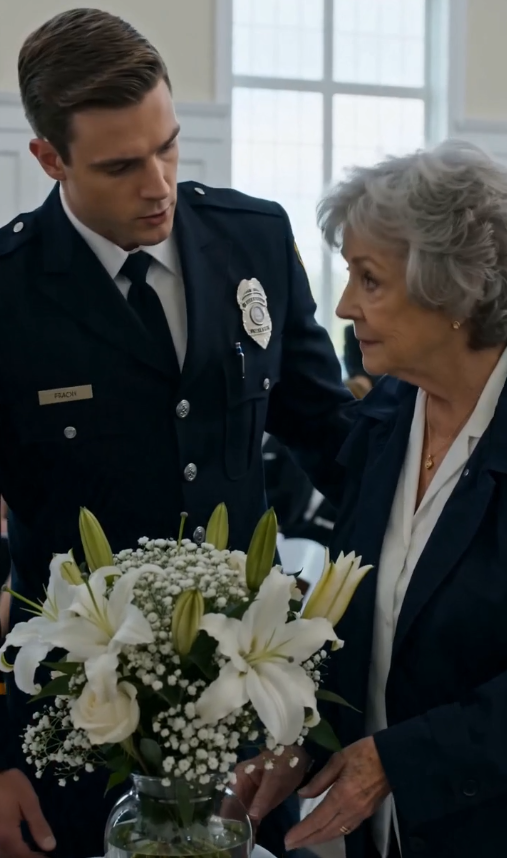
Before Fraon could answer, she continued softly, “He walked me home every night after my son died.”
The words landed like a quiet thunderclap. Heads turned. The young woman in the front row—Sergeant Reilly’s daughter, Sarah—clutched her own bouquet until her knuckles whitened.
Margaret told the story without drama. Fifteen years earlier, her son had been killed in a car accident. Grief had made the world feel dangerous and empty. Every evening after her shift at the flower shop, she would close up late and walk the six blocks home through streets that suddenly felt too long.
Sergeant Michael Reilly had noticed. He was on night patrol. Without ever making it official, he began timing his route so that he would pull up alongside her, roll down the window, and walk with her—sometimes in uniform, sometimes just talking through the open door. He never asked for thanks. He just made sure she got home safe.
For almost two years.
Sarah listened with tears streaming. She had known her father was kind, but she had never heard this chapter. The quiet protection he gave a stranger who reminded him of his own mother.
Margaret placed one final lily in the arrangement. “He told me once that the uniform wasn’t just for catching bad guys. It was for reminding people they weren’t alone.”
When the service began, Margaret sat in the back row, hands folded. Sarah found her afterward and hugged her like family. The lilies stayed on the table beside the uniform—beautiful, dignified, and deeply personal.
Years of small kindnesses had come full circle on the hardest day. The florist who had quietly received protection now gave beauty back to the officer’s family. And in the quiet rows of the funeral home, more than one person realized that the real legacy of a good cop wasn’t only the medals or the headlines—it was the unseen walks home, the steady presence, the promise kept long after anyone was watching.