The honor guard moved with mechanical grace across the dew-covered grass. Captain Daniel Gant watched the flag fold into its perfect triangle, each crease a ritual of respect. This was his duty now — to stand sentinel over the graves of the fallen. But today, the ceremony fractured.
An older woman in a dark coat stepped forward from the small gathering of mourners. Her silver hair caught the gray light. Gant raised a hand. “Ma’am, please step back.”
She looked at him with eyes that had cried enough tears for several lifetimes. “He didn’t die alone.”
Gant’s jaw tightened. The words landed heavier than any order he’d ever received. “What?”
The woman — Mrs. Eleanor Hayes — lifted a framed photograph with both hands. Her son, Sergeant Matthew Hayes, stared back from the desert sands, rifle ready, helmet tilted. “My son carried him out,” she said, voice steady despite the tears gathering. “When the ambush hit, your man was hit first. Matthew dragged him three hundred meters under fire. Stayed with him until the medevac came. He held his hand the whole time.”
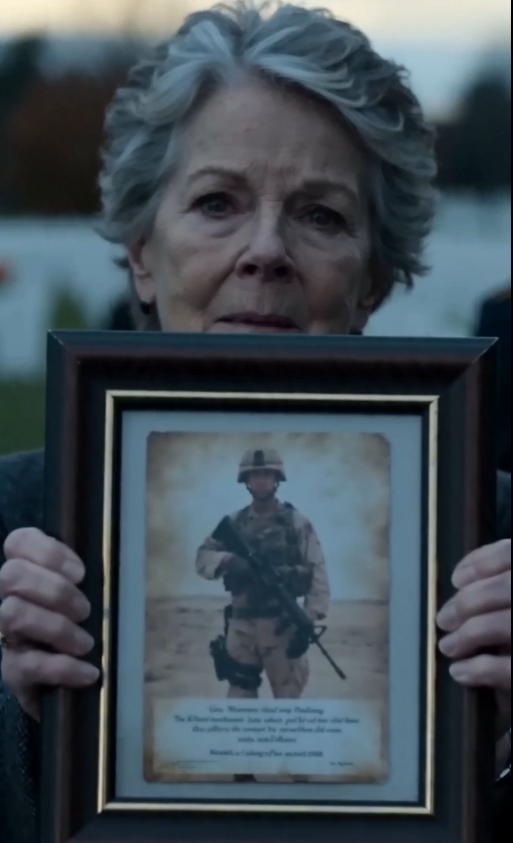
The honor guard stilled. One Marine’s gloved hand trembled slightly on his rifle. Gant stared at the photo, then at the name on the fresh headstone. Private First Class Ryan Kowalski. He had read the report — heroic actions, but names blurred in the bureaucracy of loss.
Mrs. Hayes continued softly, “They sent me his effects. Ryan’s dog tags were in Matthew’s pocket when he came home. Matthew said Ryan kept asking about his little sister. My boy promised he’d tell her stories.”
Gant felt the uniform suddenly constrict. He had delivered countless folded flags, spoken countless platitudes. But this — this was the part never written in after-action reports. The human thread that bound the dead to the living.
He stepped aside. The honor guard parted. Mrs. Hayes walked forward and gently placed the photo against the headstone. For a long moment, the only sound was the wind moving through the trees and the distant bugle.
Later, as the small group dispersed, Gant approached her. “I didn’t know,” he admitted.
“Most don’t,” she replied. “They see the flag. They don’t see the hands that carried the man underneath it.”
Gant saluted her — not as a superior officer, but as a man humbled. From that day, his briefings to new honor guard members changed. He told them the story of the mother and the photo. He told them every folded flag represented not just sacrifice, but the invisible bonds of brotherhood that outlasted the battlefield.
Some ceremonies end with silence. Others begin with truth spoken by those left behind.