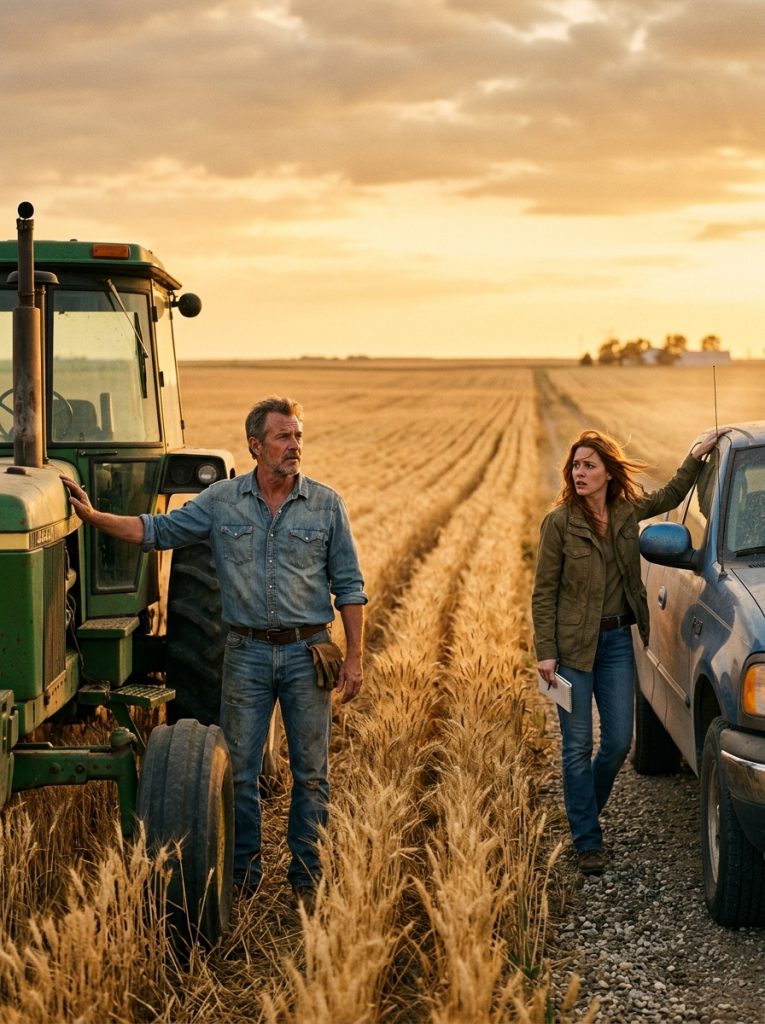
“Your mother asked me to stay away. I figured keeping the land was the one thing I could still do for you.”
The words crossed thirty yards of wheat field like a stone thrown into still water.
Cora didn’t move.
She stood by the truck door and let the sentence land.
Stay away.
Asked.
Not chose.
Asked.
“What do you mean she asked you?” Cora said.
Wade pulled the work gloves from his back pocket. Turned them over in his hands. A habit — something to do when the words came hard.
“The custody agreement. After the divorce. Sandra’s attorney put in a provision. I could keep the land in my name temporarily — or I could have visitation. Not both.”
Cora felt her chest tighten.
“That’s not how custody works.”
“It is when you can’t afford a lawyer and the other side can.” Wade’s voice was flat. Not bitter. Just factual. The voice of a man who’d burned through anger years ago and arrived at something quieter on the other side.
He looked at her across the wheat.
“Your mother’s family had money. Her attorney was good. Mine was the county public defender. I was given a choice: sign the agreement as written and give up regular contact, or fight it and lose the farm during litigation — because Sandra threatened to force a sale to cover legal costs.”
“She couldn’t have—”
“She could. Joint marital property. I consulted two attorneys after the fact. Both said the same thing. If I’d challenged custody, she’d have petitioned for partition. The farm would have been sold. And you’d have lost it either way.”
Cora’s knees felt weak.
She sat on the truck’s running board.
“So you gave us up.”
“I gave up being in the same room as you,” Wade said. His voice broke for the first time. “I never gave you up. Not for one day.”
He walked toward her — slowly, like approaching a skittish animal. He stopped ten feet away. Close enough to talk. Far enough to respect whatever boundary she needed.
“I transferred the deed when you turned eighteen. Your mother never knew. I did it at the recorder’s office on your birthday. Told the clerk it was a gift.”
Cora stared at the ground.
“I’ve been working it ever since. Leasing the fields. Paying the taxes. Making sure that when you found out — if you found out — there’d be something here worth coming back to.”
“You live here,” Cora said. It wasn’t a question. She’d seen the trailer behind the tree line on the way in.
“On the back forty. Thirty feet off the property line. Technically my own parcel. I bought it in 2014 so I wouldn’t be trespassing on your land.”
Cora pressed her palms against her eyes.
Fifteen years.
Fifteen years of believing her father was a thief. A drunk. A coward who sold the farm and disappeared.
And the entire time — every single harvest season, every frozen January, every punishing July — he was here.
Working land he’d given away.
Maintaining fields he’d never profit from.
Living in a trailer on the edge of a property he preserved for a daughter who wouldn’t answer his calls.
“I wrote you letters,” Wade said. “Sixty-three of them. One every season for fifteen years, plus extras on your birthdays. Sent them to Sandra’s address because I didn’t have yours.”
“I never got a single one.”
Wade nodded.
He’d expected that.
“I figured. But I wrote them anyway. In case someday you came back and wanted to know what I was thinking all those years.”
“Where are they?”
“In the trailer. In a box by the bed. I kept copies of every one.”
Cora looked up at her father.
Really looked.
He was fifty-nine years old. Sun-weathered in the way only Kansas farmers get — lines deep enough to hold shadow, skin darkened to leather from decades of open-sky work. His hands were calloused. His shoulders slightly stooped.
But his eyes — brown like hers, steady like hers — held no anger.
No resentment.
Just the patient, worn-down hope of a man who planted a field every spring knowing the person it was meant for might never come to harvest it.
“Why didn’t you fight harder?” Cora asked. “Why didn’t you tell me the truth?”
Wade looked at the wheat.
“Because you were sixteen. And your mother was the one you lived with. If I’d fought — if I’d dragged you into a legal war — you’d have been torn apart. Judges ask kids to choose. I wouldn’t do that to you.”
He paused.
“And I made a calculation. I figured — if I kept the land safe, one day you’d come back. One day you’d look for it. And when you found it still here — still whole — you’d know.”
“Know what?”
“That I didn’t leave because I wanted to. That I stayed because it was the only way I could still be your father without making your life harder.”
The wind moved through the wheat between them.
Golden stalks bending in unison. The sound like paper being shuffled — like all those letters he wrote and she never received.
Cora stood.
She walked toward him.
Stopped two feet away.
Advertisement
Close enough to see the gray in his stubble. The scar on his right hand from a combine belt that slipped in 2018. The small gold cross on a chain that used to hang in the farmhouse kitchen.
“I hated you,” she said. “For fifteen years I hated you.”
Wade’s jaw tightened.
“I know.”
“I wrote essays about you. Articles. I built an entire career on the narrative of a man who betrayed his family.”
“I read them all,” Wade said quietly. “Every byline. Every piece. I have a folder.”
Cora’s eyes filled.
“And you never called.”
“I didn’t think you wanted me to.”
“I didn’t.”
Silence.
“But I do now.”
Wade’s composure broke.
Not dramatically. Not the way it happens in movies. Just his chin dipping. His eyes closing. His hand coming up to press against his mouth as if holding something in that had been waiting fifteen years to escape.
Cora closed the last two feet.
She put her arms around her father for the first time since she was sixteen years old.
He smelled like diesel and wheat and sunscreen and time.
He held her back with the caution of someone afraid this might not be real.
And in a Kansas wheat field at golden hour — with fifteen years of silence between them and a hundred and sixty acres of truth beneath their feet — a wall that never should have existed finally found its door.
It didn’t fall.
Walls that old don’t fall in a single afternoon.
But for the first time — it was open.
And that was enough to start.
They stood in the field for a long time.
The wind moved the wheat around them. The sun dropped lower. The tractor ticked as it cooled.
Neither spoke.
Because fifteen years of silence doesn’t break with one hug. It cracks. And through the crack, you can see the work that still needs doing.
Cora spent three days in Kansas.
She read the letters. All sixty-three. Some were short — harvest numbers, birthday wishes. Some were long — apologies, explanations, a father’s record of years spent watching from a distance.
One letter, dated her graduation year, said: “I watched the livestream. You wore blue. I’m so proud of you I can’t breathe.”
Cora closed that one and didn’t open another for an hour.
On her last day, she drove to her mother’s house in Topeka.
Sandra opened the door and knew immediately.
“You went to the farm.”
“He never sold it, Mom. He gave it to me.”
Sandra’s jaw tightened.
Cora didn’t push. Not that day.
But the narrative Sandra had built — the one that made her the victim and Wade the villain — had a crack in it now.
Cora went back to Chicago. She wrote her article. But not the one her editor assigned. She wrote about her own family. About the cost of one-sided stories. About a man who chose silence over war because he believed patience would outlast a lie.
The piece was published in the spring.
Wade called her the morning it went live.
“You didn’t have to do that,” he said.
“I know.”
“Thank you.”
“Come to Chicago, Dad. I’ll make you dinner.”
A long pause.
“I’d like that.”
He came the following weekend.
And for the first time in fifteen years, they sat at the same table.