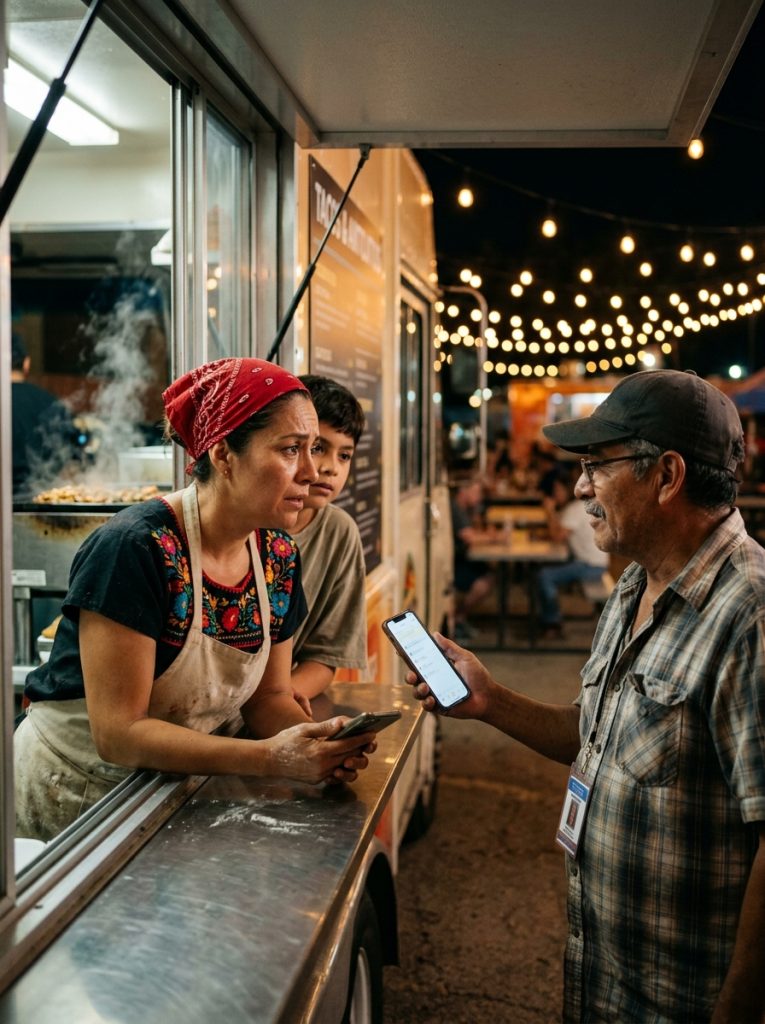
I picked the card up off my counter and read it again, just to be sure my eyes weren’t lying.
County Department of Health. Senior Environmental Health Specialist. Francis “Frank” Delgado.
Fifty-two Fridays. The man who told me my carnitas reminded him of a place that closed in 1986 was a senior health inspector.
“You’re—” I started.
“I’m the guy who inspects trucks like yours for a living,” Frank said, loud enough for the little crowd to hear. “Have been for twenty-six years. And I want everyone standing here to know something.”
He turned so he was talking to them, not just to me.
“I have eaten at this truck once a week for over a year. Not as an inspector — as a customer, on my own time, with my own money. I’ve watched this woman work. I’ve watched her son card the gloves and wipe the rails. I’ve watched her throw out a whole pan of meat one night because she didn’t like how long it had sat.” He tapped the counter. “You want to know who runs a clean kitchen? Watch where they eat when nobody’s making them.”
Then he held up his phone.
“This is the county’s public inspection portal. Anybody can look it up. Rosa’s Comal. Last inspection, six weeks ago.” He turned the screen toward the crowd. “Perfect score. No violations. Not one.”
I had that score framed by my window. For a year I’d told myself it was just a piece of laminated paper.
Standing there watching strangers pull it up on their own phones, I finally understood what it really was. It was the only thing standing between my truck and a lie. And Frank had been carrying the fact of it around in his shirt pocket the whole time, quietly, waiting to see if I’d ever need him to.
A couple of people leaned in. Phones came out. They were looking it up themselves, right there, confirming it.
“Now,” Frank went on, and his voice changed, got harder, “somebody posted this afternoon that people got sick here. That the health department was ‘looking into it.’ I’d know if we were. We’re not. There is no complaint. There is no investigation. There is no ER visit. There is a perfect score and a made-up story.”
Somebody in the crowd asked, half-joking, how he could be so sure.
Frank didn’t smile. “Because I’ve spent twenty-six years learning the difference between a sick kitchen and a clean one,” he said. “And because a real complaint comes with a name, a date, and a person willing to stand behind it. This one had none of those. That’s not a customer who got hurt. That’s a competitor who got jealous.”
He let that sit.
“You want to talk about who actually files anonymous lies about a competitor? That’s the kind of thing my office does look into.”
I watched it happen in real time. The thing the rumor had done in reverse.
People who’d walked past my window an hour ago, nervous, started drifting back. Somebody ordered three tacos “and whatever your son recommends.” Mateo, who had been so quiet and scared at the window, lit up like the string lights overhead.
The woman who’d texted me — the one with the grandkids — pushed her way to the front of the line. She didn’t say much. She just ordered four plates she clearly didn’t need, pressed a twenty into Mateo’s hand, and told him to keep the change.
That was her apology. I took it for exactly what it was. People are allowed to be scared and wrong for one afternoon, as long as they’re brave enough to walk back to your window after.
And the screenshot of my perfect score — Frank’s post, with the date and the portal link — started traveling. Faster than the lie had. Because it turns out people feel a little guilty when they realize they almost helped sink somebody over nothing, and the way they make up for it is to share the truth twice as hard.
By the end of that night, my line wrapped the lot.
I sold out. Everything. I scraped the last of the carnitas onto the last tortilla at eleven o’clock and put up the SOLD OUT sign with my hands still shaking, this time from a good kind of tired.
Chad Brunner did not have a good night.
Because here’s what Frank did the next morning, on the clock this time. He didn’t have to. He told me later he just doesn’t like watching someone do to another vendor what was done to me.
The county can’t act on a feeling. But a formal complaint about deliberately false health claims — claims designed to look like they came from the health department — that, they can trace.
It wasn’t hard. Chad had used the same phone for his own truck’s account and for the anonymous one. The festival had its own cameras. And it turned out he’d done a smaller version of this to a snow-cone vendor the summer before, who suddenly had a lot to say once she heard she wasn’t the only one.
There’s no satisfying courtroom scene for me to give you here. It was quieter than that. A county officer made some calls. A festival board read an email. Nobody put Chad Brunner in handcuffs over a fake review.
But the food-truck world is smaller than it looks, and word travels through it like a grease fire. The word on Chad became one sentence that follows him from lot to lot now: he’s the guy who tried to lie a single mom out of business, and got caught doing it.
The festival pulled Brunner’s Smokehouse from the lineup. Then the next festival did too, once word got around. He spent so long trying to take my spot that he lost his own.
I didn’t celebrate it. I was too busy. That’s the honest truth.
But I’d be lying if I said it didn’t feel like something, watching that big shiny rig pack up early on the second night while my little truck ran out of everything for the second time.
Frank still comes every Friday.
Same three tacos. Same plaid shirt. He still rounds his tip up, and now I still try to wave it off, and we have the same gentle argument about it every single week.
A few months ago I added something to the menu. A plate I named “The Inspector” — the three tacos he always orders, with an extra he doesn’t know he’s getting. It’s the bestseller on Fridays now. People ask who the Inspector is.
I tell them: he’s the regular who knew exactly who I was long before he ever told me who he was.
And then I tell them the part I think about most.
For a whole year, Frank Delgado could have flashed that badge any Friday he wanted. He could have gotten his tacos faster. Gotten them comped. Gotten treated like somebody important.
He never once did. He stood in the same line as everyone else, paid full price, and rounded the tip up.
He only ever used who he was on the single night it could save somebody other than himself.
Mateo asked me one night, closing up, why Frank never said anything for a whole year. Why he just… ate his tacos and watched.
I thought about it.
“Because the people who really see you,” I said, “usually aren’t the ones announcing it. He didn’t come to test me, mijo. He just paid attention. And when it counted, paying attention was enough to save us.”
We turned off the string lights and drove home with a full till and an empty truck.
Best night that little kitchen ever had. And it started as the worst.