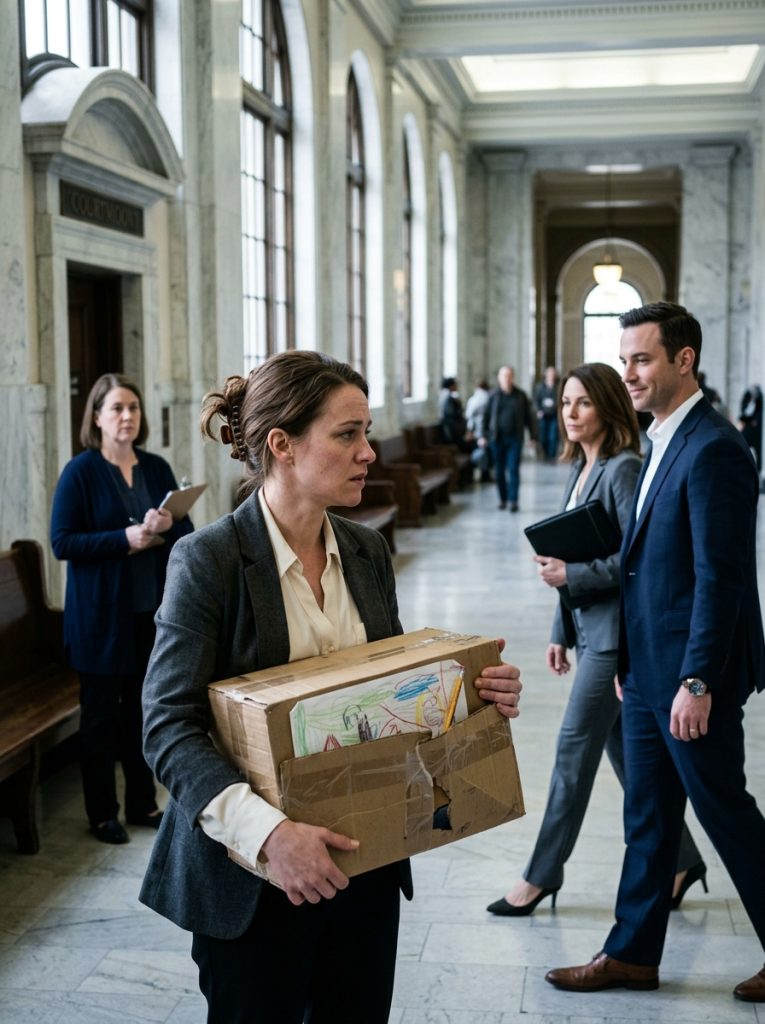
The courtroom was smaller than I expected. No jury. Just a judge named Patricia Hollis, a court reporter, Brandon and his lawyer at one table, and me with a public defender named Marcus Webb who’d taken my case for almost nothing.
And the shoebox, on the table in front of me, where I could keep one hand on it.
Brandon’s lawyer, Karen, went first. She was good. She painted him as a changed man — sobriety, stable marriage, a four-bedroom house with a yard. She used the word “environment” eleven times. She showed photos of a bedroom decorated for a little girl who had never slept in it.
Then she turned to me. The long hours. The early route. The cereal dinners, which she called “nutritional instability.”
I sat there and let her build it, brick by brick, the same way Vanessa-types always do.
When it was our turn, Mr. Webb stood up and asked the judge for permission to enter the contents of the box into the record.
He started with the logbook.
Six years of entries, in my handwriting, dated and ordinary. Fevers and their temperatures. The night of the ear infection. First steps, March 14th. First word — “moon,” not “mama,” which broke my heart a little and I wrote it down anyway. Every doctor’s visit. Every parent-teacher conference, with the sign-in sheet stapled beside it, one signature on every line.
Then the drawings.
Mr. Webb laid them out, the dated ones, in a long row in front of the judge. Crayon houses with three windows and one stick figure with yellow hair holding a smaller stick figure with yellow hair. No third figure. Never a third figure. Lily had drawn her whole world for six years and her father had not been in a single frame, because you cannot draw someone you have never met.
“Your Honor,” Mr. Webb said, “Mr. Cole describes an environment. This is the environment. In the child’s own hand.”
But the thing that ended it wasn’t the drawings.
It was the voicemail.
Two years ago, on Lily’s fifth birthday, I had called Brandon. Begged him, one last time, to just talk to her for two minutes. I’d saved his reply all that time without ever quite knowing why.
Mr. Webb asked to play it. Karen objected. The judge allowed it.
Brandon’s own voice filled that quiet room, slurred and irritated.
“Stop calling me. I didn’t want the kid then and I don’t want her now. Lose my number.”
The court reporter’s hands paused over her keys.
Judge Hollis took off her glasses.
“Mr. Cole,” she said, “I’m going to ask you one question, and I’d advise you to remember you’re under oath. What changed?”
And Brandon, who had answered every other question smoothly, hesitated.
That hesitation told the whole story.
It came out under the judge’s careful questions, and then in the financial documents Mr. Webb had subpoenaed. Brandon’s new father-in-law was wealthy and old-fashioned. He’d rewritten his trust to favor “grandchildren by blood.” Brandon’s new marriage had not produced any. But Brandon had a daughter out there somewhere — a daughter who would make him, on paper, the father of an heir.
He didn’t want Lily.
He wanted what Lily unlocked.
Judge Hollis ruled from the bench. She denied the petition for custody. She granted me sole legal and physical custody, with Brandon limited to supervised visitation he would have to request in writing — visitation he has never once requested since.
She ordered the back child support calculated to the dollar.
And before she rose, she did something I didn’t know judges could do. She looked at me, just me, and she said, “Ms. Whitfield. You kept a record for six years with no idea you’d ever need it. That isn’t paranoia. That’s a mother. The court sees you.”
I made it to the parking lot before I cried.
Lily is nine now. The fridge is still covered in drawings, and these days some of them have more figures — a teacher she loves, my mom, a scruffy dog we finally adopted named Biscuit.
Still no third figure where a father would go. She doesn’t ask much. When she did, once, I told her the truth in the smallest size that’s still true: that some people aren’t able to stay, and that it was never, ever about her.
I kept the shoebox. It lives on the top shelf of my closet.
Not because I think I’ll need it again.
Because it’s the proof, in crayon and in my own tired handwriting, of every single ordinary day I chose her.
And those days, it turns out, are the only inheritance that ever mattered.