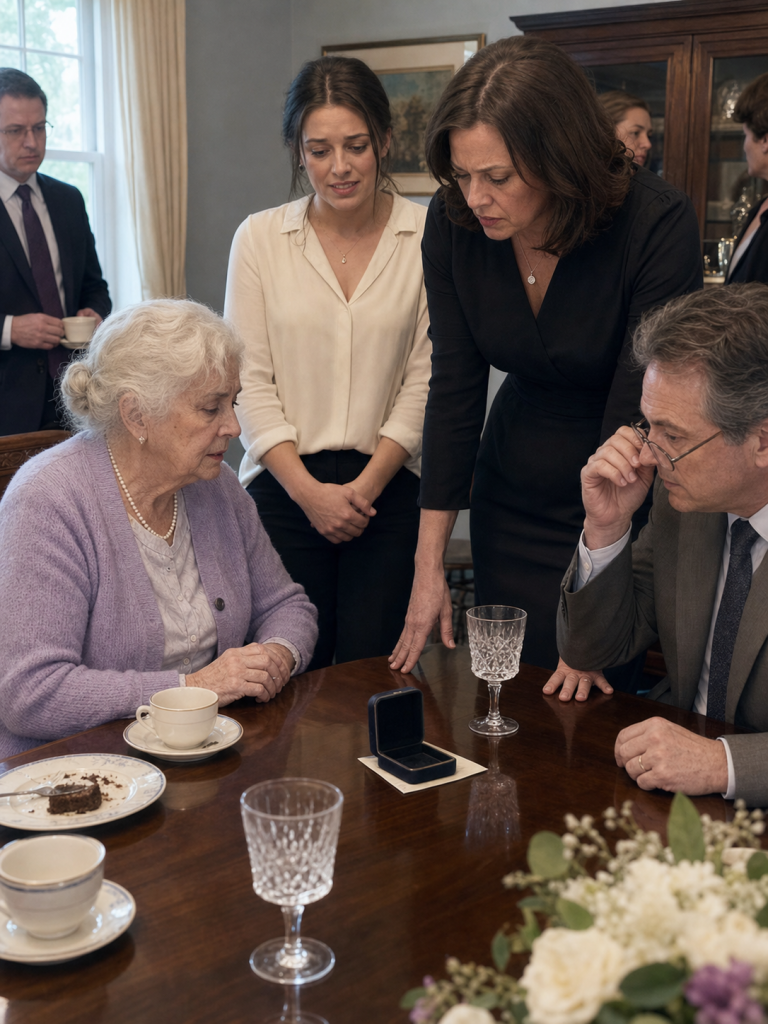
Tessa went pale so fast I knew the answer before anyone asked another question.
My mother looked at Victor, then at the empty box, trying to understand whether she had just been saved or humiliated in front of the whole family.
“What do you mean?” I asked.
Victor placed the folded slip flat on the table. It was an appraisal copy, the kind with photographs and identification numbers. He covered the text with his hand when cousins leaned in, keeping the private details private, but he pointed to the corner of the box in the photo.
“The original has a small repair mark near the hinge,” he said. “Mr. Porter mentioned he dropped it once, years ago, and had it fixed. This one does not have that mark. Also, the lining color is slightly different. Warmer in the photograph.”
Tessa laughed. It sounded awful, brittle and too high. “It’s an old box. There are probably dozens like it. You can buy them anywhere.”
“Maybe,” Victor said evenly. “But the pieces inside had matching documentation. Serial etchings on the clasps. They were here when I inspected them four weeks ago. I photographed every one.”
My mother turned to Tessa slowly. “Why would you say I moved them? Why would you say again?”
That question did what my anger could not. It made Tessa’s face crumple for one second, the mask slipping. Then she hardened again, the way people do when they decide to double down instead of drown.
“Grandma, you have been forgetting things,” she said. “Everyone knows. Mom talks about it. We all worry.”
I stepped between them. “Do not use her age as your hiding place.”
The room went still. Even the cousins who had been pretending to wash dishes stopped moving.
Tessa’s purse buzzed on the chair. She snatched it too quickly, pressing it against her side. Victor’s eyes followed the movement, and so did mine.
I asked her to open it. She refused. My brother said we were making a scene at Dad’s memorial, that Dad would be ashamed. I told him the scene had started when someone stole from an eighty-two-year-old widow and tried to convince her she was losing her mind.
Mom, quiet until then, reached for my hand across the table. Her grip was stronger than I expected.
“Call your father’s lawyer,” she said.
That surprised everyone. It also reminded us who she was before grief and age gave people permission to talk over her. My mother had run the books for Dad’s business for thirty years. She had never lost a receipt in her life.
The lawyer arrived within forty minutes. So did a police officer, because Victor advised us not to handle a possible theft as family gossip that would simply fade by dessert. Under that pressure, with an officer standing in the doorway of the dining room, Tessa finally admitted part of it. She said she had debts. Credit cards, a car she could not afford, a boyfriend who had left her with the lease. She said she meant to borrow only two pieces and replace them before anyone noticed. She said she switched the box because Grandma would panic less if she thought she had misplaced things.
That sentence ended whatever sympathy I had left.
But there was one thing Tessa did not know.
Victor asked my mother whether he could inspect the empty replacement box anyway. He turned it over, pressed along the cheap lining with his thumb, then shook his head. “No hidden compartment. This is a mass-produced case. The felt is glued straight to the wood.”
Mom looked at him through tears. “The real one has one. Frank built it into the design.”
My father had been a cabinetmaker before his hands gave out. He had modified the box himself, carved a narrow space beneath the velvet tray so thin you would never find it unless you knew to push. Tessa had stolen what she could see. She had never known there was anything underneath.
The original box was recovered two days later from a pawn shop across the county line, after Victor provided the appraisal records and photographs. The pearls and the bracelet were gone, already moved through channels that took weeks to trace and were never fully recovered. But when the box itself came home, Mom sat at her kitchen table and opened the hidden lining with a hairpin, the way Dad had shown her once as a joke.
Inside was Dad’s wedding band from the years his hands had swollen too much to wear it, a tiny black-and-white photo of the two of them at nineteen, and a note folded into a square in his blocky handwriting.
It said, “Elaine gets to decide. No one else.”
She read it once, then held it to her chest and did not speak for a long time.
Tessa was charged. The family split the way families do when the truth turns out to be expensive. Some said she made a mistake and deserved mercy. Some said my mother should forgive faster, for the sake of peace. Mom said forgiveness did not require handing a thief the story of her own mind to rewrite however she pleased.
Months later, Victor helped us recreate the appraisal file, not for money this time, but for the record. My mother kept the box on her dresser again, in plain view. She did not hide it in a drawer. She said hiding it would make Tessa the author of the rest of her life, and she was done letting other people hold the pen.
On her next birthday, Mom wore the recovered wedding band on a chain around her neck. When a neighbor told her it was brave, she smiled and touched the ring where it rested against her collarbone.
“No,” she said. “It is mine. That is all.”
And she wore it to the table, where the morning light caught it, every single day after that.