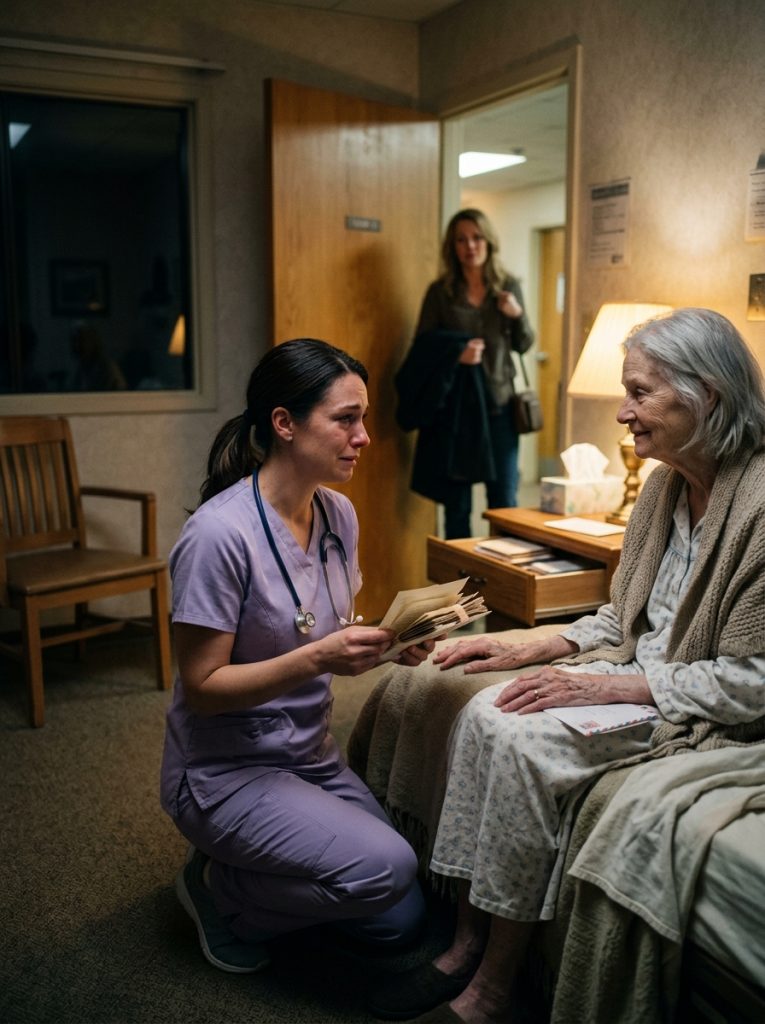
I almost didn’t tell anyone I’d mailed it.
It felt like a small, secret crime — me, in my scrubs, walking a dying woman’s letter to a corner mailbox at two in the morning because I couldn’t stand the thought of it sitting in that drawer forever, unsent, like all the others.
I’d talked myself out of it a hundred times first. It wasn’t my place. Maybe the children had reasons I knew nothing about. Maybe Eleanor would be mortified to learn I’d read her mail, let alone mailed it.
But I kept coming back to that drawer. To all those stamps.
A stamp is a small act of hope. You only buy one if some part of you still believes the letter might be wanted on the other end. Eleanor had bought dozens. She’d just never once been brave enough to let a single one go.
For three days, nothing.
Eleanor slept more and more. I read to her on my breaks. She’d surface sometimes and ask if it was Sunday, if I’d set her hair. I set it anyway. Pin curls, soft and silver, the way she liked.
On the fourth night, a woman came through the front doors of Maplewood at the very end of visiting hours.
Mid-forties. A rumpled travel coat. Eyes red-rimmed from either crying or driving or both. She had an envelope crushed in one hand.
She found me at the nurses’ station before she found the room.
“I’m looking for Eleanor Hartley,” she said. Her voice shook. “I’m — I’m Sarah. Her daughter. I got a letter.”
I knew the handwriting on that envelope. I’d watched it dry under a lamp.
“She’s in fourteen,” I said. “She’s been waiting a long time for you. I’ll take you.”
She gripped the edge of the counter. “Are my brother and sister here? David? Karen?”
I told her she was the only one who’d come.
Something crossed her face then — relief and shame fighting for the same square inch of it. “I almost didn’t,” she admitted. “I read it three times and almost talked myself out of it. Then I just… got in the car.”
“You got in the car,” I said. “That’s the only part that matters now.”
Sarah stopped at the door the way people do, like there’s a wall there only they can feel.
“I didn’t know,” she whispered. “I swear I didn’t know it was this bad. We thought — she always said she was fine. She told us she was fine.”
“She told you that,” I said gently, “so you wouldn’t worry. She’s been telling you that her whole life.”
Sarah went in. I gave them the room.
I don’t know everything they said. I know some of it, because Sarah told me after, in the family lounge, with a vending-machine coffee going cold in her hands the way Eleanor’s tea always did.
The letter had been short. Three paragraphs. It didn’t ask for anything. It didn’t guilt anyone. It said: I’m proud of the woman you became. I think about you every day. If you ever find the time, your mother would love to see your face. And whether you come or not, I want you to know I was never, not for one second, angry.
“She apologized to me,” Sarah said, staring at the wall. “In the letter. She apologized to me. For what? For working two jobs? For not having more to give us?” She pressed the heels of her hands into her eyes. “I haven’t visited in four years because I told myself she didn’t need me. That she had her routine. That my brother and sister never went either, so why was I the bad guy. And the whole time she was writing us letters she was too afraid to even mail.”
“She didn’t want to be a burden,” I said. It was the truest thing I knew about Eleanor Hartley.
“She was never a burden.” Sarah’s voice broke. “She was my mother.”
Eleanor held on for two more days.
Long enough to know Sarah was there. Long enough, on the last clear afternoon she had, to ask me to set her hair one more time, because “my daughter’s here, and I want to look nice.”
I curled it soft and silver. Sarah held the mirror. Eleanor looked at her own reflection and then at her daughter’s face beside it, and she smiled like a woman who had everything she’d ever wanted, which by then was simply this: one of her children, in the room, holding the mirror.
She passed in her sleep with Sarah’s hand in hers and the lamp on low.
Her other two children came for the funeral.
David and Karen. They sent enormous flower arrangements ahead of themselves — the kind you order to stand in for a presence you never offered. They cried at the service. I believe the tears were real. Grief and guilt look almost exactly alike, and most people carrying both can’t tell you which is which.
It was Sarah who asked to see the drawer.
I showed her. All of them — the birthday cards, the Christmas cards, years of folded pages, every one addressed, every one stamped, not one ever sent.
David picked one up with his name on it and had to sit down on the edge of his mother’s stripped bed.
They divided the letters between them. Each took the ones meant for them. I watched three middle-aged people sit on the floor of Room 14 and read their mother’s love arrive years too late, in her careful looping hand, and I had to step out into the hall.
Karen caught me before she left. She asked, in a small voice, whether her mother had ever said anything about them on the bad days. Whether she’d been angry. Whether she’d blamed them.
I told her the truth, because Eleanor had earned having it said out loud at least once.
In fourteen months, I never heard that woman speak a single unkind word about any of her children. Not one. She defended all three of you to the very last day.
Karen nodded. She didn’t say anything. She got in her car. I don’t know what she did with that, in the end. I hope she did something with it.
Here is the part I carry with me.
A few weeks later, Sarah came back. Not for anything official. She brought a box of donuts for the night staff and a small framed photo for me — Eleanor, young, laughing, holding three small kids on a porch step.
“I want you to have this,” she said. “Because you knew her when we didn’t. And because you broke the rules and mailed that letter.” She held my hands. “If you hadn’t, I’d have gotten a phone call instead of a goodbye. You gave me the goodbye.”
I think about that a lot, on the night shift, in the quiet rooms.
They tell you not to get involved. Keep your distance. Don’t carry it home.
I’ve decided I’m bad at that part of the job, and I’ve decided I’m going to stay bad at it.
Because there are drawers like Eleanor’s in half the rooms on my hall. Letters never sent. Words saved up by people too afraid of being a bother to spend them.
Now, when a resident tells me they’ve got something written down that they “don’t want to trouble anyone with,” I don’t just nod.
I find a stamp.
It costs me almost nothing. A stamp and a short walk to the corner.
I think about how close Eleanor’s last letter came to never being one of the mailed ones — how it sat in that drawer with all the rest, finished and sealed and afraid. And I think about the fact that a single stamp was the whole distance between Sarah getting a goodbye and Sarah getting a phone call.
And sometimes — not always, but sometimes — one of them comes through the doors at the end of visiting hours with a crushed envelope and red-rimmed eyes, still in time.
That’s the whole job, I think. Not the charts. Not the meds.
Just making sure the people who waited their whole lives to be loved out loud don’t run out of time with the words still in a drawer.