It took me four days to find her.
The woman at the post office gave me a first name and the direction of the orchard. The orchard family — Biscuit’s reluctant keepers — gave me the rest, along with a kind of guilty relief, like they’d been waiting for someone to ask.
“He won’t stay,” the man told me, leaning on his fence. “We’ve tried everything. Tied him, kenneled him, walked him till he’s tired. Soon as we turn around, he’s gone. Same direction every time. We figured he’d give up eventually.” He looked away. “He hasn’t.”
“He’s going to the school,” I said.
“We know.” He rubbed his jaw. “We didn’t have the heart to tell Donna. She’s been through enough.”
Donna Mercer.
Caleb’s mother.
I got her number. I held my phone for a long time before I dialed it, because what do you say? How do you call a stranger and tell her that her dead son’s dog has been walking two miles a day to wait at a gate for a boy who isn’t coming?
In the end I just said the true thing.
“Mrs. Mercer, my name is Karen Pratt. I teach at the elementary school. I think I have something of yours that doesn’t know how to stop loving your son.”
She was quiet so long I thought the call had dropped.
Then she said, “Biscuit,” and her voice broke on the second syllable, and I knew I’d done the right thing even though it was the hardest call I’ve ever made.
She came on a Thursday.
I’ll never forget it as long as I live.
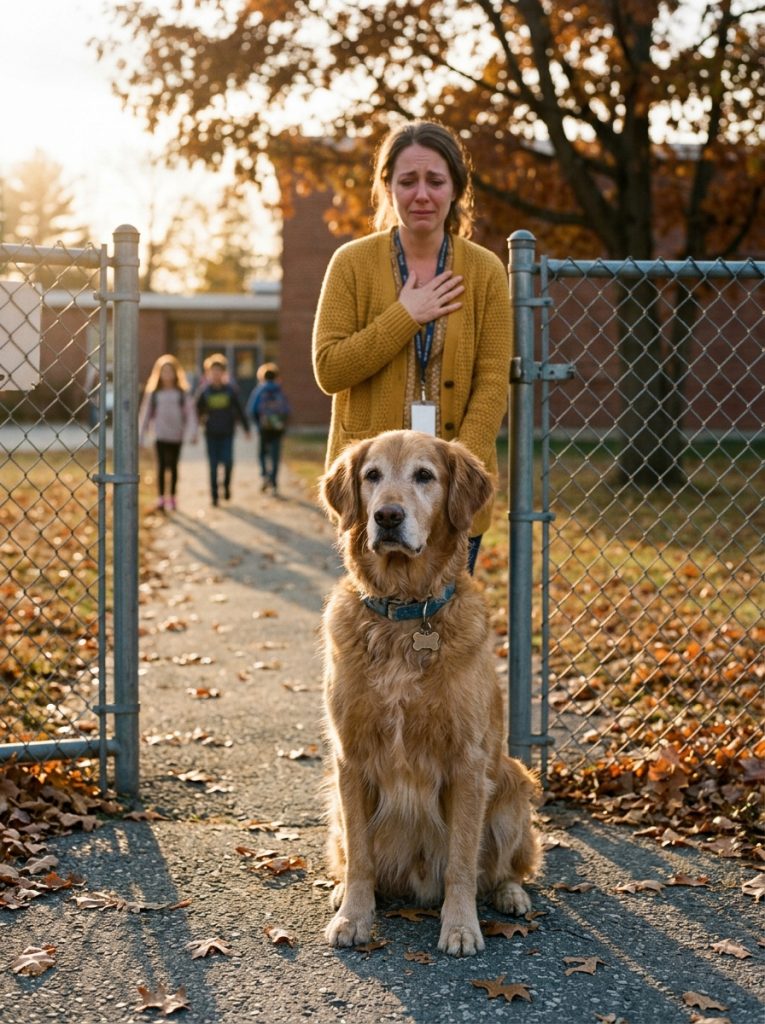
It was three o’clock. The kids were filing out. And Biscuit was in his spot at the fence, ears up, scanning, doing the thing he’d done every day since spring — looking for one specific face in a river of small faces, refusing to believe it wouldn’t appear.
Donna got out of her car at the curb.
She didn’t call his name. She couldn’t, I think. She just stood there.
And Biscuit went still.
His head came around slow. His nose worked the air. And then this old, grieving dog made a sound I have never heard a dog make — high and broken and disbelieving — and he came up off the pavement and ran to her like his body had forgotten it was old.
She went down on her knees on the sidewalk and he climbed into her arms the way a dog half his size would, and she folded over him and sobbed into his fur, and the children stopped where they stood, and even the ones too young to understand went quiet, because some things you understand before you have the words for them.
“He smells like him,” she said, when she could talk. “He still smells like my Caleb’s room.”
She told me the rest, sitting on the curb with the dog in her lap.
Caleb had been seven. He’d been sick a long time — long enough that Biscuit had appointed himself nurse, sleeping under the hospital-style bed they’d set up in the living room, walking the boy to this gate every morning he was well enough for school, waiting right here every afternoon to walk him home.
When Caleb died in the spring, Donna couldn’t stay in the house. Couldn’t pass the gate. Couldn’t watch the dog wait at a door their boy would never come through.
“I told myself I was protecting him,” she said, stroking his gray muzzle. “From the waiting. I thought if I took him somewhere new, he’d forget. He’d be happier.” She laughed, wet and hopeless. “He walked two miles back to do the waiting anyway. He never needed protecting from it. It’s all he had left of his boy. And I took it away and called it kindness.”
I didn’t know what to say to that, so I said the only thing that was true.
“He doesn’t have to wait alone anymore.”
We worked it out together, Donna and I, over the next few weeks.
She couldn’t take Biscuit back. Her new place wouldn’t allow him, and more than that — she told me, honestly — she wasn’t strong enough yet to live with a creature who grieved her son as openly as she did. Maybe someday. Not yet.
So I adopted him.
I live four blocks from the school. Biscuit comes to work with me now. He’s the reading dog for my third-grade class — the kids take turns reading to him on the rug, and he listens to every word like it matters, because to him it does. Posey, the little girl who first said we should go wait with him, reads to him most days. He puts his head in her lap.
The first week, he didn’t sleep much. He’d pace my little house at night, checking the doors, the way you do when you’ve lost something and can’t quite stop looking. I’d find him at odd hours by the front window, watching the dark street.
Then one night he climbed onto the foot of my bed, let out an enormous sigh, and slept eight hours straight. He’s slept fine ever since. I think some part of him finally understood he could stop standing guard. That the waiting was over. That he was allowed to just be an old dog who is loved.
Some nights I sit with him at that window myself, and I think about a boy I never met, and a dog who taught a whole school what loyalty actually looks like.
He’ll be eleven this year. The vet says his heart is strong. I intend to keep it that way for a long, long time.
And at three o’clock, when the bell rings?
Biscuit still goes to the gate.
But now he’s on the inside of the fence. And he isn’t waiting anymore.
Now the children walk out to meet him. Twenty-two kids who pour through those doors and find an old golden retriever waiting to greet them, tail going, like they’re the ones he’s been hoping for all day.
He gets met now. That’s the whole thing. After a year of waiting to be found, the old dog gets found, every single afternoon, by a crowd of children who run to him on purpose.
The bench was the children’s idea, really.
When I told my class that Biscuit was going to stay — that he was ours now, that he’d never have to wait alone again — Posey raised her hand and asked what about Caleb. “He still needs a spot,” she said. “For when Biscuit remembers him.”
So we asked the principal. The PTA chipped in. A dad who does woodwork built it. We set it right by the gate, in Biscuit’s old place on the outside of the fence, facing the doors, so that anyone sitting on it sees exactly what the dog used to see every afternoon.
The whole school came out the day we placed it. No speeches. The kids didn’t want speeches. They just wanted Biscuit to sit on it first, to make it his — and he did, and then he hopped down and trotted back to the inside of the fence where the children were, because that’s where he lives now.
Donna stood at the back with her hand over her mouth and watched a hundred and forty kids decide, without anyone telling them to, that her son’s dog belonged to all of them.
Donna comes on Thursdays. She sits on the new bench the school put by the gate — a small one, with a small plaque, that doesn’t say anything sad, just a boy’s name and the words a good dog always waits. She brings Biscuit a treat he’ll actually take from her now. They sit together a while. Then she goes, lighter than she came.
Caleb walked his dog to this gate every morning of his short life.
His dog never stopped coming back for him.
And now, every afternoon, a whole school full of children comes running out to meet the dog who refused to forget — so that love that had nowhere left to go finally has somewhere to land.