The sound of rubber wheels on the polished tile echoed through the suffocating silence of the terminal. The heavy, rhythmic thud of the approaching line vibrated through the soles of my combat boots. The fluorescent lights buzzed overhead, casting long, stark shadows across the gray security gates.
The man in the black suit stared. His mouth opened, but no sound came out. The color drained from his face, leaving him looking pale and sickly under the harsh glare.
Behind me, the advance team was rolling through the metal detectors.
The soldier in the front wheelchair wore a thick, rigid white neck brace. His uniform was pristine, but his eyes were hollow, staring straight ahead. Behind him, another soldier sat in a wheelchair, his right pant leg pinned up neatly above a prosthetic leg resting on the footplate. Behind them, two more soldiers walked with heavy, mechanical crutches, their faces scarred and sunken.
They weren’t just soldiers. They were my unit. The ones I had been trying to protect. The ones I was clearing the path for.
The businessman’s hands started to shake. He looked at the prosthetic leg. He looked at the neck brace. He looked back at me, his expensive Rolex suddenly looking like a cheap, gaudy toy on his trembling wrist.
“I… I didn’t know,” he stammered. His voice was thin, reedy, completely stripped of its previous booming authority. He took a half-step back, his polished leather shoes squeaking against the floor. “They can just use the priority lane. I have TSA PreCheck. I pay for that.”
The TSA supervisor didn’t blink. He didn’t look at the businessman. He kept his large, steady hand resting on my shoulder, a solid anchor in the chaotic room.
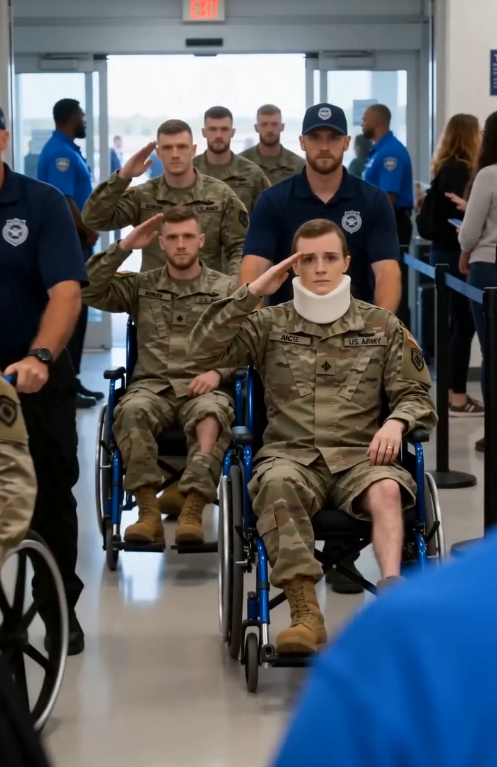
“There is no priority lane for this, sir,” the supervisor said. His voice was quiet, but it carried the weight of absolute, unyielding authority. “These men and women just gave their limbs, their spines, and their blood for your freedom. You can wait three minutes for a plastic bin.”
The businessman flushed a deep, ugly crimson. He looked around the terminal. The other travelers weren’t looking at their phones anymore. They were staring at him. A woman in a business suit shook her head in disgust. A teenager lowered his camera, his expression hard with judgment. The air in the terminal felt thick, electric, suffocating.
“I wasn’t trying to be rude,” the businessman whispered, his eyes darting toward the exit. “I just have a flight to catch.”
“Then you should have left earlier,” the supervisor said coldly. He finally looked at the man, his eyes hard as granite. “Step aside. Now.”
The businessman didn’t argue. He didn’t try to use his Platinum status. He just shrank into his sharp black suit, grabbing the handle of his rolling suitcase. He stepped out of the line, pressing himself flat against the glass wall, making himself as small as possible.
I turned back to the conveyor belt. My hands weren’t shaking anymore. I lifted the heavy plastic bin and placed it smoothly on the rubber rollers.
Behind me, the soldier in the neck brace raised his right hand. His fingers pressed flat against his brow. A crisp, perfect salute.
Then the soldier with the prosthetic leg saluted. Then the two with the crutches.
I didn’t salute back. I just nodded, my throat tight, and walked through the metal detector. The machine didn’t beep. The businessman watched us pass, his face burning with humiliation, as the rubber wheels of the wheelchairs rolled smoothly toward the gate.