Kevin’s face went white.
Not red — white. The kind of white that happens when blood leaves a face all at once because the brain needs it somewhere else. He was reading my phone screen. His eyes moved twice. Then he looked up at me.
“This is your account,” he said.
I said, “Yes.”
“Every payment. For — “
“Eighteen months.”
He looked at the screen again. Then he looked at his father. Harold was still holding the wine glass from his toast — the toast about the house, the house they built, the home they were proud of. Harold did not know yet. He was finishing a sentence to Kevin’s uncle about the kitchen renovation.
Kevin stood up.
That was the first real thing he’d done in two years.
He walked to the head of the table and he said, “Dad.”
Harold turned. Wine glass still raised, mid-sentence, the comfortable authority of a man in his own dining room at his own holiday table.
“Kevin,” Harold said. “We’re talking — “
“Dad. I need you to listen to me.”
The table went quiet. Not the gradual quiet of a conversation winding down — the sudden quiet of a room noticing that something is different.
Kevin said, “This house. The mortgage. You almost lost it eighteen months ago.”
Harold set the wine glass down. His reading glasses slid forward on his nose. “That’s — Kevin, this is not the time — “
“The balloon payment. The default notice. You didn’t tell me how bad it was.”
Irene — Kevin’s mother — put her hand on Harold’s arm. She said, “Kevin — “
“Lily paid it.”
The room was silent.
“Lily has been making the monthly mortgage payment on this house for eighteen months. From her own account. Without telling me. Without telling you.”
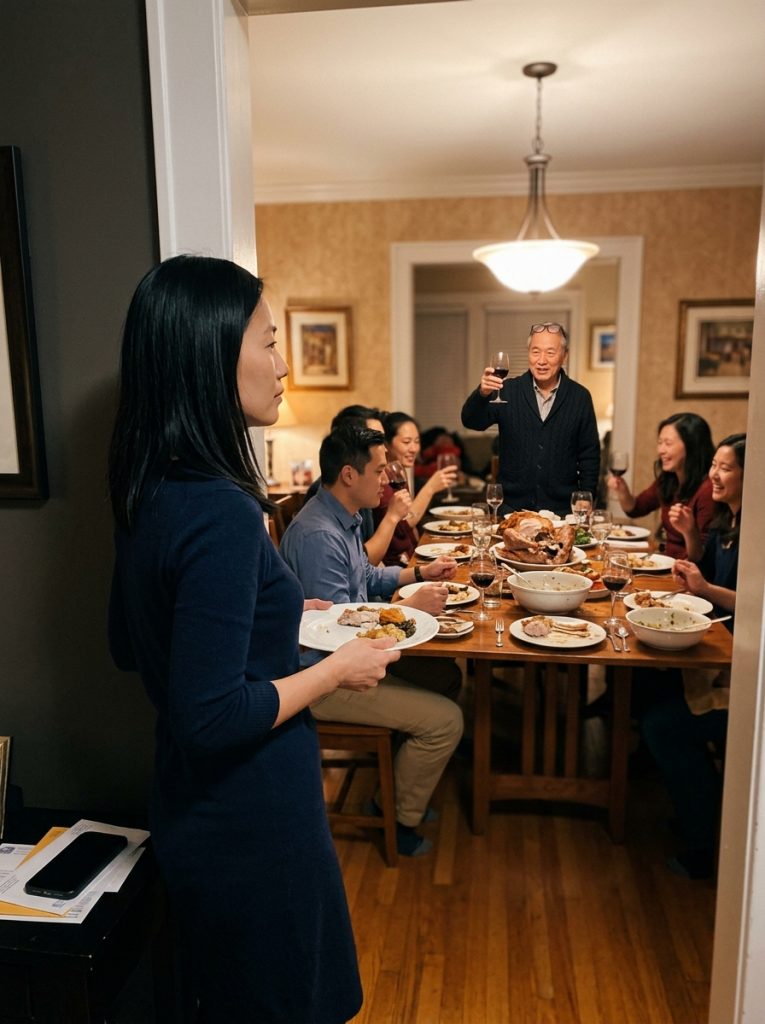
Harold looked at me. I was standing in the doorway. Plate in my hand. Phone face-down on the side table. Expression neutral.
He said, “That’s not — “
“It is,” Kevin said. He pulled the phone from his pocket — he’d taken a screenshot from my screen — and he showed it to his father. “Her name. Her routing number. Every month. Since May of last year.”
Irene’s hand came up to her mouth. She made a small sound — not words, just air.
Harold looked at the screenshot. Then he looked at me.
I waited.
He said, “Why.”
I said, “Because the house was going to be lost. And because no one else was going to handle it.”
He said, “I didn’t — I didn’t ask you to — “
“No,” I said. “You didn’t. You didn’t ask me anything. About anything. You seated me in the basement and you didn’t ask.”
That was the first time in two years I had said anything directly to Harold Park about the way his family treated me.
The table was completely still. Kevin’s uncle had his fork suspended. Kevin’s aunt was looking at her plate. The seven-year-old at the other end of the basement table — the one I’d been seated next to — had come up the stairs to see why the adults went quiet.
Harold put the screenshot down on the table.
He said, “Lily. I — “
“I don’t need an apology that starts with a stammer,” I said. “I need a direct statement. In front of this family. Acknowledging what I did and acknowledging that the way you have treated me in this house for two years was wrong.”
Harold looked at Irene. Irene was crying — not loudly, not dramatically, but in the way of someone who knows they have been part of something they should have stopped a long time ago.
Harold stood up from his chair. He stood up slowly, the way old men stand when their knees remind them of years, and he walked from the head of the table to the doorway where I was standing.
He stopped in front of me.
He said, “You saved this house. I did not deserve that from you. And I am sorry — not for a chair, not for a table arrangement — I am sorry for two years of making you feel like you did not belong in this family.”
He said it clearly. He said it in front of every person at that table.
I nodded.
“Thank you,” I said.
Irene came over then. She hugged me — clumsily, the way someone hugs when they have not done it enough and are not sure their arms are welcome. I let her. I did not hug back immediately but I did not pull away.
Kevin was watching from the head of the table. His face was still pale but there was something else in it now — something that looked like relief and shame in equal parts. He had spent two years not standing up. Tonight he finally did. But it had taken me showing him a bank statement to make it happen.
I put my plate down on the counter. I walked into the dining room. I pulled out the chair at the head of the table — Harold’s chair — and I sat down.
Nobody objected.
Kevin brought me a plate — a real plate, the ceramic ones with the gold trim that Irene only uses for holidays. He set it in front of me with a glass of wine and a napkin folded the way the adults’ napkins were folded.
I ate Thanksgiving dinner at the head of the table in the Park family home.
The food was cold by then. I didn’t care.
It wasn’t about the food. It was about the chair. And the fact that I earned it — not by paying a mortgage, but by being willing to say out loud what everyone else had been too comfortable to name.
We went home that night in silence. Kevin drove. I looked out the window at the passing lights.
At a red light he said, “I should have done that a long time ago.”
I said, “Yes.”
He said, “I’m sorry.”
I said, “I know.”
We went home. We didn’t talk about it again that night.
But the next morning — Sunday — Harold called. He called me. Not Kevin. Me.
He said, “I’d like you to come for Christmas dinner. At the table. I’d like to make it right.”
I said, “I’ll think about it.”
Advertisement
I went to Christmas dinner. I sat at the table. Harold had put a place card at the seat next to his — my name, handwritten, in careful letters.
It wasn’t perfect. It won’t be perfect for a long time.
But I will never sit at a folding table in a basement again.
Not in that house. Not in any house.
That part is finished.
I want to say one more thing. About the mortgage.
I stopped paying it in January. I transferred the remaining payments back to Harold — set up an automatic transfer from his account to the servicer, the way it should have been all along. He has the income now. His medical situation stabilized. The crisis is over.
But I kept the receipts. All eighteen months. Printed, organized, in a folder in my home office filing cabinet.
Not because I plan to hold them over anyone’s head.
Because I want my daughter — Kevin’s and my daughter, who is three years old and who was at that Thanksgiving dinner sitting at the kids’ table with me — to know someday what her mother did. Not the paying. The standing up.
Kevin and I are still married. We are working on things. Slowly. The way you work on things when the foundation cracked and you’re rebuilding it one conversation at a time.
He goes to therapy now. Tuesdays at seven. I don’t ask what they talk about but I notice the changes — the way he stood up at Easter dinner when his cousin made a comment about my cooking. The way he introduced me at his office party as “Lily, my wife, who saved my family’s house and I don’t deserve her.”
He said it like a joke. But he meant it.
Irene calls me once a week. She sends me recipes. She asks about the baby’s developmental milestones. She is trying in the particular, awkward way of a woman who spent two years doing the wrong thing and is now overcorrecting.
I accept it. Grace is not the same as forgetting. You can hold both.
Harold sent me a birthday card in March. Inside, in his careful handwriting, it said: “Thank you for being part of this family. I am sorry it took so long for me to say that. — Harold.”
A card is not redemption. But it’s a start.
And every Thanksgiving from now on, there will be a place card at the dining room table with my name on it.
Not because I paid for the table.
Because I finally said out loud that I deserved a seat at it.
That’s all it was. One sentence. One evening. One phone held up in a doorway.
And two years of silence finally broken.