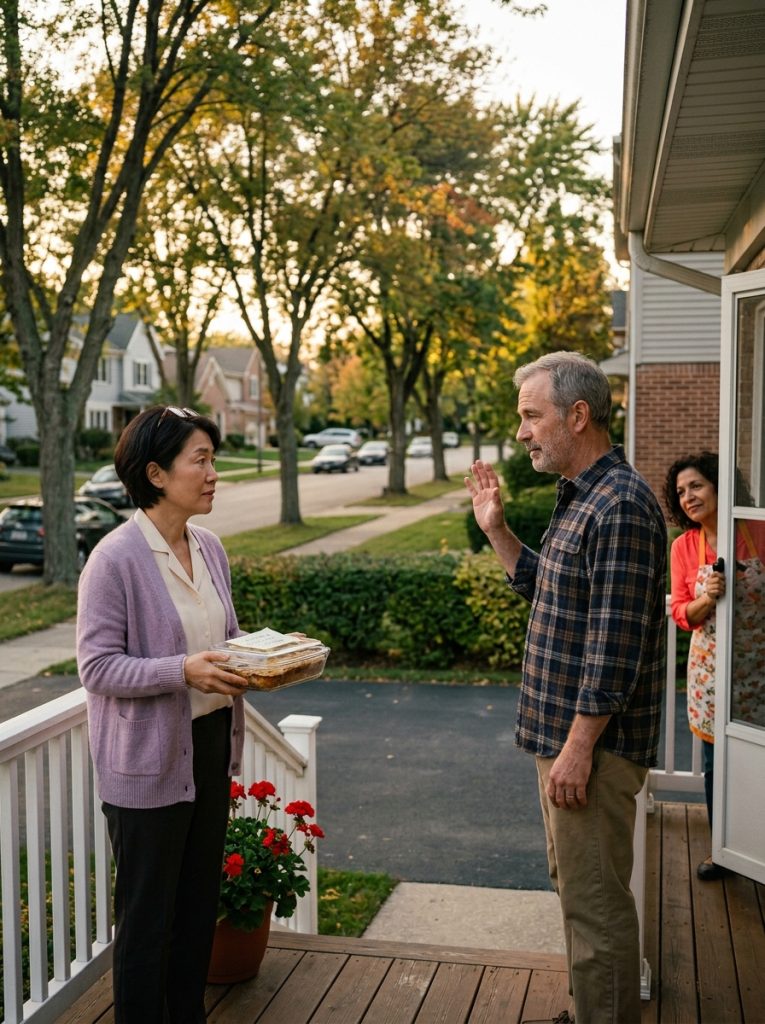
“The day of your husband’s funeral,” Sam said, “I came.”
I stood there on his porch with the warm dish still in my hands and felt the whole shape of the last nine years tilt.
“You didn’t,” I said. “Nobody could find you. I looked. The whole street brought something and you — you weren’t there.”
“I was there, Helen.” He rubbed the back of his neck, the way a man does when he’s about to hand over something he’s carried a long way. “I didn’t go to the service — I barely knew David, and I didn’t want to intrude on the family. But I made a pot roast and I wrote you a card, and I walked it across the street during the reception. Your house was full of people. You were surrounded. I didn’t want to make you talk to a neighbor you hardly knew on the worst day of your life.”
“I never got a card,” I said.
“I know that now,” he said quietly. “I set the dish on your kitchen counter and tucked the card under it. There was a woman organizing everything — sharp, dark-haired, ordering people around the kitchen.”
“My sister, Patricia,” I breathed.
“I figured it was someone like that. I didn’t want to interrupt, so I left.” He shook his head. “And then I waited. Not for thanks, exactly. Just — some sign you’d gotten it. The card said more than a card usually says. I’d lost my brother the year before. I thought I’d written something that might help.”
“What did it say?” I asked. “The card.”
He looked away, a little embarrassed. “That grief is a country with no map. That the first year, people bring casseroles and then they go back to their own lives, but the real quiet comes later — and that’s when a neighbor matters most. I told you which window was mine. I said if your light was on late and you couldn’t sleep, mine probably would be too, and you shouldn’t feel strange about knocking.”
I had to put a hand on his porch railing.
Nine years. I’d spent nine years believing this man hadn’t bothered to send a single word — and he’d written me the kindest thing anyone offered me that whole terrible year, and I had never once read it.
I closed my eyes.
I knew exactly what had happened to that card, because I knew my sister.
Patricia had flown in for the funeral and run my house like a campaign headquarters. In the days after, she’d cleaned with a fury, and she’d thrown out bags and bags of what she decided was clutter — sympathy notes she deemed duplicates, foil pans, flowers gone soft. I’d been too underwater to stop her. I never saw half of what came through that door.
She’d meant well. Patricia always means well the way a bulldozer means well. She kept the obituary and the death certificate and the bank paperwork in a neat labeled folder, and everything she judged sentimental or in the way, she bagged and set at the curb.
A casserole dish with a card tucked under it would have looked, to Patricia, exactly like trash to be cleared.
“She would have thrown it out,” I said. “Sam, she threw out half the kitchen. I never saw it. I swear to you, I never saw it.”
He was quiet for a moment, absorbing nine years of a story rewriting itself.
“All this time I thought you’d read it and decided I wasn’t worth a reply,” he said. “I’m a proud old fool, Helen. When you didn’t say anything, I told myself fine, she wants her space, I’ll give her space. And the longer it went, the harder it got to cross the street.”
“And then Margaret died,” I said, the rest of it falling into place, terrible and simple.
“And you didn’t come,” Sam said. There was no accusation left in it. Just the old ache. “And I thought, well. There it is. She’s paying me back for ignoring her. We’re even.”
“I didn’t come because I thought you’d snubbed me first,” I said. “I stood at my window the day of Margaret’s service in my good black dress and I talked myself out of going. I told myself a man who couldn’t bring a card when David died didn’t want me at his wife’s funeral.” My voice broke. “Sam. We’ve been grieving twenty feet apart for nine years over a card my sister put in a garbage bag.”
We stood there a moment, the two of us, in the last gold light of the evening, looking at the small ridiculous distance of one suburban street that had somehow taken us nine years to cross.
Then Sam started to laugh.
It wasn’t a happy laugh at first. It was the laugh you laugh when something is too sad to do anything else with. But it cracked the thing open, and then I was laughing too, and then we were both wiping our eyes on a porch in Naperville over a casserole that belonged to neither of us.
“Rosa,” Sam finally said, shaking his head. “She put you up to bringing this back, didn’t she.”
“She left it on my porch with a note,” I said. “Forged a whole friend out of thin air.”
“She’s been working me for months,” Sam admitted. “‘Such a nice woman across the street. So lonely. You two would get along.’ I thought she was being a pest.”
“She is being a pest,” I said. “She’s also, apparently, the only person on this block who could see what was right in front of us.”
We looked at each other.
“Helen,” Sam said, “would you like to stay for dinner? It’s a perfectly good pot roast. Nine years late, but I’m told it holds up.”
I should tell you I hesitated, for dignity’s sake.
I didn’t.
We ate at his kitchen table while the sky went purple, and we talked the way you talk when a dam finally breaks — David and Margaret, the good years and the long ones, the strange loneliness of outliving the person who knew all your stories. He still set two cups out from habit, then caught himself, and I told him I did the exact same thing, and we didn’t have to explain it to each other.
He showed me a photograph of Margaret — bright, laughing, a garden behind her. I showed him the one of David I keep in my wallet. We toasted them with his good water glasses, because neither of us drinks anymore, and it felt less like a date than like two veterans of the same long war finally comparing notes.
Across the street, I swear, Rosa Delgado’s porch light flicked on and off once, like a woman who’d been watching from behind a screen door and couldn’t help herself.
That was a year ago.
Sam and I take our coffee together every morning now — his porch one day, mine the next, so neither of us has to be the one always crossing. The casserole dish lives in my cupboard. We never did sort out whose it technically is. It’s ours now, I suppose. We use it for potlucks.
Rosa takes full credit, loudly, to anyone who will hold still long enough to hear it. We let her. She earned it. She saw two people drowning in plain sight and built a bridge out of a borrowed casserole dish and a forged little note, and I will be grateful to that meddling woman for the rest of my life.
We’re not young. We’re not foolish about it. Neither of us is trying to replace the person we lost; you don’t get to do that, and we wouldn’t want to.
But there’s a particular cruelty in being lonely within sight of someone equally lonely, and we wasted nine years on it because a card got thrown away and two stubborn people decided silence was safer than asking.
I think about all those mornings we waved and said nothing.
Then Sam knocks, or I do, and one of us puts the coffee on, and we don’t waste another one.
Patricia, by the way, feels terrible. She sent a card to apologize.
I made sure I got that one.