The large gold-painted letters on the facility’s entrance gate were supposed to represent care and dignity, until the arrogant manager pointed a finger at me in the dining hall and ordered me to pack my things because my account had run dry.
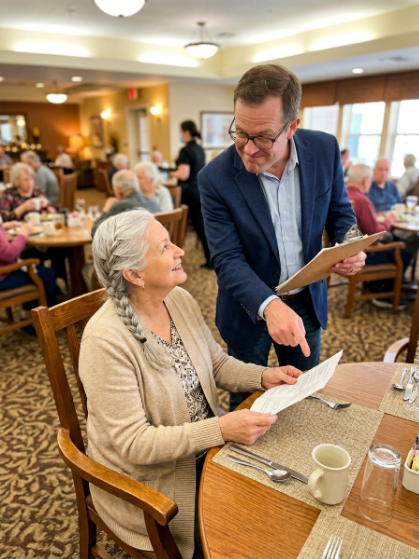
My name is Clara Jenkins. At sixty-two years old, with my silver hair kept in a neat braid and wearing a worn beige cardigan, I sat calmly in a wooden chair in the dining hall of the nursing home in Denver, Colorado. The room was warm, filled with soft lighting and round dining tables where other residents watched in awkward silence. But the atmosphere at my table was cold. Donald Miller, forty-five, the facility manager, stood over me wearing a tailored blazer and glasses, his posture arrogant as he clutched a clipboard and raised his voice.
“This is a premium retirement facility, Clara, not a welfare home,” Donald mocked, pointing a finger at my worn beige cardigan. “Your late husband’s estate has run dry, and you’ve missed the last three monthly payments. We have a waitlist of wealthy families ready to pay double. You need to sign these transfer forms immediately and prepare to move to the state-run shared ward downtown by tomorrow morning. We don’t keep non-paying residents.”
I looked at him, keeping my hands resting calmly on the polished wooden dining table. For five years, I had lived in this facility as an ordinary resident, enjoying the landscaped gardens, feeding the birds, and helping the other residents with their daily activities. Donald had been hired as the manager last year, and he had immediately begun cutting operational budgets, reducing the nursing staff, and threatening elderly residents with immediate eviction to increase the facility’s profit margins. He believed I was just a quiet, helpless widow who didn’t understand the complex legal terms of the contract. He had no idea that I had spent the last two weeks working in secret with my estate lawyers, auditing the facility’s parent corporation, and filing corporate documents to take back control.
“I won’t be signing the transfer forms, Donald,” I said quietly, my voice steady.
Donald let out a dry, patronizing laugh, shaking his head. “Clara, be realistic. You’re sixty-two, you live alone, and you don’t have the assets. If you refuse to sign, I will have the staff pack your belongings and security will escort you to the street. I have the authority to run this home, and I won’t let you drag down our numbers.”
Without saying another word, I reached into the pocket of my worn beige cardigan and pulled out a clean, folded document. I unfolded it and placed the certified blind trust registry document flat on the round dining table right in front of him.
“I suggest you look at the ownership registry on this document, Donald,” I said, my voice remaining perfectly calm.
Donald rolled his eyes, adjusting his glasses as he leaned in to scan the paper.
I watched his face. The smug, self-satisfied look on his lips slowly began to twitch, then froze completely. The color drained from his face, leaving him a pasty, ash-grey color. His hand began to shake, the clipboard trembling in his grasp as he read the name of the trust and the sole beneficiary.
The certified document proved that the entire nursing home facility—and the parent corporation that owned it—was held by a private blind trust. And the sole beneficiary and creator of that trust was Clara Jenkins.
“This… this is a mistake,” Donald whispered, his voice cracking as his fingers crumpled the edges of the page. “The corporate headquarters in Dallas… they own this branch. We answer to the board.”
“I bought the parent corporation last week, Donald,” I replied calmly. “I set up the blind trust to ensure the facility was managed without my personal bias, but I kept the power to audit and remove managers who violate our care standards. You wanted to evict me to increase your profit. Now, I suggest you look at the termination clause at the bottom of the page.”
Donald stood frozen next to the table, the registry document shaking in his hand, looking pale and panicked in the warm dining hall as he realized his attempt to evict the quiet widow had just cost him his entire career.
Just then, my personal attorney, Sarah Vance, walked into the dining hall carrying a black leather briefcase. She nodded to the other residents and walked straight to our table, placing a formal termination notice on top of Donald’s clipboard.
“As of five minutes ago, Mr. Miller, your employment contract has been terminated for cause,” Sarah said, her voice carrying clearly through the silent dining hall. “We have completed our audit of the facility’s records, and we have submitted our findings of financial elder abuse and illegal eviction practices to the state licensing board.”
Donald’s face went from pale to a deep, dark purple. “You can’t do this! I have a contract! The board has to approve my dismissal!”
“The board approved it yesterday morning, Donald,” I said, standing up slowly and smoothing down my cardigan. “Or rather, I approved it. I own eighty percent of the corporate shares. You believed that because I chose to live here in a simple room and participate in the activities like everyone else, I was powerless. But I created this home with my late husband to be a sanctuary of dignity, and I will not let you turn it into a corporate mill that treats the elderly like inventory.”
The other residents at the surrounding tables began to clap, the applause quickly spreading across the dining hall. The nursing staff and caregivers, who had lived under the fear of Donald’s budget cuts, smiled openly.
“Your company keys and access cards, Donald,” Sarah Vance said, extending her hand. “Security is waiting in the lobby to escort you off the property. Any personal items left in your office will be mailed to your home address.”
Donald stood frozen, his eyes darting from the registry document to the smiling faces of the residents he had threatened. He realized that his power was completely gone. With a trembling hand, he detached his office keys and placed them on the table, then walked out of the hall in absolute silence, his head bowed.
Once he was gone, the room erupted into cheers. I walked over to the microphone at the caller’s stand in the front of the room. It was bingo night, and the residents had been waiting for the game to start.
“Now that our administrative issues have been resolved,” I said into the microphone, smiling. “Let’s get back to our game. And starting tomorrow, the fresh fruit and organic vegetables are back on the menu, and we are rehiring the activities staff that were laid off last month.”
A year later, the facility is thriving, known as the most compassionate retirement home in Colorado. Donald Miller’s license was revoked, and he was forced to pay restitution to several families he had illegally evicted. I still live in my quiet room, enjoying the gardens and playing bingo every Friday, knowing that our home is safe and the people I care about are finally treated with the dignity they deserve.