I kept reading.
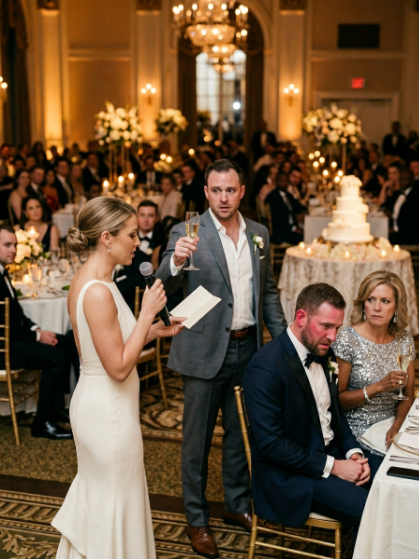
“March, last year,” I said into the microphone. “Joan’s country club dues, eight thousand, after the account she ‘manages herself’ came up short. Paid by me.”
Joan’s smile cracked at the corners.
“The down payment on Derek’s truck — the one he calls his ‘graduation gift to himself.’ Paid by me. The deposit on this ballroom. The catering. The band that played me down the aisle.” I set the ledger card flat on the head table. “Paid by me.”
The room wasn’t laughing now.
Derek finally found his feet. “Camille, sit down. You’re embarrassing yourself.” He tried for a charming grin. “She’s had a little too much champagne, folks—”
“I haven’t had a drop,” I said. “I wanted to remember tonight clearly.”
Here’s the story the Lawsons had been telling for two years. Poor girl, no family, marries into money, gets pulled up into a better life. Tyler said it in his toast. Joan implied it every holiday. Derek let them, because it was easier than the truth.
The truth was that I’d grown up with nothing, gone to school on grants and night shifts, and built a quiet career in commercial underwriting. I read balance sheets for a living. I’m very good at it.
So when I started dating Derek, and the “family money” turned out to be a tide of unpaid bills behind a glossy front, I did what I do. I steadied the books. I covered the emergencies. I told myself it was love. I told myself I was building something with people who would build with me.
I kept every receipt. Not to use them. Just because I can’t help it. It’s who I am.
And six months ago, I found the email.
Tyler to Derek, careless as ever. “Once the ring’s on, the underwriter’s salary is family money, right? Mom’s going to need the lake-house bailout by spring.”
The underwriter. That’s what they called me when they thought I wasn’t a person. An income stream with a wedding date.
I could have canceled the wedding. I almost did.
But I wanted them to understand, all of them at once, in the one room where the story they’d told got told back to them straight.
“Tyler,” I said, “you called me a woman who married up. The truth is, every nice thing in this family for two years has been quietly held up by the woman you just toasted as a gold digger.” I looked at Joan. “Your roof. Your dues. Your son’s truck. Me.”
I worked the ring off my finger. The big Lawson heirloom ring — which, I’d learned in February, Joan had borrowed against twice.
“I won’t be the bailout,” I said. “Not the lake house. Not the next one. Not any of it.”
I set the ring on the cake table, next to the four tiers I’d paid for.
“Eat the cake,” I said. “It’s covered.”
Derek grabbed my arm at the door. The charm was gone now. “You can’t just walk out. We’re married. Half of what’s yours is—”
“Read the prenup your mother insisted on,” I said. “The one she made me sign to ‘protect the family assets.’ My lawyer added two lines. Separate property stays separate. And every dollar I’ve put in is documented as a loan, not a gift.” I gently removed his hand. “You don’t owe me love, Derek. But you all owe me about ninety-one thousand dollars. With interest.”
The annulment was clean — they couldn’t afford to fight it. The loans were real and dated and signed for. Joan sold the lake house that summer to settle what the family owed me. The country club let her membership lapse. Tyler’s careless email made the rounds of exactly the people whose opinion he cared about most.
Derek texted me in the fall. “I miss you. I think I actually loved you, under all of it.”
Maybe he did. Under all of it. That was always the problem — there was so much “all of it” piled on top.
I sent the wedding photographer’s invoice back to the Lawsons the same week, marked unpaid, with a sticky note: “Family money. You’ve got this.”
I kept the cake topper. Don’t ask me why. A little porcelain bride, standing alone now.
She’s on my bookshelf at home, next to the binder of receipts I’ll probably never need again.
She’s facing the door. I made sure of that.