The hearing was on a Wednesday, in a small family courtroom that smelled like floor wax and old coffee.
Crystal arrived looking like a magazine. Cream coat, blowout, a leather folder she never opened. Greg sat beside her in a blazer, checking his watch like he had somewhere better to be. They’d brought their narrative, and their narrative had always worked.
On paper, they were the stable home. The beautiful house. The two-parent household. The mother who posted matching-pajama photos and homemade lunches and captions about gratitude.
On paper, I was the cautionary tale. The mom who lost primary custody six years ago and had spent every day since trying to earn her way back.
For a year, every hearing had been the same. Their photographs against my word. And photographs win.
Not this time.
My attorney, a no-nonsense woman named Gloria Vance, stood up and asked the court’s permission to enter a new exhibit. A digital record. Exported from the family’s own household management app — the one installed on every phone in Crystal’s house, including my daughter’s.
Crystal’s chin lifted. She actually looked pleased for a second. She thought it was going to help her. She’d built that app to prove how organized her home was.
Gloria put the first page on the screen.
“This is a complete task log,” she said. “Time-stamped, automatically, by the app. It covers the last seven months. I’d like to walk the court through who, exactly, this household assigns its labor to.”
She scrolled.
Monday: Hannah, fourteen tasks. The other two children, zero.
Tuesday: Hannah, eleven tasks, including one logged complete at 11:18 p.m. The other two children, zero.
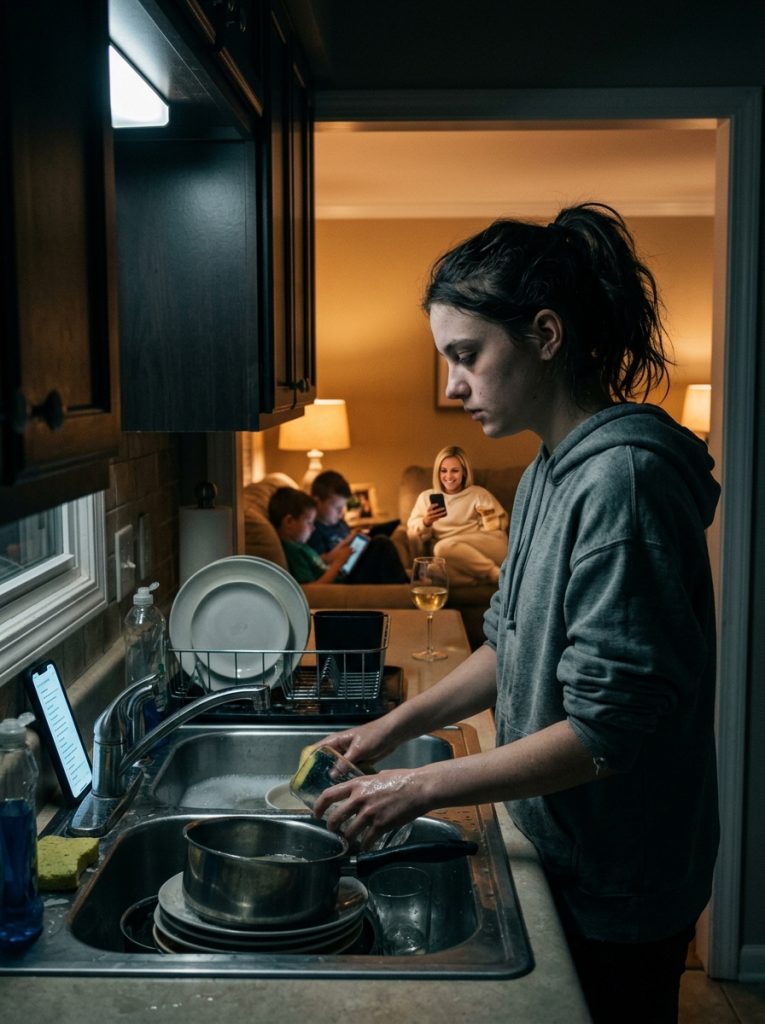
Wednesday. Thursday. Friday. Page after page after page. The same name in every row. Dishes. Laundry — the whole family’s laundry. Cooking. Packing the younger kids’ lunches. Walking the dog. Taking out the trash. A task labeled “watch siblings” that appeared almost every weekday evening, assigned to a fifteen-year-old.
The two younger children’s columns were blank. Not light. Blank. Empty as fresh snow, exactly the way I’d seen it that first night at my kitchen counter.
The courtroom was very quiet.
“Your Honor,” Gloria said, “the petitioner’s home has been presented to this court for a year as a model of structure and care. I would simply note that the structure documented here is the structure of one child running a household for the benefit of the others. These aren’t my words. They’re the time-stamps. The app belongs to Mrs. Doyle. She built the record herself.”
Crystal’s lawyer asked for a recess. The judge declined.
The judge — a woman in her sixties who had clearly seen every kind of family there is — put on her glasses and read the log herself. All of it. It took a long time. Nobody filled the silence. I have never heard a room hold that still.
Then she looked up, and she looked at Greg.
“Mr. Doyle,” she said. “These are your children. Two of them have no assigned responsibilities at all. One of them is doing chores at eleven o’clock on school nights. Were you aware?”
Greg opened his mouth. “I travel a lot for work, Your Honor. I trusted my wife to —”
“That’s not what I asked. Were you aware?”
And Greg, who had spent a year letting Crystal’s photographs speak for him, did the one thing that finished it.
He hesitated.
That hesitation said everything. He’d known. Maybe not the 11 p.m. trash runs, maybe not the exact arithmetic of it. But he’d known his daughter was tired. He’d known she’d quit choir. He’d known which kids in that house had chores and which ones never lifted a finger. He’d known, and he’d chosen the quiet of not asking, because asking would have started a fight in his beautiful house.
Then they called Hannah.
I didn’t want them to. I’d have given anything to keep her out of that room. But she’d asked to speak, and the judge allowed it, and my fifteen-year-old daughter sat in that chair with her hands folded and her voice shaking and told the truth she’d been hiding for months so I wouldn’t worry.
“I didn’t tell my mom because I didn’t want her to lose,” she said. “Every time we go to court, Crystal has all these pictures and Mom just has what she says. I didn’t think anybody would believe me over the pictures.” She looked at me, and her chin trembled. “I’m really tired. I just want to be able to do choir again. And sleep.”
I have never in my life had to work so hard not to cross a room.
When she stepped down, she walked past Crystal’s table to get back to me. Crystal didn’t look at her. Not once. She was fifteen, and she’d just done the single hardest thing in that room — told the truth when she was sure it would cost her — and her stepmother filed her papers and stared at the wall.
Hannah didn’t need her to look. She walked straight to me and put her head on my shoulder, right there in the courtroom, and I felt her let go of something she’d been carrying for a very long time.
Greg watched us. I almost felt sorry for him. He’d traded his daughter’s childhood for a quiet house, and now he had neither.
The judge’s ruling came two weeks later, in writing.
Primary residential custody transferred to me.
The judge wrote — and I have read it so many times I could recite it — that the household’s own records “depict a pattern in which one child’s labor subsidized the leisure of the others, with the knowledge and acquiescence of both adults in the home.” She ordered family counseling. She ordered the chore app deleted. She granted Greg supervised-transition visitation, to be revisited, the burden now on him to show change.
Crystal didn’t say a word to me on the way out. Her folder was still closed. She’d never needed to open it before.
I drove Hannah home that day — to my home, her home now, the small one I’d been so ashamed wasn’t grand enough to win her back.
She slept fourteen hours that first night. I checked on her three times like she was a newborn.
She’s back in choir. She made all-state this spring. I sat in the audience and cried like an idiot through a song I didn’t know the words to.
She had a solo. Eight bars, all by herself, her voice clear and rested and strong. I thought about all the eleven-o’clock dishes that nearly drowned that voice, and I had to stare at the ceiling to keep myself together.
She still flinches sometimes when a phone buzzes. Old reflex. The counselor says it’ll fade. It’s fading.
People hear this story and they want to talk about Crystal. About how someone could do that to a child. I don’t spend much time there anymore.
I think about the app instead.
Crystal built it to make her home look perfect. Color-coded. Organized. Caption-ready. She fed it every chore for seven months, certain it was proof of what a good mother she was.
She just never imagined anyone would read the column the long way down.
The same name. Every single row.
That’s the thing about the truth. You can dress it up. You can photograph it. You can post it with a grateful little caption.
But if you write it down honestly enough, for long enough, it eventually tells on you.
Hannah’s chore list these days has exactly one thing on it most days.
“Rest.”
I put it there myself.