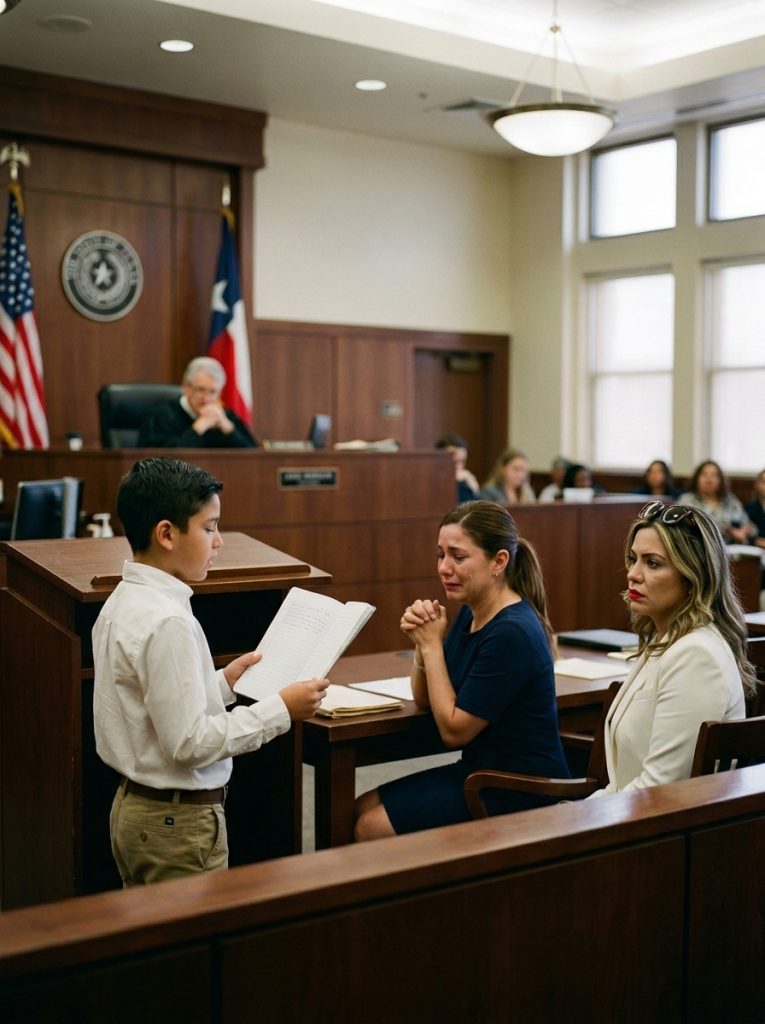
The judge looked at me over her glasses.
Not down at me. At me. Like I was a real person in that room and not just a case number on her Tuesday docket.
I closed the notebook. My hands were shaking but I didn’t care anymore. Every word I’d written over two years was in those pages. Every date. Every missed visit. Every birthday card that never came. Every promise Camila made and broke like it was nothing.
The courtroom was so quiet I could hear Rosa breathing behind me. I could hear the court reporter’s fingers hovering over the keys.
Judge Hernandez turned to Camila’s lawyer. “Counselor, your client’s objection is based on biological parental rights. I’ve reviewed the filing thoroughly.”
Camila’s lawyer stood up. Young guy. Nervous. “Your Honor, my client maintains that the biological bond between mother and child — “
“I’ve read the motion.” The judge’s voice was flat. Final. Like a door closing. “I’ve also read two years of documentation. Supervised visitation reports. School attendance records. Therapy notes. And I’ve just heard from the child himself.”
She looked at me again. “Lucas, you may sit down.”
I walked back to my seat next to Rosa. She grabbed my hand under the table. Her palm was sweating. Mine was too. I could feel her pulse through her fingertips, fast and scared.
“In the matter of petition for adoption,” Judge Hernandez said, “I find that the petitioner, Rosa Delgado, has demonstrated consistent, stable, and loving care for the minor child for a period exceeding four years.”
She paused. Looked directly at Camila.
“I further find that the biological mother’s involvement has been sporadic, unreliable, and at times harmful to the child’s emotional development.”
Camila made a sound. Small. Like air leaving a tire slowly. Her lawyer put a hand on her arm.
“The objection is denied. The petition for adoption is granted.”
Rosa’s hand squeezed mine so hard my knuckles ground together.
I didn’t care.
“Congratulations, Ms. Delgado.” Judge Hernandez smiled. Actually smiled. “He’s yours. Officially and permanently.”
Rosa stood up. Then sat back down. Then stood again. Her lawyer touched her elbow, steadying her, and she nodded, wiping her face with the back of her hand. Her mascara was already gone.
I looked at Camila across the aisle. She was staring at the table. Her lawyer was whispering something. She didn’t look up.
I thought I’d feel guilty. I’d practiced for that feeling. Braced for it.
It didn’t come.
I felt free. Like the last chain linking me to uncertainty had just been cut with a judge’s words.
We walked out of the courtroom and into the hallway. The fluorescent lights buzzed overhead. Rosa’s heels clicked on the tile floor. She was trying not to cry and failing completely, tears running down both cheeks while she smiled so wide it looked like it hurt.
I stopped walking.
She turned around. “Lucas? You okay, mijo?”
I looked at her. This woman who showed up. Every single day for four years. Who packed my lunch with little notes inside — corny jokes and reminders that I was loved. Who sat through every parent-teacher conference. Who held me when I had nightmares about the apartment on Eighth Street and never once asked me to explain.
“Mom,” I said.
Her whole face changed. Like someone flipped a switch. Like sunrise happening all at once.
“Mom,” I said again, because it felt good in my mouth. Because it was true. Because I’d been waiting to say it for four years and now there was no legal reason not to. No case pending. No objection on file. Nothing standing between the word and the truth of it.
She pulled me into her arms right there in the courthouse hallway. I could feel her crying into my hair. I was twelve and almost as tall as her now, my chin on her shoulder, but I didn’t care how it looked. I held on.
“Let’s go get tacos,” she said into my shoulder, her voice thick. “The good ones. From Rosario’s.”
“With extra guac?”
“With extra everything. We’re celebrating.”
We drove to Rosario’s with the windows down. March in San Antonio. Warm enough that the air felt soft. Rosa sang along to the radio, off-key and unashamed, wiping her eyes at every red light. I pretended to be embarrassed. I wasn’t.
At the restaurant, we ordered too much food. Carnitas. Al pastor. A plate of street corn. A horchata for me, a Jarritos mandarina for her. We ate like we’d been starving. Like the knot in both our stomachs had finally untied and left room for something good.
Halfway through my third taco, I set it down.
“I have something to show you,” I said.
I reached into my backpack and pulled out the letter. Folded and refolded so many times the creases were soft as worn fabric. The ink had faded in places where my fingers had held it too many times.
Rosa set down her Jarritos. “What is that?”
“Camila sent it when I was ten. Right after I moved in with you.”
She unfolded it carefully. Read it slowly. Her face went tight, then tighter.
The letter was short. Three paragraphs. Camila said she was sorry for everything. Said she’d come back for me when she got stable. Said she loved me more than anything in the world.
Then nothing. For two years after that letter. Nothing. No calls. No visits. No cards. Just silence shaped like a broken promise.
“This is when I started writing in the notebook,” I said.
Rosa looked up from the letter. Her eyes were wet again. “You were ten years old.”
“I knew she wasn’t coming back. Not really. But I needed proof. Not for me — I already knew. For the judge. For someday. For the day we’d be sitting in that courtroom and someone would ask whether she tried.”
“Lucas.” Her voice broke on my name. “You were ten years old and you were building a legal case.”
“I know.”
“You shouldn’t have had to do that. No kid should have to document their own abandonment.”
“But I did. And it worked.”
She folded the letter back up along its worn creases. Slid it across the table to me. “You are the bravest person I know.”
“I had a reason to be brave. I had somewhere I wanted to stay.”
She pressed her lips together. Nodded slowly. Picked up her Jarritos and held it up. “To staying.”
I tapped my horchata against it. “To staying.”
We finished our tacos in comfortable silence after that. The kind of silence that only exists between people who don’t need words to fill the space. The restaurant hummed around us — families, kids, the clatter of plates — and we were part of it. Just another family having dinner.
Everything to me.
That night, Rosa framed the adoption certificate. I watched her hang it on the fridge with the fancy magnetic clips she saved for important things. Right next to my honor roll notice, a photo of us at Big Bend, and a crayon drawing I’d made when I was nine of the two of us holding hands.
“It’s official,” she said, stepping back. Hands on her hips.
“It was always official,” I said from the kitchen doorway. “The paper just caught up.”
She laughed. Pulled me into a side hug. “When did you get so wise?”
Advertisement
“I had a good teacher.”
She kissed the top of my head. “Go brush your teeth. School tomorrow.”
I walked down the hallway to my room. My room. In my house. With my mom.
At the door, I looked back toward the kitchen. The adoption certificate glowed under the warm light. My name and her name side by side. A judge’s signature making permanent what had been true for years.
The word “mother” used to feel like a question mark. Uncertain. Conditional. Something that could be taken away by a phone call or a filing or a woman who only remembered I existed when it was convenient.
Now it feels like a period.
Final. Settled. Done.
I brushed my teeth. Climbed into bed. Pulled the covers up.
Fell asleep faster than I had in months.
Because for the first time in my life, there was nothing left to prove.