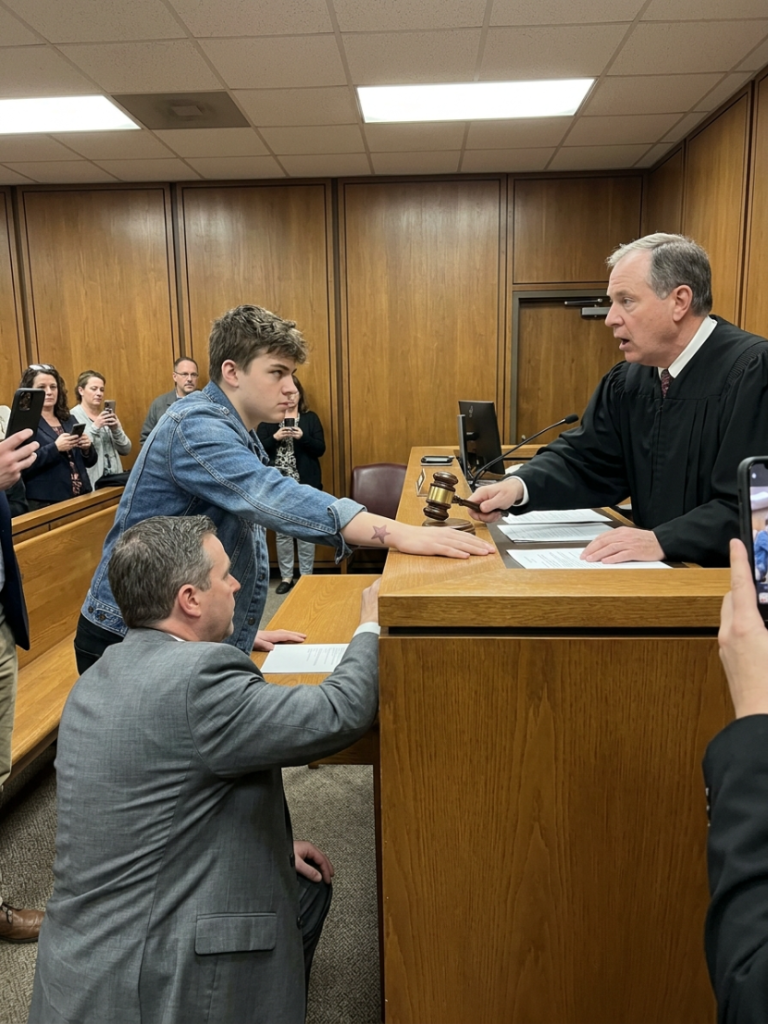
Judge Harlan whispered, “Don’t move,” and the Hamilton County probate gallery went completely still.
Jordan Ellis kept her left palm flat on the bench where the gavel should have risen — flat, deliberate, impossible to ignore under Cincinnati fluorescent light. Seventeen, denim jacket, defiant eyes, she did not look at the lawyer shouting for security. She looked at the star-shaped birthmark on her inner wrist where her sleeve had ridden up, then at the oil portrait above the judge’s chair: a girl about her age, same sharp cheekbones, same star at the wrist the painter had rendered as a pale constellation against skin.
The resemblance had hung in family stories for a decade as rumor. Today it hung in public as evidence waiting for language.
“Young lady, remove your hand from the court’s bench,” said Gregory Hale, estate attorney, gray suit, half-risen from the front row with one hand already signaling the bailiff. “This proceeding is closed to unlisted parties.”
“This proceeding is about to steal my inheritance,” Jordan said.
Judge Harlan, sixty-two, black robes, had not moved his gavel. He studied Jordan’s wrist without touching it. “Counsel, sit down. You too, bailiff.” His voice was quiet enough that the gallery leaned forward to hear. “Miss Ellis — if that is your name — explain why I should not hold you in contempt before I explain why I might believe you.”
Jordan’s jaw tightened. “Because your signature on that order finishes a lie my uncle paid to file.”
She reached with her free hand into her jacket pocket and placed a torn photograph on the bench — half a face, half a birthday cake, a child’s wrist with a star mark visible at the frame’s torn edge. The other half had been lost in a foster intake office twelve years ago when Jordan was five and paperwork mattered more than photographs.
The gallery murmured. Phones lowered but did not disappear. Thursday at ten in probate court was usually boredom and paperwork. Today it was bloodline.
Two hours earlier, Jordan had listened through the doors while Hale summarized final distribution: Ellis trust to Richard Ellis, sole heir after Eleanor Ellis, granddaughter, presumed dead in a 2014 boating accident.
Jordan had heard presumed death her whole life — from caseworkers, then from the aunt who raised her until last winter. She spent six months finding this hearing. Courage arrived when she saw Hale slide the order toward Harlan’s pen.
Hence the palm on the bench.
Richard Ellis sat at counsel table in a charcoal suit that cost more than Jordan’s jacket and bus fare combined. He did not turn when she spoke. He had not turned when she entered. That stillness was its own tell.
Hale recovered first. “Your Honor, this is theater. The decedent’s granddaughter was declared deceased after a thorough—”
“Show me the declaration,” Harlan said.
Hale produced a file. “Signed by county coroner adjunct, 2014.”
“Signed by whom specifically?”
Hale hesitated half a second too long. “Dr. Laskin.”
Harlan looked at Jordan. “Why do you say forged?”
Jordan’s voice steadied. “Because Dr. Laskin was on vacation in Maine that week. Because I was in Toledo foster care under a misspelled last name. Because Richard visited me once, told me everyone I loved was dead, and left before the social worker returned.”
Richard finally turned. His face was gentle in the way dangerous men practice gentleness. “Jordan. You were grief-sick. We all were.”
“I was five,” she said.
Harlan tapped the half-photo. “Where is the other half?”
“Destroyed when they processed my intake,” Jordan said. “This piece was in my shoe because I did not trust pockets.”
The gallery made a sound that was not quite laughter and not quite grief.
Hale tried again. “Even if identity were in question, statutory deadlines—”
“Statutory fraud has no deadline in this courtroom,” Harlan replied. He picked up the order but did not sign it. Instead he compared the portrait above his bench to Jordan’s wrist with open attention, the way judges look when they realize a case is no longer procedural.
“Richard Ellis,” Harlan said, “stand.”
Richard stood slowly. “Your Honor, I have managed that trust in good faith for eleven years.”
“You have managed it in your name while your niece ate free lunch in Toledo,” Harlan said. “Miss Ellis, step to the witness area. Bailiff, do not touch her unless I say.”
Jordan removed her hand from the bench at last. The gavel remained untouched, as if the court itself was holding its breath.
She told the story in pieces — foster homes, aunt’s death, wallet photo, portrait seen through glass, records searched in library databases until she found the hearing date. She did not cry. Crying was what Richard counted on.
Hale objected to emotion. Harlan overruled.
“Call Dr. Laskin’s office,” Harlan told the clerk. “Verify vacation dates for July 2014.”
The clerk made a call on speaker. A receptionist confirmed what Jordan’s internet search had already shown: Laskin had been out of state. The adjunct signature on the death certificate had been routed through an office Richard’s foundation donated equipment to that same year.
Richard’s color changed.
Jordan rolled her sleeve higher. The star birthmark caught fluorescent light — five points, pale brown, exact to the portrait’s wrist and the torn photo’s edge.
Hale closed his folder. “Your Honor, my client reserves—”
“Your client will sit down,” Harlan said, “while I void the distribution order pending criminal referral for falsified death records and misappropriation of trust assets.”
The gallery exhaled in a wave. Someone in the back started to clap and stopped, unsure if applause was allowed. Jordan did not smile. Victory at seventeen still felt like another form of orphan paperwork.
Richard turned to her at last with real anger stripped bare. “You have no idea how hard it was to keep that company alive.”
“You had no right to keep me dead to do it,” Jordan said.
Harlan struck the unsigned order from the bench. “Trust frozen. Independent auditor appointed. Miss Ellis listed as presumptive heir pending DNA confirmation.” He looked at Jordan. “Do you have anywhere to go tonight?”
Jordan had not expected that question. “Bus station, probably.”
Harlan glanced at the court social liaison in the gallery — a woman who had already stood when Jordan said foster care. “Not tonight.”
Outside the courtroom an hour later, Jordan sat on a bench with a paper cup of vending coffee and the half-photo in her lap. The star on the torn edge matched the star on her wrist. Matching was no longer rumor. It was file number 2026-PRO-1184.
Richard Ellis left through the attorney tunnel with Hale silent beside him. Cameras caught his profile and not his eyes.
DNA confirmation came back in nine days. Jordan chose her aunt’s apartment before the mansion, filed her own college application, and watched Richard surrender keys under supervision.
On a Thursday six weeks later, Jordan returned for the signing that had almost happened without her. Harlan raised the gavel, then set it down gently after the order entered.
In the hallway she passed Richard without speaking. He stopped as if words might still save him. Jordan kept walking, wrist bare, star visible, half-photo tucked in a wallet that finally held the right name.
Behind her, the gavel block sat worn smooth where her palm had been — proof that some inheritances are not granted by signatures alone, but by the teenager brave enough to put her hand where the court tried not to look.