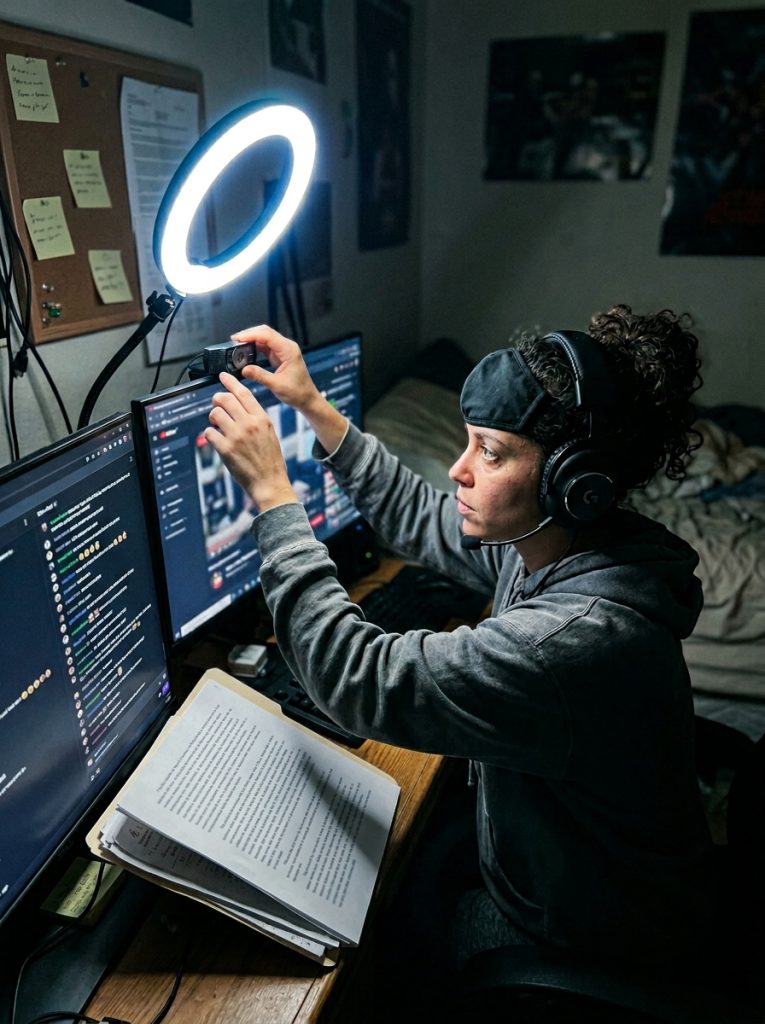
I took off the mask.
Forty thousand people saw my face at the same instant, and for a second the chat actually slowed — that rare thing online, a pause, like the whole room had inhaled.
Then I said my name. My real one. Renee Tully. And I said where I’d worked, and what I’d worked on, and I held up the folder so the camera could catch the cover before I started reading.
“My name is Renee Tully,” I said. “I’m a mechanical engineer. For six years I worked on the device a lot of you have been asking me about. Fourteen months ago I was let go after I filed an internal safety report about a defect in that device. Tonight I’m going to show you the report. And then I’m going to explain why you’ve never heard about it.”
I want to tell you what it felt like in the seconds after, because the internet only shows you the highlight, not the cost.
It felt like stepping off a ledge.
The instant my face was out there, the anonymous protection I’d hidden behind for a year was gone. The company would know by morning — would probably know within the hour, because their PR people monitor these things. The NDAs I’d signed were going to come up. The threats, which had been theoretical when I was a mask, were about to have a face and a name and, if they dug hard enough, an address.
But here’s the thing I’d realized the night before, doing the math at my desk: my anonymity wasn’t protecting anyone but me. Every day I stayed hidden, the device stayed out there, and the data stayed buried, and the warm commercials kept running over footage of children.
So I read the report. On stream. Line by line.
I showed the failure analysis — the defect rate climbing past the threshold that should have triggered a recall review. I showed the internal email chain where I escalated it. I showed the polite reply thanking me for my diligence and promising a review. And then I showed the org chart from three weeks later, where my position had simply ceased to exist.
I was careful. I’d had a lawyer — a whistleblower-protection attorney I’d found two months earlier and couldn’t really afford — walk me through what I could legally disclose. The defect data was protected disclosure under safety-reporting statutes. The documents were mine to show. The NDA I’d signed could not lawfully gag a protected safety disclosure to regulators or the public, and I said that, on stream, looking into the camera, because I wanted the company’s lawyers to know that I knew.
The stream did numbers I won’t pretend I expected. By the time I logged off, it had been clipped, reposted, and sent to three different reporters by viewers who’d been waiting for exactly this. By the next morning, a consumer-safety journalist I’d never met had the full report and was calling the regulatory agency for comment.
The company responded the way companies do. First silence. Then a statement calling my claims “the allegations of a former employee with a grievance.” Then, when the regulator confirmed it had opened an inquiry, a quieter statement about “cooperating fully” and “the safety of patients being our highest priority.”
The inquiry is ongoing as I write this. I can’t tell you it’s ended in a clean victory, because that’s not how these things go. They go slow. They go in filings and findings and corrective action plans. But the device is under formal review now. The buried data isn’t buried anymore. And whatever happens, the people who depend on that device are no longer depending on it in the dark.
There was one moment during the inquiry I’ll never forget. The regulator’s investigators asked to interview me, and I spent a full day in a conference room walking three serious people through the failure analysis I’d written two years earlier. At the end, the lead investigator — a woman about my mother’s age, careful, unflappable — closed her folder and said something off the record that I’ve held onto ever since.
“You did everything right,” she said. “You found it, you reported it, you followed the process. The process failed you. That’s not your failure. That’s ours to fix.”
I had waited two years to hear a person with authority say that sentence. You did everything right. I’d started to believe the company’s version — that I was difficult, that I’d overreacted, that a reasonable person would have let it go. Hearing an investigator say the opposite, plainly, did something to the knot I’d been carrying in my chest since the day they eliminated my position.
I need to be honest about the cost, though, because I think people who are standing where I stood deserve the truth.
I am, professionally, radioactive now. I’ve applied for engineering positions and watched the conversations go cold the moment my name gets searched. The industry is small and companies are nervous about hiring the woman who went public. I knew that might happen. It happened.
The threats got specific for a while. I changed my number. I have a security setup now that I didn’t used to need. Some nights are hard.
But here’s what came the other way, and it’s the reason I’d do it again.
Messages. Thousands of them. From people who use the device, from people whose family members use it, from other engineers at other companies who’d been told to bury their own reports and felt a little less alone watching someone refuse to. A nurse wrote to tell me she’d flagged a pattern of failures with that exact device for two years and been ignored, and that my stream got her supervisor to finally listen.
And one message I keep pinned. From a woman whose father depends on the device. She wrote: “I didn’t know I was supposed to be worried. Now I know what to ask his doctor. Thank you for taking off the mask.”
That’s the math. One radioactive career against a nurse who got heard and a daughter who knows what to ask.
I’d take that trade every time.
People ask if I regret following the channels first — if I wish I’d just gone public on day one instead of spending two years filing reports and getting erased. I don’t. I followed the channels because that’s the right way, and when the right way is designed to make you disappear, the disappearing is part of the evidence. The fact that I did everything correctly and still got buried is the whole story. It’s the part regulators need to hear, because it means the system isn’t catching these things on its own.
They ask me, too, whether I’d advise someone else to do what I did. That one’s harder. Because I can’t honestly tell a stranger that going public will be worth it for them — I don’t know their device, their company, their mortgage, their kids. What I can tell them is what I wish someone had told me on the day I walked out with my box: document everything, talk to a whistleblower attorney before you post a single word, understand that the protection you have is real but it is not the same as safety, and decide in advance what you’re willing to lose. Then, if you still want to, take the mask off with your eyes open.
Because the version of courage that goes viral — the dramatic reveal, the gasping chat — that’s not the courage. The courage is the two years before, in the dark, filing reports nobody reads. The reveal is just the moment the dark finally turns into something other people can see.
I stood alone for fourteen months. Masked, anonymous, doing it the careful way.
Then I decided that being right in the dark was worth less than being right in the light.
So I turned on the light. And it turned out I wasn’t as alone as the company wanted me to feel.
I never was. None of us are. We just have to take the mask off and find out.