The caseworker’s name was Denise.
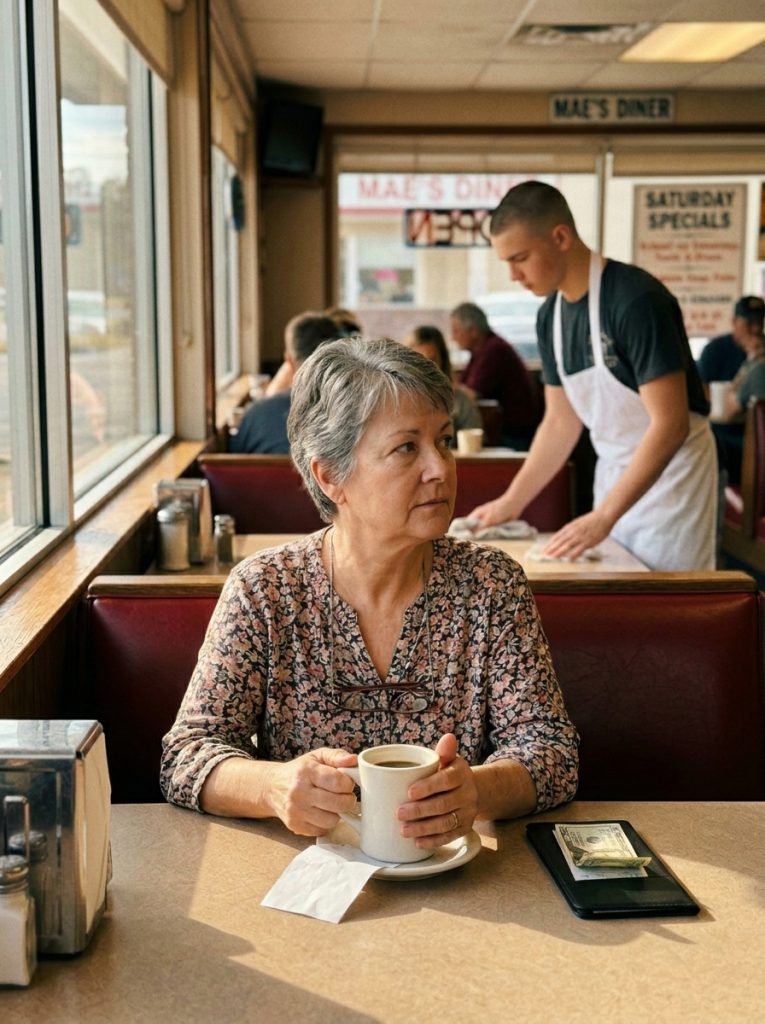
She called me back within twenty minutes of my foster mom dialing the number on the file. She asked me to describe the woman at the diner — height, hair color, blouse, the glasses on the chain, the way she held the mug.
I told her everything I remembered.
Denise went quiet on the phone for a while. Then she said, “Jaylen, I need to tell you something, and I need you to listen carefully.”
I was sitting on my bed in the Hendersons’ spare room with the phone pressed to my ear so hard my palm was sweating.
“A woman named Ruth Delacroix filed a petition to reconnect with a biological child two years ago. The petition was processed, but due to an administrative error in the system transition between counties, the response was returned as ‘subject aged out — file closed.’ That response was incorrect. You had not aged out. You were fifteen at the time.”
I didn’t say anything.
“Ruth has been searching independently since then. She does not have your address. She does not have your last name. The only information she retained from the original file was the county and a physical description from when you were seven years old.”
I held the note in my hand while Denise talked. I’ve been looking.
Two years.
She had been looking for two years with nothing but a county and a memory of a seven-year-old boy.
Denise asked me what I wanted to do. She said I didn’t have to do anything. She said the decision was mine — I was seventeen, old enough to consent or decline contact. She said she could arrange a supervised meeting, or I could call the number, or I could wait.
I said I wanted to call.
Denise said, “Do you want me to stay on the line?”
I said no.
I waited until the house was quiet. The Hendersons go to bed early — nine-thirty on weeknights, ten on weekends. By ten-fifteen the hallway was dark and I was sitting on my bed with my phone and the folded note.
I dialed the number.
It rang once.
She picked up before the second ring.
“Hello?” Her voice was careful. Like someone who has been waiting by a phone for a very long time and is afraid that hope will sound too loud.
I said, “This is Jaylen. From the diner.”
She didn’t say anything for five, maybe six seconds.
Then she said my name. Just my name. Jaylen. And the way she said it — the way it came out of her like it had been sitting in her throat for seventeen years — I understood something I had never understood before.
I had been looked for.
In every foster home, in every new school registration, in every move where my file went to a new county and my information went into a new system — someone had been looking. Not the system. Not a caseworker. A person. A specific person who remembered my face from when I was small and who had spent two years walking into diners across south Georgia with nothing but hope and a note in her pocket.
We talked for forty-seven minutes that first call.
She told me she had been nineteen when I was born. She told me the circumstances were hard — a situation she was not safe in, a decision that was made for her by people who said they were helping. She told me she signed the papers because she believed she was giving me something better. She told me she never stopped thinking about whether it was better.
I told her about the diner. About the rhythm of clearing tables. About the bus I take. About the Hendersons, who are kind but who will not be my family in fourteen months when I turn eighteen and the system releases me.
She said, “I want to be there. If you’ll let me.”
I said, “You left a hundred-dollar tip on a four-dollar coffee.”
She laughed. It was a wet laugh — the kind where someone is crying and laughing at the same time. She said, “I’ve left tips like that at every diner between here and Valdosta. For two years. Every Saturday. Just in case the kid behind the counter was you.”
Every Saturday. Two years. That’s over a hundred diners. Over a hundred tips left on tables with a folded note underneath.
I’ve been looking.
We met again at Mae’s the following Sunday. I asked Darlene if I could take my break at three o’clock. She said yes without asking why. I sat in the window booth — table 7, Ruth’s table — and I waited.
Ruth walked in at 2:58. Same floral blouse. Same glasses on the chain. She saw me and she stopped moving for a moment — just a half-second where her whole body went still — and then she walked over and sat down across from me.
Neither of us said anything for a while.
Then she reached across the table and put her hand, palm up, on the laminate surface between us.
I put my hand in hers.
Her fingers were trembling. The same way they’d trembled around the coffee mug.
Darlene brought two coffees without being asked. She set them down and walked away without a word.
We sat there for a long time. Two people who had been strangers a week ago and who were now something else — something that didn’t have a name yet, something that would need time and patience and a lot more cups of coffee to grow into.
Ruth filed the formal reconnection paperwork through the county the following week. Denise helped expedite it. By December, Ruth had been approved for supervised visits. By February, the supervision was lifted.
I still work at Mae’s. Ruth comes in on Saturdays.
She always sits at table 7. She always orders coffee and pie. She always leaves a big tip — not because she’s looking for someone anymore, but because she remembers what it felt like to hope.
And every time I clear that table at the end of her visit, I check under the saucer.
There’s never a note anymore.
She doesn’t need to write it.
I already know.
I want to say one more thing. About the system.
Six foster homes. Three schools. Two counties. One file that got lost during a database migration and caused a two-year delay in a reconnection that should have happened when I was fifteen.
The system did not find Ruth. Ruth found me. She found me because she refused to accept a form letter that said “subject aged out” and decided to search on her own — no address, no last name, just a county and a memory and the desperate patience of a woman who had spent seventeen years carrying a loss she was never given the chance to grieve properly.
I don’t blame the caseworkers. Denise was kind. The Hendersons were kind. The people inside the system mostly tried.
But the system is not the people inside it. The system is a set of processes that move children through files and files through databases and databases through transitions — and sometimes, in the space between one transition and another, a person falls through.
I fell through.
Ruth climbed down after me.
With a coffee cup and a folded note and four words that changed everything I believed about where I came from.
I’m eighteen now. I aged out of foster care in March. Ruth and I are working with a lawyer on a formal adult-child reconnection — it’s not adoption, legally, because I’m an adult. But it’s recognition. It’s paperwork that says: this person belongs to this person. This connection is real.
I still work at Mae’s on Saturdays. I’m saving for community college. Ruth drives me to campus visits when I can’t make the bus schedule work.
She sits in the car and waits.
She’s good at waiting.
Advertisement
She’s been doing it for seventeen years.
But she doesn’t have to wait anymore.
And neither do I.