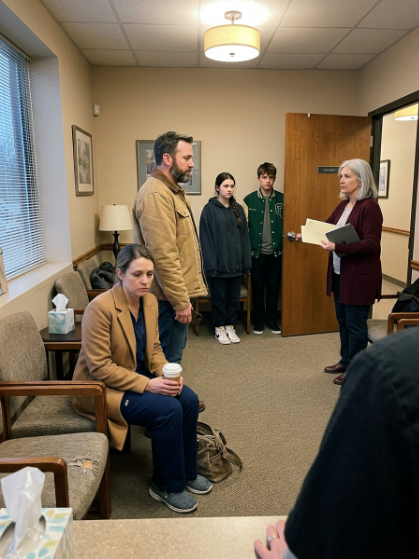
Dr. Porter did not open the letters right away.
She looked at Nora and Owen first.
That mattered.
For months, every adult conversation in our house had been filtered through Mark. What the twins felt. What they wanted. What they could handle. What I should not push.
Now Dr. Porter was asking them directly.
Nora wiped her cheek with the sleeve of her hoodie and nodded again.
Owen’s voice came out barely above a whisper.
“Read mine first.”
Mark shifted beside me.
“This is inappropriate.”
Dr. Porter turned to him with the kind of calm I recognized from clinical supervisors who had already decided where the boundary was.
“They gave consent in session. You do not get to withdraw it for them.”
That was the first crack.
Not in our family.
In the version of our family Mark had been carrying into every room before us.
I sat back down because my knees were suddenly not trustworthy. The paper cup of tea was still on the table, cold now, the damp ring spreading slowly on the coaster.
Dr. Porter opened Owen’s letter.
She did not read everything.
She told us that first.
Some things belonged to him.
Then she read one line.
I want Leah to come because Dad keeps saying she is busy, but I think she just stopped trying.
I felt the words hit my chest before I understood them.
Owen stared at the carpet.
Nora looked at me then, really looked, and her face had the same hurt I had been carrying from the other side of the wall.
Mark said, “That was taken out of context.”
Dr. Porter picked up the tablet.
“The calendar gives us context.”
She turned it toward him, not toward the children. I saw blocks of appointments, cancellations, notes. Her finger moved down a column.
Canceled from Mark Ward email.
Canceled from Mark Ward email.
Canceled from Mark Ward email.
My mouth went dry.
All those evenings I had sat in the car with my purse on my lap, waiting for Mark to say the twins were not ready.
All those times I had told myself not to take it personally.
All those quiet dinners where I thought the kids had chosen distance.
Someone had been moving the doors.
And I had been apologizing to the wall.
Nora spoke next.
“You didn’t cancel?”
I turned toward her too quickly.
“No.”
The word cracked.
I tried again.
“No, Nora. I didn’t.”
Her mouth trembled, but she pressed it flat like crying would give someone too much power.
Owen looked at Mark.
That look was worse than anger.
It was measurement.
A child recalculating a parent in real time.
Mark put both hands up.
“I was trying to slow things down. Everyone was overwhelmed.”
Dr. Porter read the second consented line from Nora’s letter.
If Leah does not want us, I wish someone would just say it instead of making us wait.
I covered my mouth.
Not to hide from them.
To keep from making the sound that rose out of me.
Because I had thought the same thing.
If the twins did not want me, I wished someone would just say it.
We had been sitting on opposite sides of the same sentence, both believing the other had written it.
Advertisement
Mark sat down hard in the chair beside me.
He said he was protecting his children.
Nora said, “From what?”
He did not answer fast enough.
Owen did.
“From liking her?”
That was the turn.
Not the letters.
Not the calendar.
That question.
It took the vague fog Mark had used for months and gave it a shape.
He had been afraid of losing the center.
Afraid that if the twins let me in, his old family would become less under his control.
Afraid that love in a blended home might not obey hierarchy.
Dr. Porter closed the letters and placed them on her lap.
She told Mark the session would continue without him for the next fifteen minutes if the twins agreed.
Mark objected.
Dr. Porter said this was not a punishment.
Then she looked at him until he understood it also was not a request.
He stepped into the hallway.
The door clicked shut behind him.
The room felt enormous.
Nora sat across from me. Owen sat beside her, shoulders stiff, hands in his jacket pockets.
I wanted to rush toward them with every explanation I had saved.
I wanted to say I was there. I waited. I tried. I made space because I thought space was what you wanted.
But I had learned enough as a nurse to know that the first flood of relief can drown the person you mean to help.
So I said one sentence.
“I did not stop coming.”
Nora cried then.
Owen did not, but his eyes went red.
He asked why Dad would do that.
I could have answered in anger.
I had plenty.
But those children did not need me to sharpen a knife with their father’s name on it. They needed one adult to tell the truth without making them carry it.
“I think he was scared,” I said. “But being scared does not make it okay.”
Dr. Porter nodded once.
Nora asked if I still wanted sessions.
The question almost undid me.
Still.
As if wanting them had been conditional.
“Yes,” I said. “Only if you do. But yes.”
The next weeks were not easy.
That is important.
A revealed misunderstanding does not heal a house by magic.
Mark apologized badly at first. He used words like overwhelmed and miscommunication and thought it was best. Dr. Porter stopped him every time he tried to turn a decision into a weather event.
“You canceled appointments,” she said. “Name the action.”
The twins heard that.
So did I.
Eventually, Mark named it.
He admitted he had told me the kids refused therapy and told them I was unavailable. He admitted he had wanted more time before we became a real household because a real household meant he could not manage everyone separately.
Nora asked if he knew it made her feel unwanted.
He cried when she asked.
I did not comfort him.
That was new for me.
In our marriage, I had often soothed the person who hurt me just to get the room breathing again. This time, I let the discomfort stay where it belonged.
Our sessions changed after that.
Nora brought a list of things she wished I had known. She hated when I knocked too softly because it made her feel like a guest in her own house. Owen admitted he liked when I came to his games but got embarrassed when I stood alone, so he pretended not to see me.
Small things.
Huge things.
I told them I had been afraid of replacing someone who could not be replaced.
Nora said, “You’re not replacing Mom.”
Then, after a long pause, she added, “But you live here too.”
That was the first time I let myself believe it.
Mark had to give Dr. Porter access to the shared calendar. No more private cancellations. No more speaking for everyone. If someone needed a break, they said it themselves.
At home, the hallway changed slowly.
One evening, Owen left a bowl of cereal on the counter and said, without looking at me, that it was the kind I liked too.
Another day, Nora asked if I could braid her hair before a school concert because her hands were shaking.
The first real apology did not come in a speech.
It came three months later, in the same waiting room, when Mark arrived late and found the three of us already inside Dr. Porter’s office.
Nora looked at him and said, “We started because we did not want to wait anymore.”
Then she looked at me.
Not away.
At me.
I still keep the first cold-tea coaster in my desk drawer.
Not because it was painful.
Because it reminds me that sometimes a door opens with two children finally being asked what they actually said.