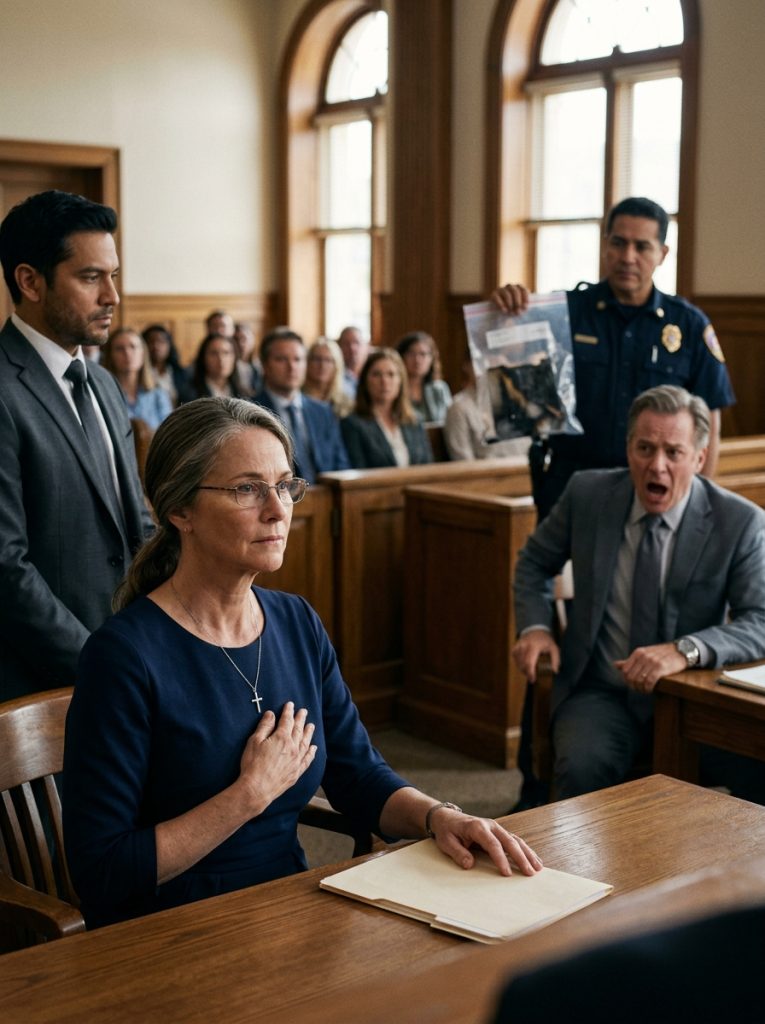
Crane’s “objection” died in the air, because there was nothing left to object to. The document was already in the record. The marshal was already holding the proof up where the jury could see it.
So Daniel asked the only question that mattered.
“Marshal Ortiz, you said this component is where the fire originated. Is this a known issue?”
“Yes.” Ortiz didn’t hesitate. “This is a residential electrical panel. This specific model and lot were the subject of a safety bulletin. Under certain loads, the bus bar can overheat at the connection and ignite the surrounding material. It’s a documented failure pattern. We’ve seen it before.”
“Overnight. With no one touching it.”
“Correct. The homeowner doesn’t have to do anything. That’s what makes it dangerous.”
I sat very still with my hand on Tom’s cross.
Daniel let it breathe. Then he walked back to our table and picked up a second folder. A thin one. The one he’d been saving.
“Your Honor, the defense — Meridian Mutual — produced documents in discovery they fought very hard to keep sealed. I’d like to read from one.”
Crane was on his feet again. There was a hurried sidebar I couldn’t hear. The judge’s face went flat in a way that told me everything. He waved Daniel on.
“This is an internal Meridian risk memo,” Daniel said. “Dated almost two years before Mrs. Holloway’s fire. It lists this exact panel model under a heading I’ll read word for word: ‘Elevated loss exposure — known ignition defect.'”
The courtroom made a sound. A collective intake of breath.
“Meridian flagged this panel as a fire risk,” Daniel said. “Two years ago. They had a list of every policyholder whose home contained it. Mrs. Holloway was on that list. They never sent a warning. They never funded a single replacement. And when one of those homes burned down exactly the way their own memo predicted — they accused the widow who lived there of arson.”
He set the memo down.
“They didn’t investigate a crime. They manufactured one. Because it is cheaper to destroy a grieving woman’s reputation than to admit you sat on a defect that burned her house down.”
Crane tried. I’ll give him that. He stood and talked about “preliminary internal assessments” and “actuarial language taken out of context.” He used a lot of words.
But you can feel the moment a room turns. I’d felt it turn against me for three days. Now I felt it turn back, like a tide deciding which way it wanted to go.
The jury wasn’t looking at me like an arsonist anymore.
They were looking at Crane.
I want to describe his face, but the truth is it simply emptied out. All that confidence he’d worn for three days — the silver watch, the slow and gentle cruelty — it drained away the same way the color had drained out of him the second Ortiz lifted that bag.
He sat down. He didn’t object again. There was nothing left to perform for.
The judge had heard enough. He didn’t even send it to the jury for the company’s claim against me — he dismissed Meridian’s case from the bench, with a few cold sentences about bad faith that I’ve since read more times than I’ll admit.
But it didn’t end there. Daniel had filed our own counterclaim, and that’s the one that mattered.
It took another four months. Depositions. More memos clawed out of Meridian’s files. It turned out I wasn’t the only one. There were others — a couple in Nebraska, a family in Ohio — all on the same list, all denied, two of them quietly accused of the same thing I was.
Daniel flew two of them in for depositions. Afterward we sat together in a hotel conference room with bad coffee and just… looked at each other for a while.
The man from Nebraska had lost his late wife’s piano in his fire. The mother from Ohio had spent eight months with the word arsonist trailing her through a town about the size of mine.
We weren’t strangers, somehow. We were the list nobody at Meridian was ever supposed to find. When one of us got choked up, the other two waited. Then we signed our statements, and we made very sure those statements could never be sealed away again.
Meridian settled rather than let all of it come out at trial.
They paid my claim in full. They paid to rebuild. They paid damages on top, the kind with enough zeros that their lawyers stopped checking their watches and started checking with headquarters.
And the state insurance commissioner — who got a very thick envelope from Daniel — opened a formal investigation into how a company handles claims involving a defect it already knows about. That part isn’t about money. That part is about the next widow on some list she doesn’t know she’s on.
They sent letters, finally. Real ones, on company letterhead, to every household still on that list. A warning two years late is still a warning. I like to think one of them stopped a fire that never got the chance to happen. I’ll never know which one. That’s the strange thing about prevention — you only ever get to count the disasters you failed to stop.
Vincent Crane sent a letter too. Through counsel, of course. It used the word “regret” without ever using the word “sorry.” I didn’t answer it.
Some people need your forgiveness so they can feel lighter about what they did. I was not in the business of making Vincent Crane feel lighter.
Here is the part I actually carry with me.
The Sunday after the verdict, I went back to church. The same pew. Thirty years.
The woman who’d turned her grocery cart away from me — my old Sunday school friend — was waiting in the parking lot. She didn’t make excuses. She just took both my hands and said, “I believed it because it was easier than thinking an insurance company would lie. That was cowardly of me. I’m so sorry, Grace.”
I forgave her. Not because she deserved it in that second, but because carrying it would’ve cost me more than it cost her.
They rebuilt the house that fall.
I stood on the new concrete slab where the back porch used to be — the same slab where Tom proposed to me before there was a porch at all — and I watched them frame the walls back up.
It’s not the same house. The pencil marks on the kitchen doorframe are gone, the ones tracking the kids’ heights year by year. You can’t rebuild those.
My daughter drove down for the framing. She put her hand flat on a fresh-cut stud and said, “Dad would’ve liked that they made the porch a little bigger.”
I had to step outside for a minute.
He would have. He was always saying we needed more room out back for the grandkids who hadn’t come along yet.
But the new panel they put in is a good one. Safe. Inspected twice. And there’s a smoke alarm in every single room, hardwired, because I will never again wake up at 2 a.m. and wonder if I imagined the sound.
People ask me how I sat there for three days and said nothing while a man in a slate-gray suit called me an arsonist in front of my whole town.
I tell them the truth.
I had my hand on the cross my husband gave me. And I knew something Vincent Crane didn’t.
I knew I didn’t do it. And I knew that sooner or later, the truth about that house was going to walk through the door in an evidence bag — whether they wanted it to or not.
I just had to be still long enough to let it.