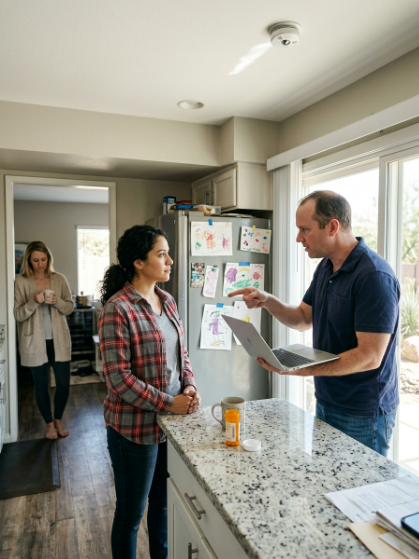
Craig held my card in two fingers like it might bite him.
“Child Protective Services,” he read out loud. His voice didn’t sound like a threat anymore. “Josephine Navarro. Licensed clinical social worker.”
“Master’s in social work,” I said. “And yes. I was placed in your home three weeks ago, after a report from your son’s kindergarten teacher. She noticed he was falling asleep at his desk by ten in the morning. She noticed he was hungry. She did the right thing and she called us.”
Melanie had drifted in from the doorway. The coffee mug was still in both her hands. I could see, now that I was looking for it, the faint chalky ring at the bottom where the pills never fully dissolved.
“You can’t just — put someone in our house,” Craig said. “That’s not legal. You spied on us.”
“You installed the cameras, Mr. Davenport.” I kept my voice level. I always do. “Three of them. The kitchen, the playroom, the upstairs hall. You told me about them on my second day. You wanted them pointed at me.”
I let that sit.
“They were pointed at you the whole time too.”
He went very still.
“Every morning,” I said. “The mug. The spoon. The white residue on the granite I wiped up after you both went under. The two hours, sometimes three, when neither of you was conscious and a four-year-old was deciding whether it was safe to wake you. I didn’t have to gather any of it. You recorded it. In high definition. With timestamps.”
I didn’t tell him the rest. That I had three weeks of my own notes too, written each night after the kids were asleep. The morning the boy made his sister cereal because no one else was up, and got more on the floor than in the bowl, and apologized to me for the mess like it was his fault. The afternoon I found the girl sitting outside her parents’ bedroom door, just waiting, the way a dog waits. The grocery list I started keeping because the cabinets were always close to empty.
Three weeks. A child learns a lot of survival in three weeks. So does a social worker.
Melanie started to cry. Not the loud kind. The quiet kind, where a person realizes the floor they’ve been standing on was never there.
“I love my kids,” she said.
“I believe you,” I told her. And I did. That’s the part people never expect me to say. “I’ve met a lot of parents in your situation, and almost all of them love their kids. Love was never the question. Whether they’re safe was the question. And right now, in this house, with what’s in that coffee, they are not.”
The next part happened the way it always happens. Faster than the parents expect, slower than the children deserve.
I made the call I’d been authorized to make. Within the hour there were two more caseworkers and a sheriff’s deputy in that white granite kitchen. The children’s grandmother — Melanie’s mother, who had been quietly frantic for months and kept being told everything was fine — drove over from Mesa and was there before the sun started to drop.
I’ll tell you the part that stays with me.
When the grandmother came through the door, the little girl didn’t run to her right away. She looked at me first. She’d learned, in three weeks, to check with me before she trusted that something good was actually allowed to happen. I nodded at her. Only then did she let go of my hand and run.
That’s what neglect does. It doesn’t always leave marks you can photograph. Sometimes it just teaches a four-year-old to ask permission before she feels safe.
I was the one who packed the kids’ bags. I knew where everything was. I knew the boy needed the dinosaur book or he wouldn’t sleep, and I knew the girl’s blanket had to go in last so it was on top where she could find it.
I knelt down in front of both of them by the front door.
“You’re going to your grandma’s,” I said. “You’ve stayed there before. You know her house.”
The little girl looked at me with those too-quiet eyes. “Are you coming?”
And here’s the thing about my job that they don’t put in the training manuals.
You are not supposed to be the safe place. You are supposed to find the safe place and hand the child to it and step back. You are a bridge, not a destination.
But that little girl had spent three weeks learning that the woman with the cleaning hands and the dinosaur voices was the one who showed up. Who fed her. Who stayed awake.
“I’m going to make sure you’re okay,” I said. “That’s my actual job. The real one. Not the pretend one.”
She thought about that. Then she handed me her blanket to carry to the car, which is the highest honor a four-year-old can give you, and I carried it like it was made of glass.
Craig and Melanie didn’t go to jail that day. That surprised a lot of people who heard the story later. They wanted handcuffs. They wanted a villain dragged out by the collar.
That’s not what this work is for.
What happened was a court hearing, and a judge who’d read my report twice, and an order that was clear and strict and — I will say it — fair. Mandatory inpatient treatment for both of them. Supervised visitation only, and only once they were clean and could prove it. The children stayed with their grandmother, where there was food in the cabinets and no chalky ring at the bottom of anyone’s mug.
I testified at that hearing. Craig’s lawyer tried, the way they always do, to make the cameras my fault — to argue I’d violated their privacy by living in their home under a different name. The judge listened. Then she asked Craig’s lawyer one question.
“Who installed the cameras?”
The lawyer didn’t have an answer that helped him. Craig had. Craig had bought them, mounted them, and aimed them. Every second of footage the state held, the Davenports had recorded in their own home, of their own free will, hoping to catch someone else.
The cameras Craig installed to catch the help became the centerpiece of the state’s file. Every frame he’d recorded to protect himself from me, he’d recorded against himself. I almost felt the irony was too neat. Real life usually isn’t.
I checked on the kids six weeks later. Standard follow-up. The grandmother had the boy in a soccer league, and the girl was drawing on every surface in the house, mostly pictures of a tall figure holding two small hands.
Craig was forty days sober. Melanie was struggling, then she wasn’t, then she was again — recovery is not a straight road, and I have stopped pretending it is. But they were trying. They were showing up to the visits clean. The grandmother said the boy had started laughing in his sleep instead of waking up afraid.
The little girl ran up to me at the door and hugged my knees.
“You came back,” she said.
“I told you I would.”
She nodded, very serious, like we’d had a deal and I’d honored it. Then she ran off to show me a drawing.
People hear what I do and they think it’s about catching bad parents. Trapping them. Winning.
It isn’t.
It’s about a teacher who noticed a hungry boy and made one phone call. It’s about three cameras that were never meant to tell the truth, and told it anyway. It’s about a blanket carried carefully to a car.
They installed the cameras to watch the nanny.
I just made sure that for once, somebody was watching the right people.