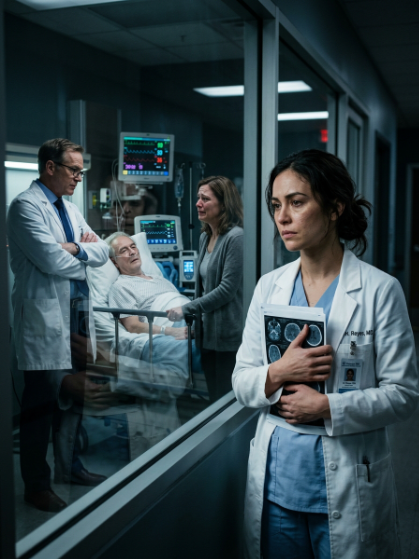
Dr. Prescott told me to go home and sleep before I said something that ended my career.
I didn’t go home.
I went to the one person in that hallway who hadn’t given up: Diane Crane.
“Mrs. Crane,” I said through the glass doorway, “I’m not promising you anything. I could be wrong. But I think there’s something we ruled out too early, and I think it’s treatable, and I am asking you for one thing — don’t let them stop tonight. Give me until the morning labs.”
She studied my face the way mothers study a thermometer.
“You’re the only one who’s looked me in the eye in three days,” she said. “Tell me what you need.”
What I needed was for someone with authority to reopen a case three senior doctors had closed.
So I did the thing residents are taught never to do. I went over Prescott’s head.
I called the attending on backup, Dr. Okonkwo, at home, at three forty in the morning, and I walked her through the old scan and the lab value that didn’t belong. My voice was steady even though my hands weren’t.
There was a long pause on the line.
“Send me the images,” she said.
Twenty minutes later she called back, and her voice had changed.
“Order the confirmatory test. Now. And Hannah — good catch. If you’re right, you just bought this man a chance nobody else was going to give him.”
I was right.
Walter Crane didn’t have an untreatable cascade shutting his body down. He had a rare, reversible condition that mimics one — the kind they warn you about in a single paragraph in a textbook and then you never see. Left alone, it kills. Caught, it’s a course of treatment and time.
We started that morning.
By the third day, his numbers turned.
By the end of the week, his eyes were all the way open, and the first full sentence he said was to ask Diane if she’d been eating.
I’d love to tell you it was a clean, golden ending.
It wasn’t. Not entirely.
Because the truth I’d fought for came with a harder truth underneath it.
Walter had been sick, quietly, for a long time before that night. He’d skipped appointments. He’d told no one how tired he was. By the time he reached us, the delay had already cost him things we couldn’t give back — his kidneys never fully recovered, and he’d need dialysis for whatever years he had left.
We didn’t save the man he used to be. We saved the man he still got to become.
Diane found me in the stairwell after he was moved out of the ICU. She put her hands on both my shoulders.
“My father and I hadn’t spoken in two years,” she said. “Stubbornness. Both of us. I came here to say goodbye to a man I was still angry at.” Her voice broke. “You gave me the chance to stop being angry. Do you understand what that is?”
I did. I understood it more than she knew.
I became a doctor because of a night that went the other way. My own grandfather, a small hospital, a tired team, a thing that got missed. No one called the backup attending. No one reopened the chart. We were told to gather, and we gathered, and he was gone before sunrise.
I never wanted another family to stand in a hallway wishing one more person had looked twice.
So I looked twice.
Dr. Prescott never apologized. Men like him rarely do. But the case went to morbidity-and-mortality review, the way close calls do, and in front of the whole department the chief said the words out loud: the catch came from the first-year, and the system should have caught it sooner, and we would change how transferred scans get a fresh read.
That was the real victory. Not me being right. The next Walter Crane getting a second set of eyes by policy, not by luck.
Walter went home six weeks later. Dialysis three times a week. A daughter who drives him every time.
On his last day on the floor, he asked the nurses which one I was. They pointed me out.
He waved me over with a hand that still shook a little.
“They tell me you’re the reason I’m leaving through the front door,” he said. “Instead of the other way.”
“You did the hard part,” I said. “I just made them look again.”
He shook his head slowly. “No. Everybody else saw a finished story. You saw a man who wasn’t done yet.” He squeezed my hand. “Don’t ever lose that. The world’s full of people in a hurry to call things over.”
I think about that more than any lecture I’ve ever sat through.
He didn’t get every year back. The clock had already taken some of them while he was too proud to come in.
But he got Diane back. He got mornings on his own porch. He got to be the grandfather at the table instead of the name on a folded flag.
Some nights I still walk past that ICU glass and see my own reflection laid over the empty bed.
And I remember: the most dangerous words in any hospital aren’t “I don’t know.”
They’re “there’s nothing more we can do” — said by someone who stopped looking.