The trust document was filed six years ago.
Lily’s father, Thomas Prescott, had drawn it up eighteen months before his death — a detailed, notarized trust naming his daughter as sole beneficiary of his life insurance payout, his retirement account, and the equity in the family home.
The document was supposed to be held by an independent fiduciary: a bank trust officer named Allan Marsh.
It never reached him.
Diane intercepted it.
She found the filing in Thomas’s desk drawer three weeks after his funeral while Lily slept upstairs in what was then still her real bedroom — the second-floor corner room with lavender walls and the bookshelf Thomas built by hand.
Diane read the trust.
Then she put it in her own safe deposit box.
And she never told anyone it existed.
For six years, Diane Prescott collected the life insurance proceeds under the assumption that as the surviving spouse and stepmother, all assets defaulted to her. She spent Lily’s inheritance on the house renovation, her biological children’s private school tuition, and a lifestyle that required the appearance of wealth without the income to support it.
Lily, meanwhile, was moved to the attic.
It happened gradually. First it was “temporary” — during the renovation, the contractors needed access to the second-floor rooms. Then it was “her choice” — she liked the quiet, Diane claimed. Then it was permanent. The lavender room became Madison’s. The furniture was redistributed. The bookshelf Thomas built was painted white and placed in Aiden’s room.
Lily said nothing.
Because Lily had learned the same lesson every child in her position learns: visibility means vulnerability. If you’re noticed, you can be punished. If you’re silent, you might survive.
She survived.
Straight A’s. Near-perfect attendance. No behavioral incidents. The kind of student who disappears into the background so completely that most teachers forget she’s struggling — because struggling students are usually loud.
Lily was never loud.
Until Mrs. Patterson.
Grace Patterson taught sophomore English at Cary High School. She’d been teaching for twenty-two years. She’d seen every kind of student — the loud ones, the quiet ones, the ones who disappear.
Lily disappeared.
But her writing didn’t.
The assignment was simple: a personal essay on the topic “A Room in Your House.” Most students wrote about their bedrooms, their kitchens, their porches.
Lily wrote about the attic.
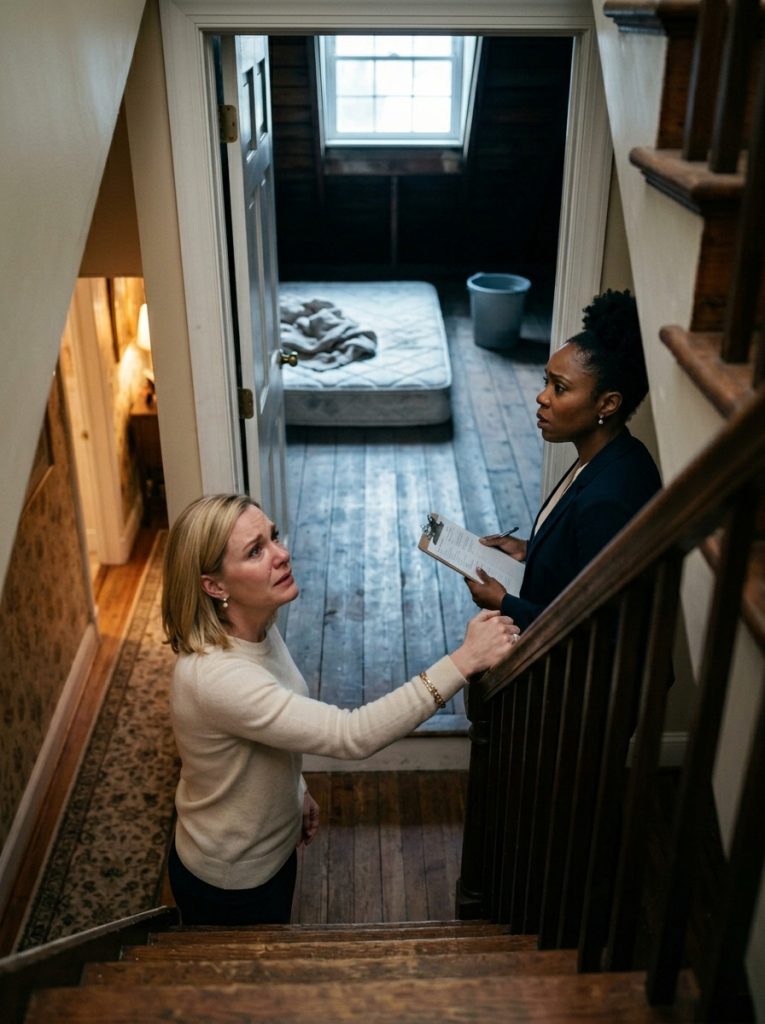
She wrote about the cold. The single blanket. The bucket she used for water because the attic had no plumbing. The way the temperature dropped below fifty degrees in January while the rest of the house stayed warm.
She wrote about listening to her stepsiblings laugh downstairs while she did homework by the light of a single bare bulb.
She wrote about the nail in the wall where her backpack hung — the only personal item allowed in the space.
Mrs. Patterson read the essay three times.
Then she filed a report.
Two days later, Renee Calloway stood at the top of those attic stairs.
And twelve hours after that, the wheels of the system began to turn.
The emergency custody transfer was authorized by a judge at 4:47 p.m. on a Wednesday. Helen Prescott — Lily’s paternal grandmother, a retired school librarian in Durham who had been fighting for visitation rights for two years — was granted temporary custody effective immediately.
Diane contested it.
Of course she did.
She hired an attorney. Claimed the report was exaggerated. Claimed Lily had behavioral issues that required “alternative housing arrangements.” Claimed the attic was heated — which the temperature logs from Renee’s visit definitively disproved.
The hearing was scheduled for three weeks out.
But the trust document surfaced first.
Allan Marsh — the bank trust officer who was supposed to have received Thomas’s filing — had flagged an anomaly during a routine compliance check. A trust that should have been activated upon Thomas Prescott’s death had never been presented for execution.
He made inquiries.
The trail led to Diane’s safe deposit box.
When the judge reviewed the document, the case changed entirely.
This was no longer just a custody dispute.
It was fraud.
Diane Prescott had knowingly concealed a legal instrument that protected her stepdaughter’s financial interests. She had spent funds intended for Lily’s education and welfare. And she had done so while simultaneously neglecting the child’s basic physical needs.
The temporary custody order became permanent within the month.
Lily moved into Helen’s small brick house in Durham — a modest home with a vegetable garden, a guest room with actual sheets, and a bookshelf her grandmother had built from a tutorial she found online because she remembered Thomas used to build them.
The first night, Lily didn’t sleep in the bed.
She slept on the floor beside it.
Helen found her there at 6 a.m. and didn’t say a word. Just brought her a blanket and a pillow and set them on the floor beside her.
It took Lily three weeks to sleep in the bed.
But she did.
The trust was activated in full. The life insurance proceeds — untouched in a frozen account since Thomas’s death — were released to Lily’s education fund. The retirement account was transferred to a custodial investment account managed by Allan Marsh.
The home equity was a messier fight. Diane had refinanced twice, pulling equity out. The house was now underwater. But the court ordered restitution — monthly payments from Diane’s income until the original equity amount was repaid.
It would take years.
But the money was never the point.
The point was the attic.
The point was a fourteen-year-old girl who slept on a bare mattress in forty-nine-degree air while her stepsiblings had heated rooms twelve feet below.
The point was silence.
The kind of silence that children use as armor — the kind that lets them endure things no child should have to endure, because the alternative is drawing attention, and attention in that house was never safe.
Mrs. Patterson received a letter from Lily four months later.
It was short.
Advertisement
“Thank you for reading it. Everyone else assigned the essay. You’re the only one who read it.”
Grace Patterson framed that letter.
It hangs in her classroom to this day.
Renee Calloway continued her work in Wake County. She never forgot the attic. She tells the story in training sessions for new social workers — not as a horror story, but as a reminder.
“Listen to the house,” she says. “Not the person giving the tour. The house will tell you everything if you pay attention. Count the place settings. Count the bedrooms. Count the coats on the hooks. And if the numbers don’t match — open every door.”
Lily graduated from Cary High School two years later with a 4.1 GPA.
She was accepted to UNC Chapel Hill with a full scholarship funded by her father’s trust.
On move-in day, Helen drove her.
They carried boxes up three flights of stairs together.
When everything was unpacked, Lily stood in the middle of her dorm room — small, plain, shared with a stranger — and ran her hand along the radiator under the window.
Warm.
She pressed her palm against it and held it there.
Helen watched from the doorway and said nothing.
Some things don’t need words.
Some things are just a girl in a warm room, finally.