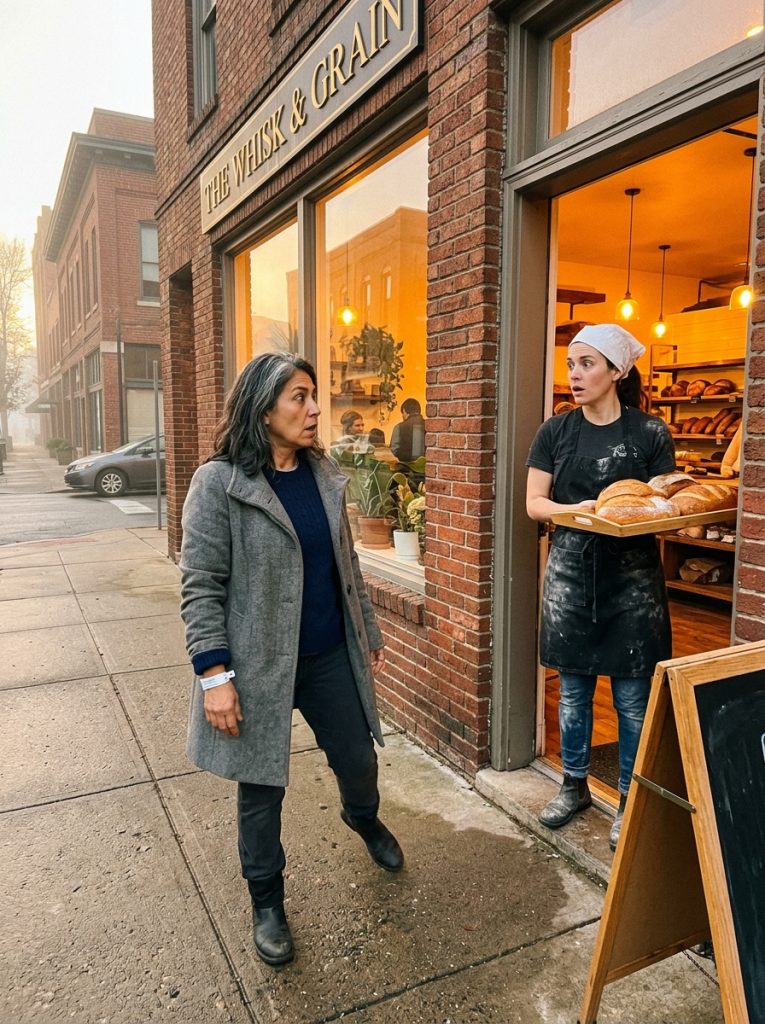
Elena sat me down on a stool behind the counter and made me a coffee I didn’t remember ordering but somehow knew the taste of.
Two sugars. A splash of oat milk.
She knew. I knew. Neither of us understood how I knew.
“You really don’t remember,” she said. It wasn’t a question. She was looking at the hospital bracelet on my wrist and the careful, lost way I held the warm cup.
“I was in an accident,” I said. “Eight weeks ago. I have retrograde amnesia. They told me my name is Miriam Solano. I have an ID. A wallet. A library card. But I don’t have — me. I don’t have anything before the crash.”
Elena pressed her hand to her mouth.
“Miriam. You disappeared fourteen months ago. Not eight weeks. Fourteen months.”
The number didn’t fit.
“The accident was eight weeks ago,” I said.
“The accident was eight weeks ago,” Elena agreed. “But you went missing fourteen months ago. We thought — we filed a report. The police looked. Then they stopped looking. We didn’t know where you went. And now you’re standing on the sidewalk in front of your own bakery and you don’t even know it’s yours.”
The bakery.
My bakery.
She walked me through it that morning, slowly, like you’d walk a child through their own home. The ovens — six of them, German-made, that I’d apparently financed by selling my house twenty-two years ago. The recipe binders, handwritten, in handwriting that matched the signature on my ID. The photo on the wall by the register: a younger me, flour on my face, cutting a ribbon at the grand opening.
I didn’t remember any of it.
But my body did.
When Elena handed me a bench scraper, my hand closed around it in a grip I didn’t choose. When she set a bowl of dough in front of me, my fingers began to fold and turn it before my brain could ask what I was doing. The muscle memory was deeper than the amnesia. My hands remembered a life my mind had lost.
That first morning, I didn’t leave the bakery for six hours.
Elena closed the front for an hour and sat with me at the little marble table in the back where, she said, I used to test new recipes. She told me stories. She showed me photos on her phone — me at staff Christmas parties, me teaching a class of schoolchildren how to shape rolls, me on a ladder hanging the hand-painted sign.
None of it triggered a memory. Not yet.
But the bread did.
Halfway through the morning, a timer went off. Without thinking, I stood up, crossed to oven number three, grabbed the peel from the hook — the right hook, the one I didn’t have to look for — and pulled a tray of sourdough boules out in one smooth motion.
Elena stared at me.
“You just — you didn’t even hesitate,” she said. “You knew which oven. You knew where the peel was. You knew the bake was done without checking the timer label.”
I looked at the golden loaves in my hands.
“My hands knew,” I said.
That was the first crack of light under the door.
I started coming to the bakery every morning.
The neurologist had said sensory triggers could help recover episodic memory in some retrograde cases. Smell is the strongest. And there is no smell on earth like a bakery at five AM.
The memories came back in pieces. Out of order. A flash of my mother teaching me to braid challah. The day I signed the lease, terrified, twenty-nine years old with my whole savings on the line. The first employee I ever hired — a teenager named Elena Voss, who cried when I gave her the job because she’d been turned down everywhere else.
Elena.
She’d been with me eighteen years.
When I vanished fourteen months ago, she didn’t let the bakery die. She kept it running. Made payroll out of revenue. Paid the lease. Kept my recipes exact. Told customers I was “on leave.” Held my life together with flour-dusted hands while I was — somewhere. I still don’t fully know where.
That’s the part that’s still missing. The fourteen months between disappearing and the crash. The neurologist thinks I may have had an earlier fugue event — a dissociative break, possibly triggered by stress or an undiagnosed condition — that sent me wandering before the accident ever happened. I’d been living under a different name two states away, working at a diner, paying cash for a room. The police pieced that part together later from a paper trail.
I may never remember those months. I’ve made peace with that.
The detective who’d worked my missing-person case came by the bakery once I resurfaced. A kind man, near retirement, who’d never closed my file even after his department told him to. He sat at the marble table and Elena gave him a cinnamon roll and he told me what they’d been able to reconstruct.
I’d left on an ordinary Tuesday. Locked the bakery. Never came home. My car turned up three weeks later in a long-term lot at the Knoxville airport, though I’d never bought a plane ticket. The trail went cold there.
What they figured out, eventually, was that I’d been living forty miles outside Knoxville under my mother’s maiden name, working mornings at a diner, paying cash for a room above a hardware store. The landlord recognized my photo when they finally circulated it wide enough.
I don’t remember any of her — the woman I was for those fourteen months. The diner. The room. The name I borrowed from my dead mother.
The doctors think a combination of an undiagnosed neurological issue and a tremendous amount of buried grief sent me into a dissociative fugue. The accident, eight weeks ago, happened when I was driving back toward Asheville — toward home, maybe, though I’ll never know if some part of me was finding its way back on purpose.
The crash gave me amnesia. But it also, strangely, set me on the road that walked me past my own bakery door.
I’ve made peace with the hole. You can’t grieve what you can’t remember. And the life on either side of it — the twenty-two years before and the months since — is enough.
What I remember is what matters: the bakery. The recipes. The eighteen years with Elena. The reason I built this place — because my mother died young and the only thing that ever made our tiny apartment feel like home was the smell of her bread, and I wanted to give that feeling to an entire city.
That came back. All of it. Over about three weeks of mornings, the smell of bread pulling me home one loaf at a time.
I resumed ownership. The lawyers sorted out the legal tangle of a missing-then-found business owner. It took months.
But the first real decision I made — before any of that paperwork was done — was this:
I made Elena a full partner.
Fifty percent. Her name on the deed next to mine.
She protested. She cried. She said she couldn’t accept it.
I told her she’d already earned it. That she’d kept my life’s work alive when I couldn’t even remember it existed. That a person who does that isn’t an employee. She’s family.
Solano’s Artisan Bread is now Solano & Voss.
We changed the sign together.
I still don’t have the fourteen months. There’s a hole in my life I’ll probably never fill.
But I have the bakery. I have the recipes my hands never forgot. I have Elena.
And every morning at five AM, when the first loaves come out and the smell fills the whole shop and drifts out the propped-open door onto the Asheville sidewalk —
I remember exactly who I am.
A baker.
Home.