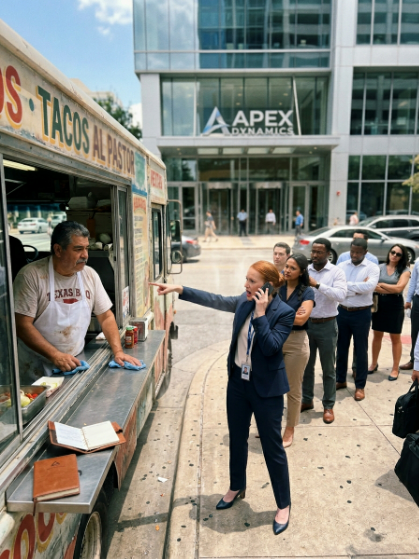
Rodrigo set down the cloth. Looked at Bradford. Then looked at me. And smiled.
That smile — I will never forget it. It wasn’t smug. It wasn’t triumphant. It was the smile of a man who had been waiting for exactly this moment and was not in any rush to explain it.
Bradford Lane — our CEO, the man whose signature is on my employment contract, the man I’d watched command boardrooms with absolute authority for two years — was standing on the sidewalk six feet from a taco truck, and he looked like he was about to be sick.
“Mr. Salinas,” Bradford said again. His voice was different now. Lower. Controlled. The way people speak when they’re managing fear. “I didn’t realize you were — operating — here.”
Rodrigo leaned forward on his counter. Arms crossed. Apron stained with salsa verde. That salt-and-pepper mustache framing a calm, unhurried expression.
“Every day for fourteen months, Bradford,” he said. Quietly. First-name basis. No “sir.” No deference.
I was still holding my phone. The parking enforcement dispatcher was asking if I was still there. I hung up.
“What is—” I started.
Bradford turned to me. Fast. His face — I’ve never seen fear on his face before, and I’ve sat across from him in quarterly reviews and budget negotiations and one very uncomfortable sexual harassment debrief. But this was something else. This was existential.
“Megan,” he said. “Put your phone away.”
“I’m calling to have this truck—”
“Put. Your phone. Away.”
I put it away.
Bradford stepped closer to the truck. His expensive shoes on the hot concrete. His tailored charcoal suit absorbing the Austin sun. He was sweating at the temples — and it wasn’t just the heat.
“Mr. Salinas is a stakeholder,” Bradford said to me. Carefully. Each word measured.
Rodrigo laughed. Low. Warm. The kind of laugh you hear from your grandfather when you say something naive.
“A stakeholder,” Rodrigo repeated. He reached for the leather notebook on the counter — the one with the corporate logo I hadn’t been able to read from my angle. He turned it toward me.
The logo was unmistakable.
Apex Dynamics.
“I am the majority silent investor in this company,” Rodrigo said. His English was clear now — still accented, but precise. Deliberate. “I hold fifty-three percent of voting shares through Salinas Capital Partners. I have held them since before Bradford was hired.” He looked at Bradford. “I approved his compensation package personally. Two-point-one million dollars per year.”
The sidewalk tilted.
Fifty-three percent. Majority. He wasn’t a stakeholder — he was THE stakeholder. The man behind the man. The person whose signature made everything at Apex Dynamics possible.
And I’d been standing on this sidewalk for five minutes threatening to have his truck towed.
“Megan,” Rodrigo said. My name in his mouth sounded different than it did in my own head. “I park this truck here every day because I want to know how my company treats the people who feed it. The people who serve it. The people at the bottom.”
He opened the notebook. Turned it so I could see the pages.
Dates. Times. Names. Notes in small, precise handwriting. Observations. Quotes.
My name appeared fourteen times.
“You threatened a vendor with a valid permit,” he read from one entry. “You called parking enforcement in front of eight employees. You referred to my service as ‘unprofessional’ three times in emails to building management. You mocked my accent to your assistant in the elevator on March 14th.”
My stomach dropped. The elevator. I thought we were alone.
“You weren’t alone,” Rodrigo said, as if reading my mind. “The woman behind you is one of my truck’s regular customers. She sent me the recording that evening.”
Bradford was staring at the ground.
“Bradford,” Rodrigo said. “Look at me.”
Bradford looked up.
“You knew I was in Austin. You didn’t know I was here — on your sidewalk — but you knew I was watching. I told you three years ago: I will always be watching. And what I’ve seen in the past fourteen months is a company that treats service workers, maintenance staff, food vendors, and anyone below director level as invisible.”
He closed the notebook.
“That changes today.”
He looked at me again.
“Your termination authority is revoked, Megan. Effective immediately. You will be reassigned to a non-client-facing role. I’m recommending the mailroom — you’ll report to Dominic Aguilar, who I believe you tried to fire in February for taking a fifteen-minute lunch break.”
My mouth opened. Nothing came out.
“Bradford,” Rodrigo continued, “you will implement a company-wide food service subsidy by end of quarter. Every employee gets a meal stipend. Every food truck and vendor within three blocks of this building gets a standing welcome. No permits revoked. No towing threats. No ‘unprofessional’ emails.”
Bradford nodded. “Yes, sir.”
Rodrigo picked up his cloth. Wiped the counter once. Set it down.
“Now,” he said. He looked past me at the line of office workers still standing on the sidewalk — six of them, maybe eight now, all watching with wide eyes and open mouths. “Who wants a taco? On the house today.”
The line surged forward.
I stood there. On the sidewalk. In my navy pantsuit with my lanyard badge and my phone in my pocket and my entire understanding of my own importance crumbling under the Austin sun.
Rodrigo served every person in line. Slowly. The same speed I’d complained about for fourteen months. Carefully wrapping each taco in foil. Adding extra lime. Asking names.
When the last person walked away, he looked at me one more time.
“Megan,” he said. “The reason I’m slow is because I make everything fresh. Every tortilla. Every salsa. From scratch. For every person.” He shrugged. “That’s how my mother taught me. You don’t rush when you’re feeding people.”
I didn’t say anything. I couldn’t.
I turned around and walked back through the revolving doors.
The mailroom was on the second floor. I’d been there once — to fire someone.
Now it was my office.
Rodrigo’s truck was still there when I looked out the window at five o’clock. Same spot. Same hand-painted awning. Same man behind the counter, wiping slowly, writing in his leather notebook.
He’d be there tomorrow. And the day after that.
Three weeks later, the food service subsidy launched. Every employee received a daily meal credit — enough for a full lunch from any vendor within walking distance. Six food trucks now parked on Congress Avenue during the lunch hour. Rodrigo’s was still the most popular.
The mailroom turned out to be quieter than I expected. Dominic Aguilar — the man I’d tried to fire for a fifteen-minute lunch break — turned out to be one of the most competent supervisors in the building. He didn’t hold it against me. He just handed me a stack of packages to sort and said, “Welcome to the team, Megan. We start at eight.”
I sorted packages. I delivered interoffice mail. I learned the names of people on floors I’d never visited in two years as HR director.
And every day at lunch, I walked past the taco truck on my way to the break room. Rodrigo was always there. Same apron. Same cloth. Same unhurried pace.
One afternoon — maybe six weeks in — I stopped. Stood in line. Ordered a taco. Paid full price.
He wrapped it in foil. Added extra lime. Handed it across the counter.
Advertisement
“Thank you, Megan,” he said.
I nodded. Took the taco. Walked back inside.
It was the best taco I’ve ever had.
And every single person who walked past that truck from now on would know exactly who he was — and exactly who he’d been watching all along.