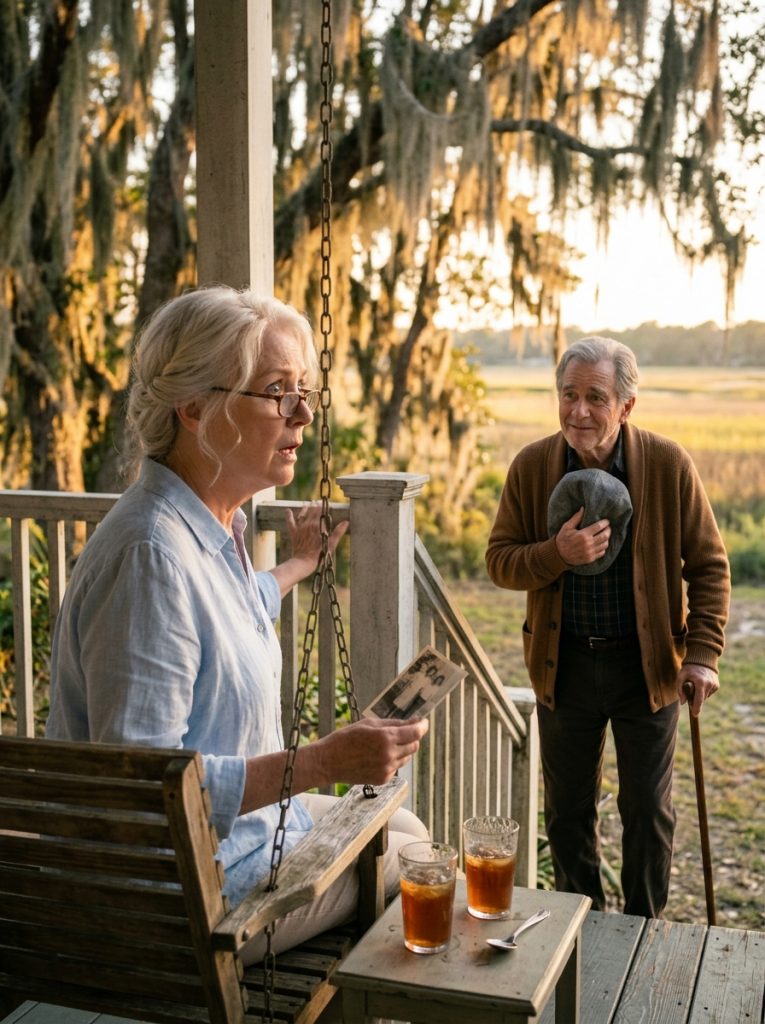
“I was on my way to you,” Tom said. “I swear it on everything. I was on my way.”
He lowered himself onto the porch step because his legs wouldn’t hold the story standing up.
That Friday in 1971, he’d left his father’s house an hour early, tickets in his jacket, walking the shortcut along Bay Street toward the station. He remembered the heat. He remembered counting the money twice. He remembered stepping off the curb at the corner of Bay and Charles.
He did not remember the truck.
A delivery truck, a driver who never saw him, and then nothing — nothing for three days, and after that, a hospital ceiling and a leg in pieces and a head he couldn’t trust. Six weeks at the county hospital. Months more before he could walk without two canes.
“I asked them to call you,” he said. “I begged. But I didn’t have your number written anywhere — it was all in my head, and my head was scrambled for weeks. All I had was your father’s name.”
My father.
“They reached him,” Tom said quietly. “Your father came to the hospital. Once. He stood at the foot of my bed and he told me you’d already left town. That you’d thought better of it. That a girl like you wasn’t going to wait around for a boy with a broken back and no prospects.” Tom’s jaw worked. “He told me the kindest thing I could do was let you go. And God help me, lying in that bed, I believed him. I thought — she’s smart, she got out, she didn’t wait. Why would she wait.”
I had to sit down on the swing.
My father. Who told me, for years, that he’d “heard Tom Bishop ran off to Atlanta.” Who watched me cry for a month and never said a word. Who died when I was forty and took it with him.
He hadn’t been protecting me. He’d been protecting his idea of me — a daughter who married the dentist’s son and stayed close, instead of a girl who ran off with a hurt boy and no money.
Two fathers, two lies, fifty-one years.
It was an obituary that finally brought him back, he admitted. He’d seen my husband’s name in a paper from the next town over, and under it, my own — Vivian, of Beaufort. Widowed. He’d carried that scrap of newsprint in his wallet for two years before he found the nerve to drive down. “I told myself I only wanted to know you were all right,” he said. “That was a lie. I wanted to tell you the truth before one of us ran out of time.”
“I wrote you,” Tom said. “Once I could hold a pen. I sent the letters to your house. They came back.” Of course they did. By then my father had made certain there was nothing to come back to.
We sat on that porch a long time, two old people and a whole stolen life laid out between us in the gold evening light.
I won’t tell you it all came rushing back and we were twenty-one again. We weren’t. He married a good woman in 1979 and buried her in 2018. I married my good man and buried him three years ago. We’d each had children, and storms, and ordinary Tuesdays, and decades of believing the other one had simply not shown up.
You don’t get those years back. Anyone who tells you grief and time can be undone is selling something. Fifty-one years are gone, and I grieved them all over again that evening, fresh, as if the loss were brand new — because in a way it was. I’d been mourning the wrong thing my whole life. I’d been mourning a boy who didn’t want me. He never existed.
But Tom reached into his coat, and he took out an envelope, soft as cloth from handling.
Inside were two train tickets. Beaufort to Atlanta. Dated that Friday in 1971.
“I never threw them away,” he said. “I don’t know why. I think part of me was always still standing at that station.”
I put my hand over the tickets. Over his hand. Spotted and trembling, both of us, but warm.
“We can’t catch that train,” I said.
“No,” he agreed.
“But there’s a porch swing,” I said, “and it’s a long evening, and I have nowhere I need to be.”
He laughed — the same laugh, fifty-one years older, exactly the same.
He comes by most afternoons now. We don’t talk about Atlanta. We sit on the swing and watch the marsh light go down over the water, two people who finally know the truth, holding hands like teenagers who got the timing wrong by half a century.
The tickets are framed on the mantel.
Not because we’re sad about them.
Because we finally know neither one of us let go.