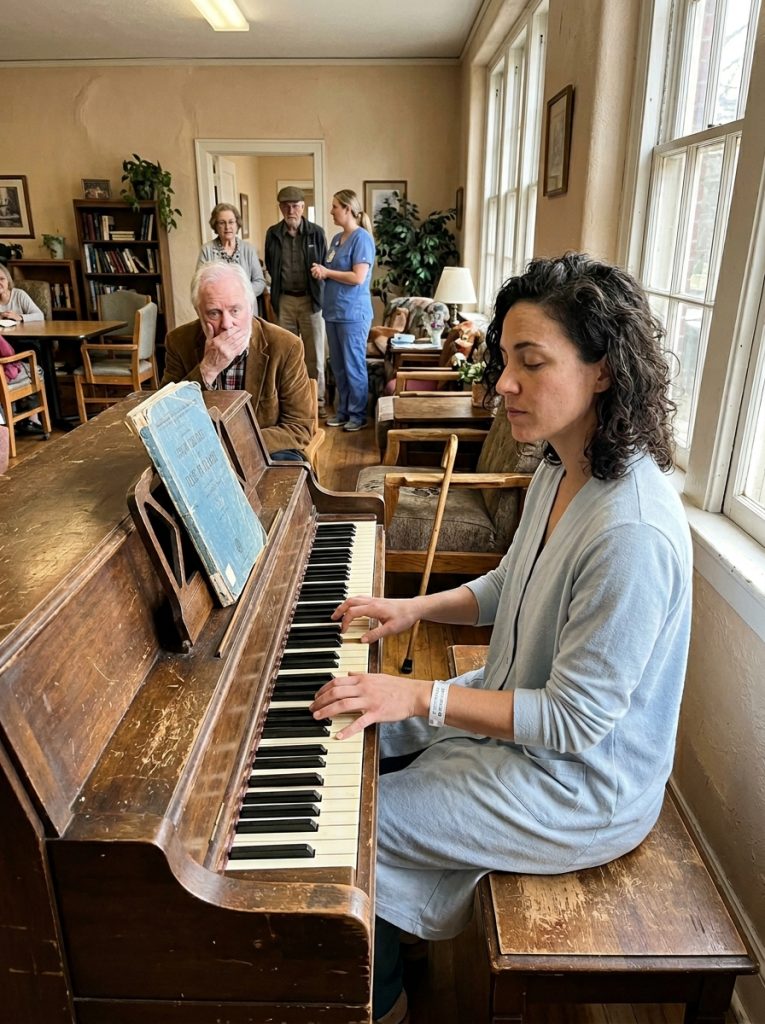
“Eleanor,” he said. “Her name was Eleanor. But she made everyone call her Nell.”
Nell.
The word went through me like a key turning in a lock I didn’t know I had. I didn’t remember being Nell. But my body did the thing it had done at the piano — it recognized the feeling before the fact arrived.
“That’s not my name,” I said. “My wristband says Nora Whitfield.”
Theo lowered himself back into his chair, never taking his eyes off me. “Whitfield was your mother’s maiden name,” he said softly. “Eleanor Whitfield. You used Nell on stage because you said Eleanor sounded like someone’s aunt.” A wet laugh escaped him. “You were nineteen and impossible and the best I ever taught.”
I should tell you that I did not just believe him. You don’t, when your whole self is a question mark. We were careful. The staff were careful. But careful only slowed the truth down; it didn’t change it.
Over the next few days, Theo brought things.
He brought a recital program from a small conservatory hall, with a photograph of a teenager at a grand piano, dark curls pushed back exactly the way mine fall when I don’t fight them. The name under the photo was Nell Whitfield. The face was younger, but it was mine.
He brought the folder off the top of the piano. Inside was the piece I’d played — handwritten, in faded pencil, with a dedication on the first page: For Nell, who plays what I can only hear.
And he brought the hardest thing: the story of how I disappeared.
I hadn’t vanished into thin air. At twenty, just after that recital, I’d had a falling-out with my family over the thing families fall out over — they wanted me to be sensible, and I wanted to be a musician, and somebody said something that couldn’t be unsaid. I cut everyone off. I moved away. I changed how I lived. I stopped performing. Theo had written letters that came back unopened. Eventually he stopped writing.
“You broke my heart,” he admitted, “but I always told myself you were out there somewhere, playing. The not knowing was easier if I imagined the music continuing.”
The accident, the social worker later pieced together, had happened on a road two hours from the town where I grew up. I’d been driving toward it. Toward home, maybe. I’ll probably never know what I’d finally decided to say after fourteen years of silence, because the part of me that decided it is gone.
That should be the sad part of this story. And it is sad. I have grieved a self I can’t even remember — the proud, stubborn girl who threw away the people who loved her. I’ve cried about choices I made that feel like they belong to someone else.
But here’s the thing the song taught me, the thing I hold onto.
The accident took my memories. It did not take me.
It couldn’t reach the place where the music lived. Eleven years of silence, a head injury, eleven lost years — and the moment my hands touched the keys, the truest thing about me came pouring back out, intact. Whoever I had been, underneath all the anger and all the running, I had always, always been someone who plays what others can only hear.
Theo became my anchor. Not my rescuer — he was careful about that. He didn’t try to pour the old Nell back into me like water into a glass. “You’re not her,” he said one afternoon, watching me practice. “You’re who she became when everything else was stripped away. I think I like you better. She was a little bit of a snob.”
I laughed so hard a nurse came to check on us.
Some memories did come back, in pieces, over the following weeks. Never the big dramatic flood you see in movies. It was smaller and stranger than that. The smell of rosin. A specific ache in my left wrist from an old practice injury. A children’s lullaby I caught myself humming while washing my hands, that made a nurse stop and stare because she’d never heard it and I couldn’t say where I had.
Theo helped me understand that this is how it works for musicians. “The hands remember what the mind forgets,” he said. “Music lives in an older part of you than your name does.” He’d bring me pieces I’d supposedly played as a teenager and watch, delighted and weeping, as my fingers found their way through music my conscious mind swore it had never seen.
Not everything was tender. There were bad days — days I’d look in the mirror and feel like a ghost wearing a stranger’s face, days I’d resent the proud girl who’d thrown away everyone who loved her and left me to clean up a life I couldn’t remember choosing. Theo never rushed me through those. He’d just sit, and sometimes play, and let the music say the thing neither of us could.
The conservatory still had my old records. With Theo’s help and a kind administrator, we tracked down a cousin — not the family members from the old fight, who I wasn’t ready for and might never be, but a younger cousin named Priscilla who’d been a child when I left and had grown up hearing about “Aunt Nell who played piano and broke Grandma’s heart.” She drove four hours the day she got the call. She brought a shoebox of photos.
I didn’t recognize a single face. I told her so, terrified she’d be hurt.
She just took my hand. “That’s okay,” she said. “I’ll introduce you to all of them. We’ll do it slow.”
We’re doing it slow.
I’m out of the facility now. I rent a small place with a piano that takes up most of the living room. Theo comes by twice a week. We don’t call them lessons, because he says there’s nothing left to teach me about the instrument. We call them visits. He plays me the things he wrote in the years I was gone, and I play them back better than he can, and he pretends to be annoyed about it.
Last month, he asked me to do something I wasn’t sure I could.
He’s seventy-one. His hands shake too much to perform anymore. There’s a small recital hall, the same one from the program with my teenage face in it, and they were holding an evening of his compositions. Pieces nobody had ever heard. Including one written for a student who vanished.
“I’d like the world to finally hear it played the way I imagined,” he said. “By the only person who can.”
So I played his concerto in public for the first time in eleven years.
I couldn’t remember the last time I’d been on that stage. My body could. The moment my hands found the keys, the fear went quiet, and the song came — the same song that had broken eleven weeks of silence in a sunlit common room, the song that gave me back not my memories but myself.
Theo sat in the front row with his cane across his knees and wept openly, the way he had the first time.
I almost didn’t go through with the recital. The morning of, I sat in the green room with my hands in my lap and the old fear rose up — not stage fright, something deeper, the terror that I’d sit down and the music would be gone, that the one true thing I had left would abandon me in front of a full house. Theo found me there. He didn’t give me a pep talk. He just took my hands in his shaking ones and said, “They’ve waited eleven years to hear this. So have you. Go give it back to the both of you.”
Afterward, a reporter asked me how it felt to “recover my gift.”
I told her she had it backwards.
I didn’t recover the gift. The gift recovered me.