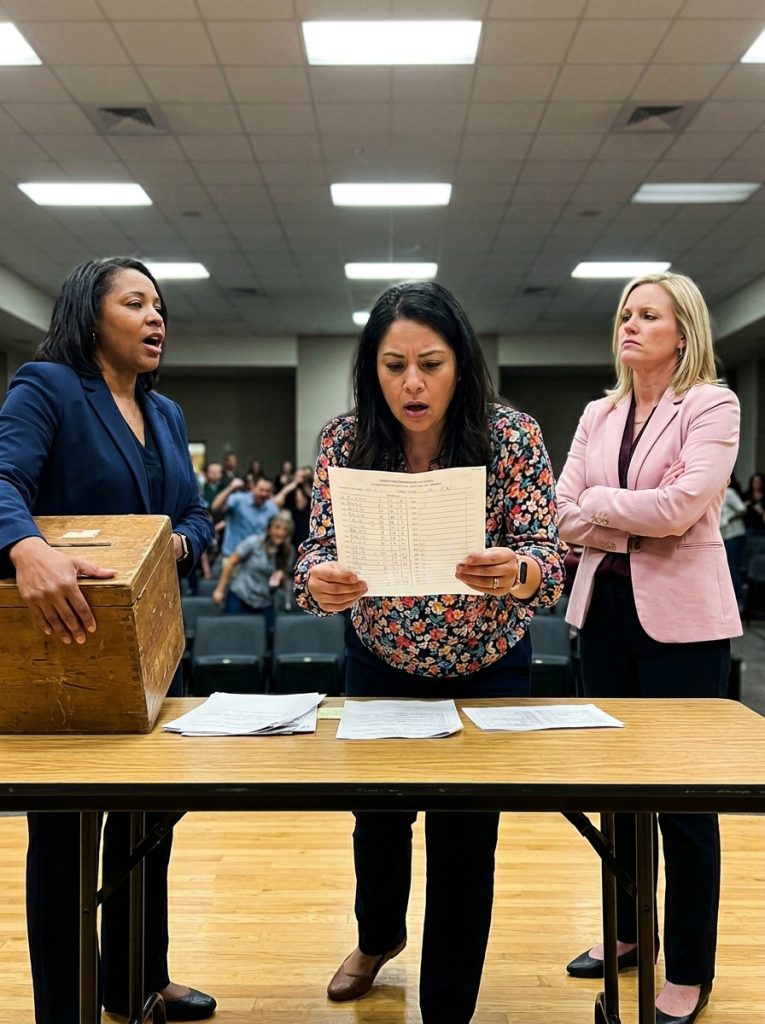
The number was seventy-four.
Danielle Ford said it clearly into the auditorium microphone, holding the tally sheet at arm’s length so the parents in the back rows could see her lips match the words.
“Rosa Mendez — seventy-four votes.”
Then she said: “Karen Whitfield — thirty-one votes.”
The room moved.
Not all at once. First it was the back rows — the parents who had never been in this auditorium on a Tuesday night, who had filled out absentee ballots at kitchen tables and in car pickup lines and at bus stops with pens I delivered. They rose. Not clapping. Just standing. Like they needed to be vertical to believe what they were hearing.
I was standing too. I don’t remember getting up. I was at the counting table with the tally sheet in both hands — I’d asked Ford if I could see it and she’d handed it to me without hesitation — and I was looking at the numbers.
Seventy-four.
We had counted on sixty. We had hoped for sixty-five. We had planned for the possibility of losing by ten and coming back next year.
We won by forty-three.
Karen Whitfield was standing three feet behind me. I could feel her there the way you feel someone who has not yet decided how to react. Her arms were crossed. Her pastel blazer was buttoned and her chin was elevated in the posture of someone who still believes they are in charge of the room.
She said, “I want a recount.”
Ford said, “Of course.”
The recount took twelve minutes. Ford called each ballot individually. A parent volunteer verified. The number did not change.
Seventy-four to thirty-one.
Karen said, “The absentee ballots. Those need to be verified individually. The signatures — “
Ford said, “Karen. The ballots were verified upon receipt per district policy 4.7.2. I verified them myself.”
Karen did not speak again for the rest of the meeting.
I turned around. I looked at the auditorium. The back rows were full — fuller than I had ever seen them. Parents who worked second shift. Parents who spoke Spanish at home and had never received a PTA email in their language. Parents who had been told, implicitly, for years, that this space was not for them.
They were here.
My first act as incoming president — before the paperwork was filed, before the transition meeting was scheduled — was a motion from the floor.
“I move for an immediate financial audit of the PTA operating account, conducted by an independent CPA, covering the past five fiscal years.”
Seventy-four parents voted yes.
The audit took six weeks. The CPA — a woman named Veronica Okoye, referred by a parent in our WhatsApp group who happened to be a financial advisor — delivered the report at the January meeting.
The findings:
Karen Whitfield had been receiving vendor kickbacks from three contracted companies over five years — a bounce house rental company, a catering service, and a photography studio. Each contract was awarded without competitive bid. Each vendor paid a 15% referral fee to a personal PayPal account registered in Karen’s name.
Total recovered: $14,200.
It doesn’t sound like a lot. But for a Title I school where the PTA budget is $40,000 a year, $14,200 is the difference between aftercare for twelve families and aftercare for none.
I presented the findings at the February meeting. Karen was not present. She had resigned in writing the week before — a two-sentence email to the PTA secretary that said she was stepping down for personal reasons.
Nobody asked follow-up questions.
With the recovered funds and a restructured vendor process, I established the Creekside Community Aftercare Program in March. Twelve slots. Free. No application fee, no income verification — just a sign-up sheet. First come, first served.
The first twelve slots filled in nine minutes.
By April we had a waitlist of thirty-four families. I wrote a grant application to the district. It was approved in May. We expanded to twenty-four slots by fall.
I still work two jobs. I still pick up shifts at the dry cleaner on Tuesday and Thursday evenings. I still drive to drop-off in the morning and pick up my kids and help with homework and make dinner and check the WhatsApp group before bed.
But on Tuesday nights I’m in that auditorium. At that table. With the books open and the budget projected on the wall and the parents in the back rows who used to feel invisible sitting up front now.
The first PTA meeting I ran as president, the auditorium was so full they had to open the gymnasium.
I wore my work clothes. I didn’t have time to change.
Nobody said a word about it.
They were too busy listening.
I want to tell you one more thing. About the WhatsApp group. It still exists. It has a hundred and twelve members now. We don’t just organize PTA elections — we share school forms, translate documents, help each other with homework questions we don’t understand, coordinate carpools.
It is not political. It is not radical. It is seventy parents answering each other’s questions at 10pm because nobody else was going to.
That’s what Karen Whitfield lost.
Not an election.
A room full of people who finally realized they were allowed to be in it.
I want to end with one more thing. About my kids.
My daughter is nine. She was in the auditorium that night. She sat in the third row with her abuela and she watched the count. When Ford said the number, my daughter stood up before I did.
She came up to the stage after — when people were shaking my hand and I was holding the tally sheet like it was the most important piece of paper I’d ever touched — and she pulled on my sleeve.
She said, “Mom. You won.”
I said, “We won.”
She said, “Can I hold the paper?”
I gave her the tally sheet. She held it with both hands, very carefully, the way you hold something you know is important even if you don’t fully understand why yet.
She’s going to understand someday. She’s going to grow up knowing that her mother — a woman who works two jobs and wears her work clothes to meetings and speaks with an accent that some people use as permission to dismiss — stood in a room full of people who doubted her and won.
Not because she was loud. Not because she was angry. Not because she had money or connections or a pastel blazer.
Because she counted. And because she helped other people realize they counted too.
That’s the thing about power that Karen Whitfield never understood.
It’s not about the chair at the front table.
It’s about who’s in the room.
And on that Tuesday night in Phoenix, Arizona, the room was finally full.
One last thing. About Karen.
I saw her at the grocery store in March. Aisle seven, pasta sauce. She had a cart and a list and she looked like any other person doing errands on a Saturday afternoon.
Advertisement
She saw me. I saw her see me.
She didn’t say anything. She didn’t look away either. She just nodded — one small nod — and pushed her cart past.
I don’t know what that nod meant. Maybe it was acknowledgment. Maybe it was resignation. Maybe it was the beginning of something that looks like acceptance from a distance.
I don’t need to know.
What I know is this: the books are open. The aftercare is funded. The auditorium is full on Tuesday nights. And the parents in the back row aren’t in the back row anymore — they’re at the counting table, asking questions, reading budgets, holding tally sheets.
That’s enough.
That’s more than enough.
That’s everything.