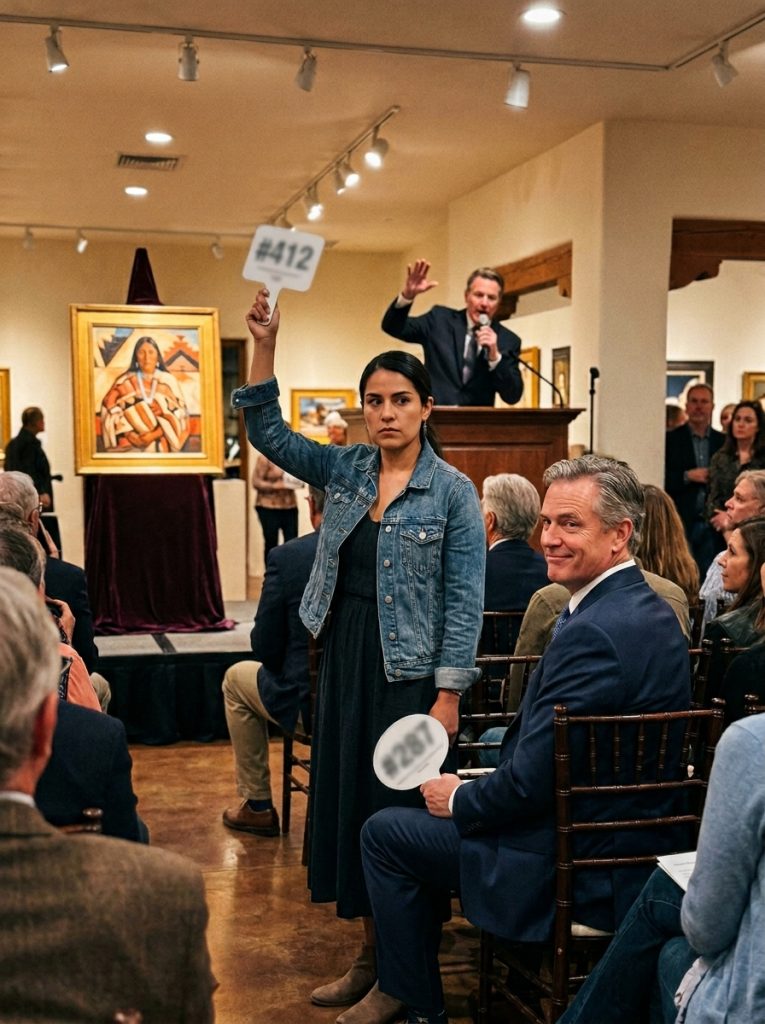
The auctioneer’s gavel hovered. Preston Vaughn raised his paddle one more time, a number that made the room murmur, and he turned to me with that smile that said: your move, sweetheart, and we both know you can’t.
I didn’t raise my paddle.
I lowered it.
And I said, clearly enough for the front rows to hear, “Before the hammer falls, I’d like to speak with the auction director about a right of first refusal on this lot.”
The room went still in a new way.
The auctioneer, Ed Brandt, paused mid-call. “I’m sorry?”
“Lot thirty-four,” I said. “The estate of the artist. There’s a recorded right of first refusal held by a surviving family member. I’m the family member. I have the documentation.”
Let me back up and tell you what Preston Vaughn never bothered to ask.
My father painted that self-portrait in the converted garage behind our house when I was sixteen. I watched him do it. He hated painting himself — said his own face bored him — but my mother had asked for one, just one, so that someday there’d be a picture of him made by his own hand. He grumbled and he did it and he gave it to her on their anniversary.
When my mother passed, the painting stayed with my father. When my father passed eight months ago, it should have come to me. Everything in his will did. But there was a mess — there’s always a mess — involving the landlord who owned the garage studio. After Dad died, the landlord cleared the space and, claiming unpaid back rent, consigned a batch of canvases to a gallery, including the self-portrait that was never his to sell.
I’d been fighting it for months. My lawyer had filed the right of first refusal clause from my father’s estate documents with the auction house weeks before — the legal instrument that gives the estate’s heir the right to match the winning bid and take the work. The auction house had acknowledged receipt. They just hadn’t flagged it on the lot, and I’d come in person to make sure they honored it, dreading exactly this: having to invoke it in a room full of people who’d already decided I was a girl who wandered in off the street.
Ed Brandt conferred with a woman in a headset at the side of the room. She checked a tablet. She nodded.
“The right of first refusal is on file,” Brandt announced. “It’s valid. The lot is subject to it.”
What that meant, in plain terms: Preston could bid all he wanted. Whatever number the hammer landed on, I had the right to match it and take the painting. He could run the price into the sky, but he could not take my father’s face home.
Preston’s smile was gone now.
“This is absurd,” he said. “Who is this person?”
And I finally got to answer the question he’d never thought to ask.
“My name is Nina Calderon,” I said. “The artist was my father. That’s his self-portrait. He made it for my mother. And I’m here to take it home.”
I won’t pretend the whole room burst into applause. It’s an auction house, not a movie. But something rippled through it — that turn where the crowd realizes the person they’d written off is the only one with an actual claim to what’s on the easel. A few people did clap. The woman who’d half-turned earlier to look at the girl in denim turned all the way around now, and her face had changed.
Preston put his paddle down. He’d lost interest the instant the painting stopped being winnable. Men like Preston don’t want art. They want acquisition. The second it couldn’t be acquired, my father’s face was worthless to him.
I matched the standing bid — a fraction of what Preston had been about to spend, because the right of first refusal pegged it to the last legitimate number before my invocation, and my lawyer had structured the filing to cap my exposure. I paid it. The painting was mine.
But that’s not the part of the night that changed my life.
As I was arranging to collect the canvas, a woman approached me. Older, silver-haired, sharp-eyed, with the kind of presence that makes auction staff stand straighter. She introduced herself as Renata Mills, and she owned a gallery two blocks off the plaza — a real one, a serious one.
“I’ve been watching you for ten minutes,” she said. “Not the bidding. You. The way you looked at that painting.” She paused. “You’re a painter too, aren’t you.”
I told her I was. That I’d been painting my whole life, in the same garage, taught by the man on that easel. That I’d never shown anywhere because I’d spent the last eight months fighting to get his work back instead of making my own.
Renata handed me her card. “When you’ve got fifteen canvases,” she said, “come see me. I don’t make this offer twice, and I’ve never made it across an auction floor before. But I know what it looks like when someone comes from somewhere real.”
I have the card framed now, next to the self-portrait.
I should tell you what happened with Preston Vaughn, because it’s a smaller story but it stuck with me.
About a month after the auction, I got an email from him. Forwarded through the auction house, since he didn’t have my address. It was short, and it was not an apology, exactly — men like Preston don’t really apologize, they reposition. He wrote that he “hadn’t realized the personal significance of the lot” and that if I was ever “looking to place pieces with serious collectors,” he’d be “happy to take a look at the estate’s holdings.”
He still thought it was about acquisition. He’d watched a daughter fight to bring her dead father’s face home, and the lesson he took from it was that there might be more inventory.
I didn’t reply for a week. Then I wrote back two sentences: “The estate isn’t selling. But thank you for teaching me, in front of a full room, exactly the kind of collector I never want my father’s work to belong to.”
He didn’t write again.
I’m not proud of how good it felt to send that. But I’m not ashamed of it either. There’s a particular clarity that comes from being underestimated out loud — it tells you precisely who someone is, and it tells you precisely who you don’t have to become to win.
My father’s face hangs in my living room, where it was always meant to be — made by his hand, for my mother, kept by their daughter. Preston Vaughn has a wall full of acquisitions and not one thing on it that made him cry.
Six months later, I had my fifteen canvases. Renata gave me a show. It was small. It sold out. The local paper ran a piece with a headline about a “rediscovered” family of Southwest painters, and I laughed at that word again — rediscovered — because my father was never lost. He was just overlooked by people who didn’t know how to look.
At the opening, I hung the self-portrait at the center of the room. Not for sale. A loan from the artist’s estate, the placard said. The artist’s daughter.
People stood in front of it a long time.
And I thought about that auction, and the man who told a girl in a denim jacket that the opening bid was more than her car, and I understood something my father had tried to teach me with every canvas in that garage:
The people who measure you by what you can afford will never understand what you’re actually holding.
I was holding his name. His hand. His whole way of seeing the desert.
You can’t outbid that. Preston Vaughn never had a chance.