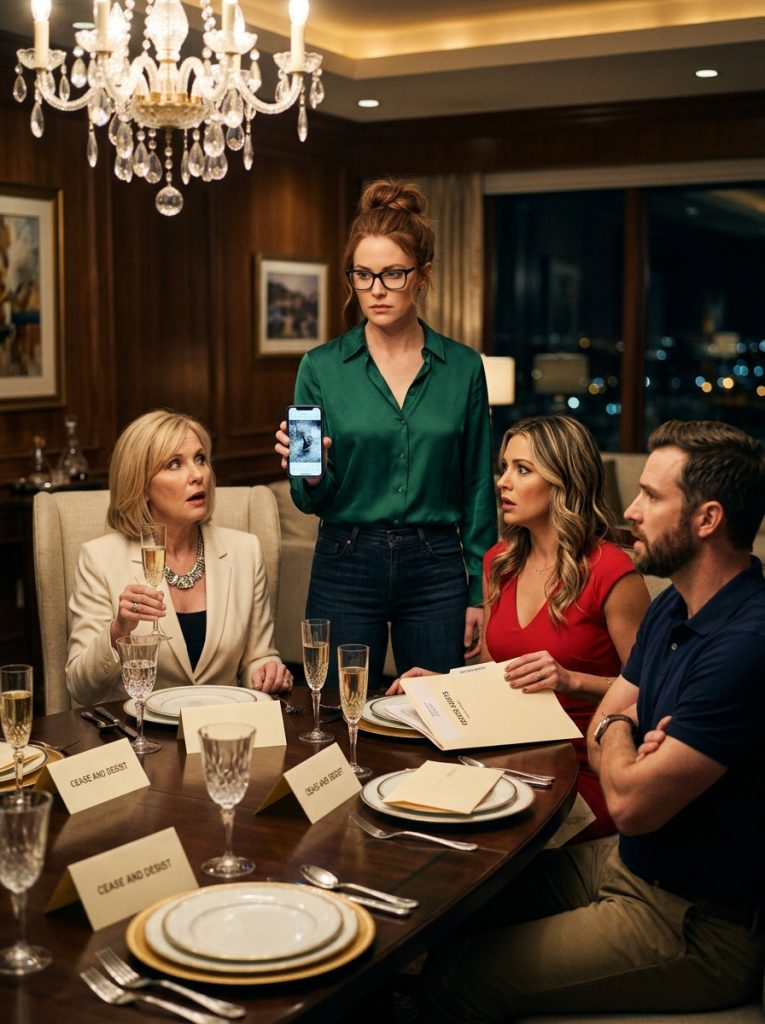
Jenna’s coat was already on.
She buttoned it slowly. Deliberately. While the room stayed frozen behind her.
Patricia’s champagne glass tilted — not dropped, but forgotten. The golden liquid pooling toward the rim like it was trying to escape the table too.
Kayla’s mouth opened. Closed. Opened again.
“Jenna, you can’t just—”
“I can.” Jenna’s voice was calm. Not cold. Not angry. Just finished. “I’ve been watching all of you prepare to take from me for three weeks. Did you think I wouldn’t notice?”
“Take from you?” Patricia’s voice went high. The mother-tone. The one that used to work. “We’re your family, Jenna. We just want to—”
“You want to profit from something you spent three years calling worthless.”
Silence.
Derek stood up.
“Look. I know things between us ended badly, but—”
“You told your friends I was delusional, Derek. You said my app was ‘a cute hobby that would never make a dollar.’ That was fourteen months ago. I have the text.”
Derek sat down.
Jenna turned to Kayla.
“That folder. The one you brought. Your ‘partnership documents.’ Want me to tell you what’s in it?”
Kayla’s hand moved to cover the manila folder instinctively.
“It claims you were a creative consultant during development. It lists dates you visited my apartment. It includes a fabricated email exchange you had your husband draft last week — I know because the metadata shows it was created six days ago, not two years ago.”
Kayla’s face went white.
“How did you—”
“Because I’m a software engineer, Kayla. I read metadata for a living.”
The room was so quiet Jenna could hear the chandelier humming above the table.
She looked at her mother.
“And Mom. The financial advisor you gave my number to? He’s not a wealth manager. He’s an estate litigation specialist. I looked him up. He helps families contest individual asset ownership. You were trying to establish a claim that my app was ‘family intellectual property’ because I lived in your basement for six months in 2021.”
Patricia set the champagne glass down with a sharp clink.
“That’s not—”
“It is. And it won’t work. Because I documented everything. The development logs. The timestamps. The solo commits. Three years of evidence that I built this alone — in an apartment I paid for, on equipment I bought, during hours when none of you called, visited, or asked how I was.”
Jenna pulled on her gloves.
“The cease-and-desist letters are real. My attorney is real. And the next step, if any of you test this, is a courtroom. I promise you — I’m better prepared for that room than you are.”
She walked to the door.
Put her hand on the handle.
And stopped.
Not because she had more to say to them.
But because she had one more thing to say. Period.
“When Dad was alive,” Jenna said without turning around, “he used to tell me that family shows up. Not when things are good. Not when there’s money. When things are hard. When it’s unglamorous. When there’s nothing to gain.”
She turned her head. Just enough to see Patricia’s face in profile.
“None of you showed up during the hard years. Not once. So you don’t get to show up now.”
The door opened.
Closed.
And Jenna Reeves walked out of a room full of people who shared her blood — and into a night that belonged entirely to herself.
The car was waiting at the curb.
Not a limo. Not a Tesla. A four-year-old Honda Civic with cat hair on the seats and a cracked phone mount on the dash.
Behind the wheel: Mrs. Nguyen.
Seventy-three. Silver hair. Jenna’s neighbor of four years. The woman who had watched Byte every single time Jenna worked a seventy-hour week and couldn’t come home to feed him. The woman who left soup on her doorstep during crunch periods. The woman who never asked what the app did, never asked how much money it made, and never once suggested she deserved a cut.
Jenna climbed into the passenger seat.
“How’d it go, honey?” Mrs. Nguyen asked.
“About how I expected.”
“They try to take your money?”
“They tried.”
“And?”
“They failed.”
Mrs. Nguyen nodded. Put the car in drive.
“Good. You want pho? I made extra.”
Jenna leaned her head back against the seat.
Smiled.
“Yeah. Pho sounds perfect.”
They drove in comfortable silence through Denver’s Saturday night streets. Past the apartment where Jenna had coded until 3 a.m. for a thousand nights straight. Past the coffee shop where she’d first tested the app on her own phone and watched it work for the first time — alone, at a corner table, with tears on her face and no one to tell.
Past the restaurant where her family was probably still sitting in stunned silence, reading legal documents they didn’t understand.
Jenna didn’t look back.
She’d spent three years building something from nothing.
She’d spent three more years being told it was worthless.
Advertisement
And now she’d spent one evening proving — quietly, precisely, without shouting — that she knew exactly who had been beside her and who hadn’t.
The money would change things. She knew that.
It would buy her a house. A real office. Maybe a small team someday.
But it wouldn’t change who she called.
It wouldn’t change who she cooked for on Sundays.
It wouldn’t change who got a key to her new place.
Those things were decided long before the acquisition offer. Long before the fourteen million. Long before the cease-and-desist letters and the family dinner and the champagne Patricia bought with Jenna’s name on the seating card.
They were decided during the years when no one called.
And Mrs. Nguyen brought soup anyway.
Two months later, Patricia tried again.
A letter. Handwritten. Three pages of “I’m sorry” and “family is everything” and “your father would have wanted—”
Jenna read it once.
Folded it.
And wrote back one line:
“When you’re ready to be my mother without being my investor, you know where I live.”
She never got a response.
But the following Christmas — ten months after the dinner — a card arrived. No return address. Just a simple message in Patricia’s handwriting:
“I was wrong. I’m sorry. I don’t want anything. I just miss you.”
Jenna put it on the refrigerator.
Right next to the photo of her and Mrs. Nguyen eating pho on acquisition night.
She didn’t call her mother.
Not yet.
But she didn’t throw the card away either.
Because Jenna Reeves was precise about everything.
Including forgiveness.
And she’d get there.
When it was earned.
But one thing Jenna knew for certain — on the night of the dinner, in the car with Mrs. Nguyen, eating pho at a kitchen table older than her app — was this:
She didn’t build something worth fourteen million dollars to impress the people who mocked her.
She built it to prove to herself that the quiet hours mattered. That the discipline mattered. That the choice to keep going when no one believed in you — not your mother, not your sister, not the man who claimed to love you — was the only choice that ever counted.
And the people who showed up during those hours?
The neighbor who fed the cat. The barista who remembered her order. The stranger on a coding forum who debugged her API at 2 a.m.
Those were her people.
Not the ones who came after the check cleared.
Jenna Reeves was thirty-one years old, worth fourteen million dollars, and eating leftover pho in sweatpants on a Saturday night.
And she had never been happier.
Because happiness was never about the money.
It was about who was in the room when there wasn’t any.