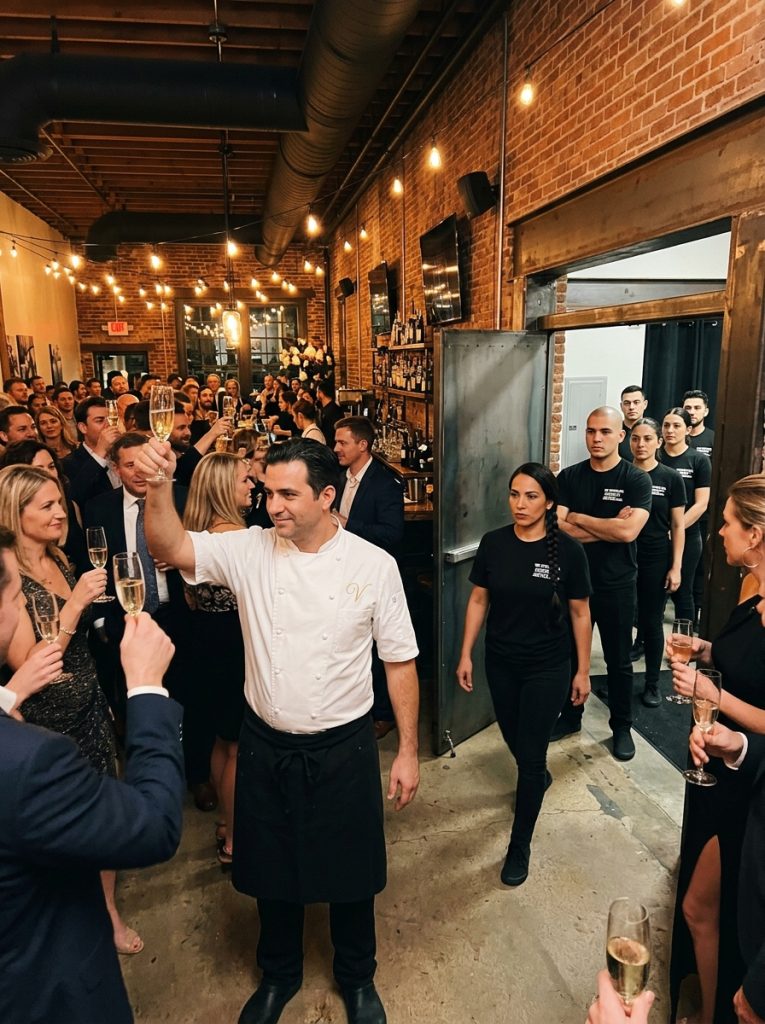
Anton tried to laugh it off. That was his mistake.
“This is a disgruntled former employee,” he said again, louder this time, turning to the investors with his performer’s smile. “Every restaurant has them. This is just—”
“I have the texts, Anton,” I said.
I held up my phone.
“I have the message where you told Miguel that overtime laws don’t apply to back-of-house. I have the message where you told me to clock out and then keep working. I have the screenshots of the schedule changes you made after the fact to erase our hours.”
I looked at the investors.
“You’re about to put money into a man who steals from the people who cook his food.”
The woman in the dark suit — one of the investors — set her champagne glass down on a passing server’s tray. She didn’t pick up another.
That’s when I knew.
The room had turned.
Anton felt it too. His smile cracked at the edges. He set his own glass down on the bar and walked toward us, lowering his voice to the kind of hiss that’s meant to be private but carries in a silent room.
“You need to leave. Right now. Or I’m calling the police.”
“Call them,” Miguel said.
Anton blinked.
“Call them,” Miguel repeated. “We’ll wait. And when they get here, we’ll show them the same texts. And then maybe they’ll want to talk about the cash payments you never reported. Or the tip pool you skimmed. Or the prep cook you paid under the table for eight months.”
Anton’s face went the color of raw dough.
He hadn’t expected Miguel to know about the cash. About the tip pool.
But Miguel had kept everything. Miguel keeps everything. That’s who he is.
One of the press photographers — there were two, covering the opening for a local food blog and the city paper — had stopped taking glamour shots of the plating and started filming us on his phone.
The investors were already moving toward the door. The woman in the dark suit caught my eye on her way out and said, quietly, “Thank you. We had no idea.”
By the time they reached the exit, they were on their phones.
I found out later they pulled their funding that same night. A two-hundred-thousand-dollar investment that Anton was counting on to make his first three months of rent and payroll.
Gone. Before the appetizers were served.
Before we left, something happened that I’ll never forget.
A young woman in a server’s apron — one of Anton’s new hires, someone who’d been working the opening — followed us toward the door. She caught my sleeve.
“Is it true?” she whispered. “The wages?”
“Every word,” I said.
She looked back at Anton, who was now surrounded by the few guests who hadn’t drifted toward the exit, doing damage control.
“He told me my first paycheck would be ‘delayed because of opening costs,'” she said. “I’ve been working for free for two weeks. He said it was normal for a new place.”
I gave her the labor board’s number. I gave her my number. I told her to screenshot every schedule, every text, every promise he’d made.
She took her apron off right there. Folded it. Set it on a chair.
And she walked out with us.
Eight of us, then.
We didn’t stay for the rest of the fallout. We’d said what we came to say. We walked back out through the industrial doorway, past the Edison bulbs, into the Richmond night, our black shirts with their white numbers catching the streetlight.
Miguel exhaled like he’d been holding his breath for eleven months.
“That felt good,” he said.
“It did,” I agreed.
But here’s the part I didn’t expect.
The food blogger posted that night. A short video. Seven former employees in numbered shirts, a chef caught flat-footed, a statement about stolen wages. He captioned it factually — no embellishment, just what happened.
It got shared. A lot. Richmond is a small food city and the restaurant community talks.
The next morning, the health department showed up at Varga Bistro for an unannounced inspection. I’d love to tell you we orchestrated it, but we didn’t. It turned out another former employee — a dishwasher who hadn’t even joined our group — had filed a complaint weeks earlier about food being stored improperly and pest issues being ignored. The complaint had been in the queue. The viral video just moved it to the top.
They found violations. A lot of them. Improper cold storage. Expired product relabeled. A rodent issue Anton had been hiding. Raw chicken stored above produce. A handwashing sink being used to store mop water.
The inspector’s report became public record. In a food city like Richmond, that report traveled faster than any review. Restaurants live and die on trust, and Anton had spent his on stolen wages and hidden rats.
They didn’t shut him down that day. But they cited him, fined him, and scheduled a follow-up.
The follow-up failed too.
Varga Bistro served dinner for exactly nineteen days before the combination of pulled investment, a damning health record, and a restaurant community that no longer trusted Anton Varga forced it to close.
He filed for bankruptcy four months later.
Now — the wages.
You might think this is the part where I tell you we got our money. It’s more complicated than that. When a business goes bankrupt, unpaid employees become creditors, and creditors stand in line.
But here’s what happened: the publicity around the closure caught the attention of a state labor attorney who’d been building a case against wage theft in the restaurant industry. She reached out to us. She took our case — all seven of us — pro bono, as part of a larger enforcement action.
It took fourteen months. The attorney deposed Anton. She subpoenaed his payroll records — what little he’d kept. She brought in three of us to testify. Miguel’s screenshots, the ones everyone had told him were pointless to save, became the backbone of the case.
The state ruled in our favor. Anton was ordered to pay the full $47,200 in back wages, plus penalties, garnished from the sale of his remaining assets and future earnings. The young server who walked out with us got her two weeks, plus damages.
Miguel got his $4,200.
I got my $8,600.
It wasn’t really about the money, though. Not for me.
It was about the four years I gave that man. The dishes I created that he served under his own name. The nights I worked past midnight for a wage that didn’t cover my rent. The way he fired me and then told the whole city I was “difficult.”
I’m a chef. I have my own place now — a small spot, twelve tables, where I pay my staff fairly and post the tip distribution on the wall so everyone can see it.
I named it after my grandmother, not myself.
And on the wall by the kitchen, framed, is one of those black t-shirts.
The one that says $8,600.
Advertisement
To remind every cook who works for me that their labor has a number, and that number is not negotiable, and nobody — nobody — gets to erase it.
The champagne was cold the night we walked in.
By the time we walked out, Anton Varga’s whole house of cards was already falling.
We just opened the door, on the night of his big debut, and let the truth blow in like cold air off the Richmond street.