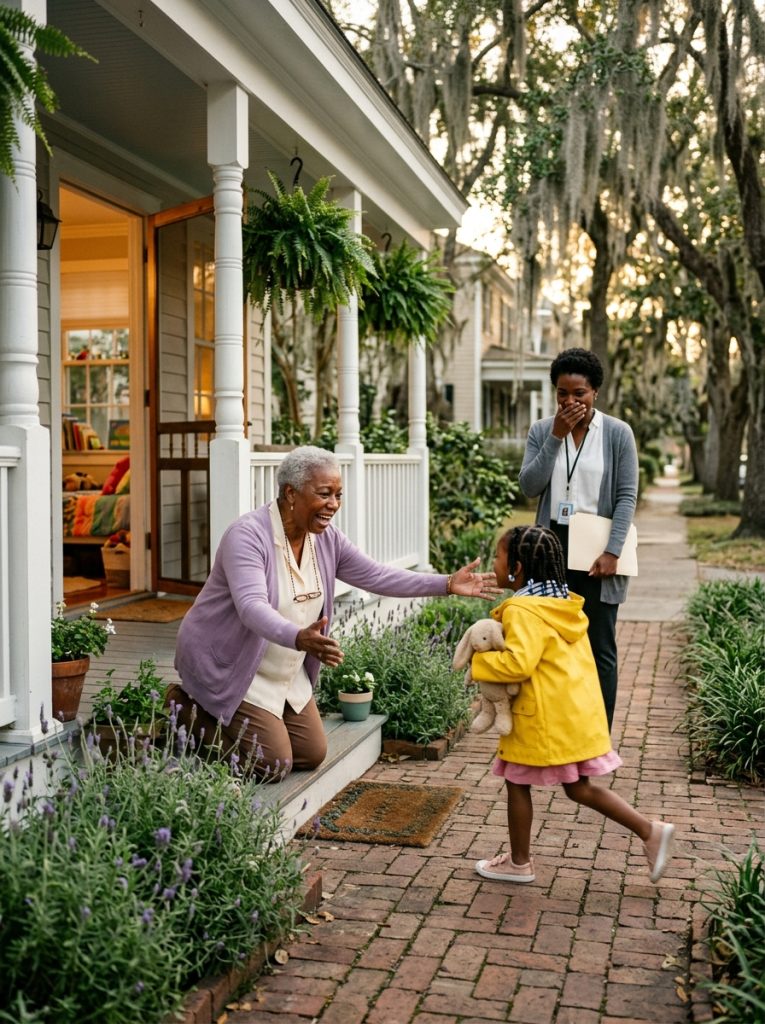
Maya stepped out of the car clutching her stuffed rabbit with both hands.
She didn’t run.
Not at first.
She stood on the brick walkway and looked up at the bungalow porch — at the hanging ferns, the lavender border, the woman kneeling on the steps with her arms wide open.
Diane held her breath.
For eleven days, this five-year-old hadn’t spoken a full sentence. She slept with her shoes on. She ate only when reminded. She carried that rabbit like an anchor to a world that had been ripped away from her without explanation.
The system said she had no one.
The system was wrong.
Loretta didn’t move. She stayed on her knees, arms open, face wet with tears she didn’t try to hide. She let the child decide.
Maya tilted her head.
She studied Loretta’s face the way children study adults they’re not sure about — carefully, thoroughly, searching for something recognizable in the features of a stranger.
Then her nose twitched.
“You smell like Mama’s house,” she whispered.
Lavender.
Loretta’s garden. Loretta’s perfume. The same scent Tasha grew up with in this very bungalow before life took her somewhere harder.
“Yes, baby,” Loretta said. Her voice cracked. “I smell like home.”
Maya took one step.
Then another.
Then she dropped the rabbit on the walkway and ran.
She hit Loretta’s arms at full speed — tiny body crashing into softness and warmth and the particular safety of someone who’d been waiting for exactly this.
Loretta wrapped around her like a blanket.
Held her.
Rocked her.
Whispered words that weren’t for anyone else to hear.
Diane stood three steps back with her manila folder pressed against her chest and her hand over her mouth.
She’d been a caseworker for fourteen years.
She’d seen reunions before.
But none like this.
Because this one almost didn’t happen.
One phone call. One disconnected number. One overloaded system that stopped looking.
If Diane had signed off yesterday — if she’d let Mark’s deadline stand — Maya would be in a stranger’s home right now. In a different city. With people who’d never smelled like lavender. Who’d never known Tasha. Who’d never spent two years filing paperwork the system kept losing.
Diane picked up the stuffed rabbit from the walkway. She walked it over to the porch and set it gently beside the two people still holding each other.
Loretta looked up.
“Thank you,” she said. “God bless you. Thank you.”
Diane nodded. She couldn’t speak yet.
She sat on the porch step and waited.
After a long time, Maya pulled back from Loretta’s arms. Her face was red. Her braids were messy. Her eyes were puffy.
But for the first time in eleven days — she smiled.
“Are you my grandma?” she asked.
“I’m your great-auntie,” Loretta said. “But you can call me whatever you want, sweetheart.”
Maya thought about this seriously.
“Can I call you Nana?”
Loretta’s face crumbled.
“You can call me Nana.”
Maya nodded, satisfied. Then she looked past Loretta into the house.
“Is there a room for me?”
“There’s been a room for you since the day you were born,” Loretta said.
She took Maya’s hand and led her inside.
Diane stayed on the porch.
She pulled out her phone and typed a message to Mark:
Signed off. Kinship placement confirmed. Loretta James, 1414 Oleander St., Savannah. Maya is home.
Mark replied in thirty seconds: Good work, Diane.
Two words that didn’t begin to cover it.
But they were enough for the record.
Inside the house, Diane could hear Maya’s voice — quiet but present — asking questions. What’s this? What’s that? Can I touch it? Is that Mama?
And Loretta answering every one.
Patiently.
Truthfully.
With the kind of love that doesn’t perform. That just is.
Diane drove back to Atlanta that evening. Three and a half hours on the interstate. She didn’t turn on the radio. She just drove in silence and thought about systems.
Advertisement
About how a single disconnected phone number can make a grandmother invisible.
About how paperwork filed in one county can vanish in another.
About how a child can be declared alone when she isn’t — simply because the adults responsible for looking stopped too soon.
The next morning, Diane walked into Mark’s office.
“I want to propose a protocol change,” she said.
“For what?”
“Kinship search. Right now we get one attempt before placement proceedings begin. One call. One database hit. If it fails, we move forward. I want a mandatory second contact attempt within seventy-two hours — different method, different channel — before any permanent placement can be recommended.”
Mark leaned back.
“That’s more work.”
“It’s one more phone call. Or one drive. And it’s the difference between a child ending up with family or ending up in the system forever.”
He looked at her.
“Write it up. I’ll take it to policy.”
Diane wrote it up that afternoon.
The proposal was adopted four months later as a pilot program in the Atlanta metro district.
In its first year, eleven children were placed with verified kinship connections who’d been missed on the initial search.
Eleven children who would have been placed with strangers.
Eleven Mayas.
Six months after the placement, Diane received a letter at her office. Hand-addressed. Savannah postmark.
Inside was a drawing.
Crayon on white paper. A house with a big porch. A garden with purple flowers. Two stick figures holding hands — one tall with silver hair, one small with beads in her braids.
Across the top, in the unsteady handwriting of a child learning to spell:
THANK YOU FOR FINDING NANA.
Diane pinned it above her desk.
She still looks at it every morning.
And every morning, it reminds her:
The system isn’t designed to love.
But the people inside it can choose to.
One more call.
One more drive.
One more refusal to sign off.
That’s all it takes.
One year after the placement, Diane was invited to Maya’s sixth birthday party.
She almost didn’t go. Professional boundaries. Caseworker distance. The training that says you don’t get attached.
But Loretta had written her a handwritten invitation. Maya had drawn a rainbow on the envelope.
Diane went.
The bungalow was decorated with streamers and balloons. Six children ran through the garden. Loretta stood at the porch with a cake shaped like a rabbit — Maya’s favorite animal.
Maya saw Diane and ran straight to her.
“You came!” she shouted, throwing her arms around Diane’s legs.
“Happy birthday, sweetheart.”
Maya grabbed her hand and pulled her inside to show her the room — the same room Diane had glimpsed through the window a year ago. It was different now. Full of books and drawings and a shelf of stuffed animals. A growth chart on the wall showed six months of marks in Loretta’s careful handwriting.
On the nightstand: a framed photo of Tasha.
Maya pointed at it.
“That’s my mama. Nana says she loves me even when she can’t be here.”
Diane nodded.
“She does, baby. She absolutely does.”
Tasha was released four months later on parole. She moved to Savannah. Got a job at a restaurant Loretta’s church friend owned. She visited Maya three times a week — supervised at first, then unsupervised as the court approved.
She didn’t try to take Maya back.
Not because she didn’t want to.
Because she understood — for the first time — that love isn’t possession. It’s presence. And right now, the most loving thing she could do was let Maya have stability while she rebuilt herself into someone worthy of it.
Loretta helped.
Not with judgment. Not conditions.
With dinner every Sunday. With a spare key. With the quiet act of treating her niece like family instead of a failure.
Two years after the placement, Maya’s family wasn’t broken anymore.
It was bigger.
Loretta. Tasha. Maya. Diane — who came to every birthday and every school play and every milestone a caseworker isn’t supposed to attend but does anyway because some cases become more than cases.
They become proof that the system can work — not because it’s designed to, but because someone inside it refused to sign off.