The projector was already set up in the private dining room for a slideshow of our five years of marriage, but the images that appeared on the screen next were not of vacations or shared smiles.
Instead, a large audio player icon filled the screen, and the first track began to play automatically, the sound of the restaurant’s built-in speakers broadcasting a familiar voice throughout the elegant room.
“Charles, if she won’t sign the building over, we have to force her hand,” the voice said, the volume clear and sharp enough to make every head at our table turn. It was the voice of Charles Vance, Robert’s business partner. “We need to create a situation where a court will grant you a favorable asset split in a divorce. Hire an investigator to fabricate evidence of an affair with her property manager. We’ll feed him the fake hotel receipts, edit some photos, and then you accuse her publicly. Once her reputation is ruined and she’s desperate to avoid a public trial, she’ll sign the building over just to get you to sign the divorce papers.”
Robert’s voice responded on the tape, sounding slightly hesitant but desperate: “I don’t know, Charles. Fabricating a cheating rumor? What if she demands a paternity test for our daughter, Lily? She knows I’m the father.”
“That’s the beauty of it,” Charles’s voice replied, followed by the clink of a glass. “You demand the paternity test yourself, publicly. It makes you look like the aggrieved victim. By the time the test results come back—and we both know they’ll prove you’re the father—the pressure will be so high that she’ll have already signed the settlement. She’s too proud to let this drag out in public. Just make a scene at the anniversary dinner. In front of the board, she’ll crumble.”
The private dining room went dead silent. The board members and colleagues sitting at our long table froze, their forks hovering, their eyes wide as they looked between Robert, Charles, and me.
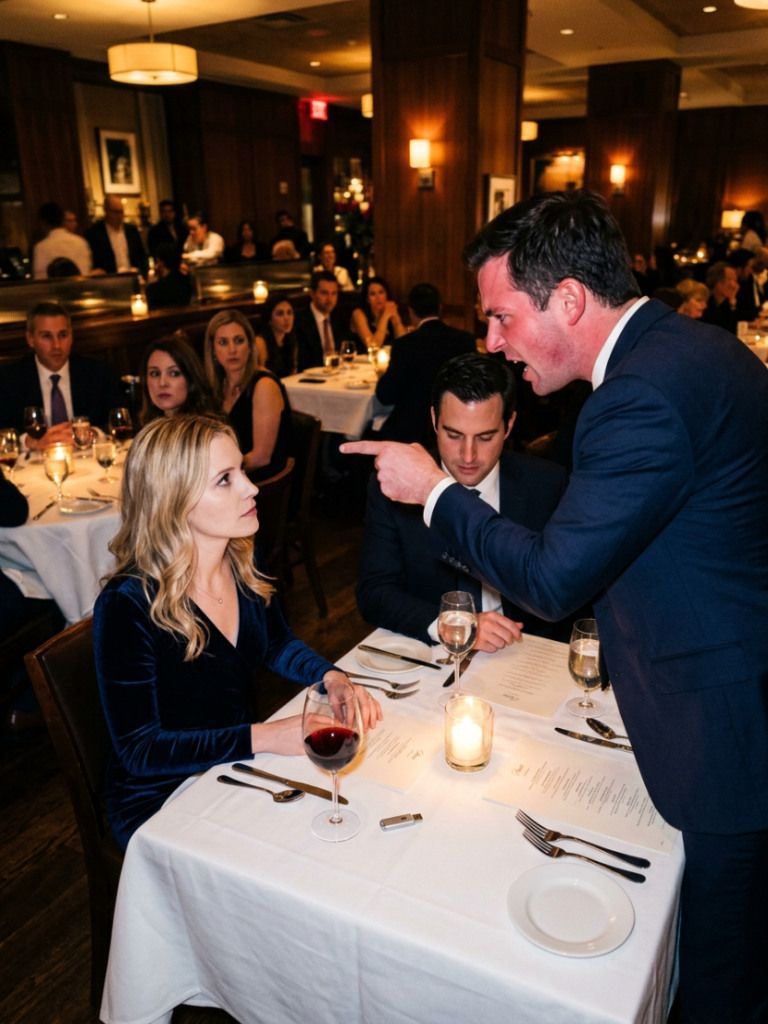
Robert’s face went from a flushed, angry red to a pale, horrified white. He knocked his wine glass over as he scrambled to his feet, trying to run toward the media laptop at the side of the room. “Turn it off! Clara, turn that garbage off! It’s a hack! It’s a deepfake!”
But two of our senior board members, older men who had known my father for decades, stood up and blocked Robert’s path, their faces set in cold disgust. “Let it play, Robert,” one of them said, his voice flat.
Charles Vance stood up, his dark suit immaculate but his face twisted in panic. He tried to project an air of outraged innocence. “This is a ridiculous fabrication! Clara, you are trying to destroy our business reputation because you’re angry about a simple disagreement. This audio is edited, and it won’t stand up in any corporate board or court of law!”
“The audio was retrieved from your own secure server, Charles,” I said quietly, remaining seated in my dark blue velvet dress, my voice steady and clear in the silent room. “When the spyware you installed on my laptop attempted to upload my personal search logs, it opened a temporary backdoor that my forensic investigator used to trace the source back to your office IP address. We have the server logs, the digital signatures, and the wire transfers to the private investigator who fabricated the photos. We even have the unedited receipts for the hotel room you claimed I visited.”
Robert sank back into his chair, his head in his hands, his ambition completely shattered in front of the colleagues he had spent years trying to impress. He was a man who had let himself be bought by a partner’s promises of wealth, choosing to betray his wife rather than admit his business was failing.
My father, Richard Thorne, was a man of quiet, fierce devotion who had spent forty years building our commercial real estate holdings in Chicago. He had always been a sharp judge of character. Before he passed away last year, he had called me to his bedside at the hospital, his voice barely a whisper under the hum of the medical monitors. He had taken my hand and looked at me with a desperate clarity that I would never forget. “Clara,” he had said, “Robert’s ambition is a hollow thing. He loves the prestige of the Sterling name, but he doesn’t know how to build a foundation. He will try to use your inheritance to cover his own failures. Remember my last wish: protect your independence, and protect your daughter Lily. Do not sign the building over, no matter what he promises. And if he ever doubts your loyalty, look into his partner’s files.”
I had kept that promise, fulfilling my father’s last wish to the letter. When Robert first began pressuring me to sign the deed as collateral for Charles’s failing developments, I remembered my father’s warning. I quietly hired a forensic accountant and a private investigator to audit the firm’s filings, only to discover that Charles Vance had been systematically draining the company’s accounts for his personal debts. Robert was too blind to see it, believing Charles’s promises of a future merger, and when they realized I wouldn’t sign, they turned to deception. They thought I was a naive housewife who would crumble under the pressure of a public accusation, but they didn’t know that my father had prepared me for this battle.
“I will take the paternity test tomorrow, Robert,” I said, my voice quiet but carrying a finality that made him flinch. “But it will be for the custody hearings, not for our marriage. I wanted to build a life with you, but you only wanted my inheritance. You wanted my father’s building, but you’ve ended up with nothing.”
I slowly reached down and slid my wedding ring off my finger. I placed it on the white tablecloth next to my wine glass, the gold band reflecting the candle lights. I didn’t look at Charles, and I didn’t look at Robert’s tearful face as he began to realize the cost of his greed.
I picked up my purse, smoothed my dark blue velvet dress, and walked out of the luxury restaurant into the cool Chicago night. The air felt clean against my face, washing away the years of suspicion and paranoia. I was no longer bound by his ambition; I was the guardian of my father’s legacy, and I was finally free.
I walked out of the restaurant into the Chicago night, carrying my father’s legacy and knowing I was finally free of his paranoia.