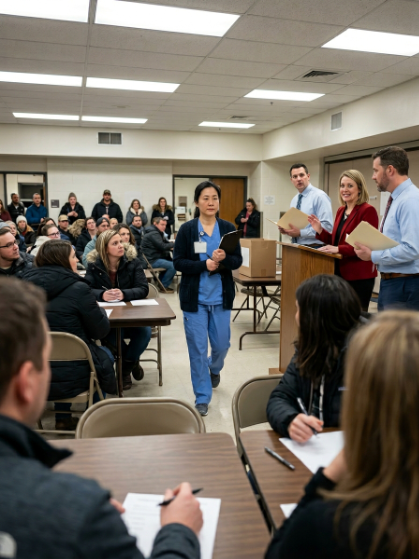
For two seconds, nobody responded to my name.
Not because they had not heard me.
They had.
My pharmacy badge was clipped to my sweater, turned sideways from my drive over after a twelve-hour shift. I had planned to sit in the back, listen, and go home before my daughter woke up.
Then Melissa Stroud laughed once.
“Grace,” she said, making my name sound like something out of place. “This is sweet, but nominations are closed.”
Principal Bell looked at the sheet in front of him. His fingers were on the bylaws, the same bylaws he had shown me when I arrived early and asked one quiet question.
“Write-ins are allowed,” he said.
Melissa turned on him. “Aaron.”
He did not look at her.
“Any clearly written name may be counted if the person is eligible and consents to serve. Mrs. Kim, do you consent?”
I thought about the field trip envelope still folded under a cereal bowl on our kitchen table. I thought about Ms. Patel buying construction paper at the pharmacy with her own debit card. I thought about Melissa saying parents who cared made time.
“Yes,” I said.
The word came out too small.
A man in the second row said, “Say it again.”
So I did.
“Yes. I consent.”
Melissa set both palms on the table. “We cannot allow someone who wanders in at the last second to hijack an election she has never participated in.”
But missing a meeting was not the same as missing my child.
I put the clipboard on the nearest chair and stepped into the aisle.
“I am Grace Kim,” I said. “My daughter is in fourth grade. I work nights at Miller’s Pharmacy on East Douglas. I have missed meetings because they begin while I am either at work or asleep before work. That does not mean I do not care. It means this room was built for a different kind of parent.”
I kept going before courage could leave.
“Field trips should not feel like bills. Teachers should not buy basic supplies after payday. Parents should not have to donate at a gala to be heard. If I am elected, I want budget lines posted before votes. I want one evening meeting and one Saturday meeting each month, with child care in the library. I want half the gala money moved to classrooms and trip assistance. And I want every working parent to know absence is not apathy. Sometimes absence is survival.”
That was the whole speech.
Melissa reached for the microphone. “Thank you. Now, as the only printed candidate, I move that we proceed by voice vote for continuity.”
“No,” someone said.
It was Lana Ortiz from the cafeteria, still wearing her apron near the kitchen doors.
“You announced paper ballots,” Lana said. “Use the paper ballots.”
A murmur moved across the room, low and firm.
Principal Bell picked up the stack. “We will use the paper ballots.”
An older dad with a Cedar Ridge baseball cap pulled a chair out with his foot and said, “Sit before you fall.”
Then came the sound I will never forget.
Pens.
Not applause. Not shouting. Pens scratching on half sheets of paper while parents wrote my name carefully because Principal Bell had said clearly written names would count.
One mother whispered, “Kim with a K?”
Three rows answered, “K-I-M.”
Melissa heard it. She began straightening papers that were already straight.
When the ballots reached the front table, she stood again.
“I request that write-ins be reviewed for eligibility,” she said. “People who barely attend should not decide leadership.”
A tired laugh came from the back, but Principal Bell raised his hand.
“Eligibility applies to the candidate,” he said. “Mrs. Kim is a dues-paid PTA member and a parent of an enrolled student. I confirmed that before tonight’s meeting.”
That was when Melissa looked at my clipboard differently.
I had not walked in brave.
I had walked in prepared.
The count happened in public. Principal Bell read each ballot. The secretary marked the whiteboard.
Melissa.
Grace Kim.
Grace Kim.
Melissa.
Grace Kim.
I tried counting, then stopped when my eyes blurred. I stared at my pharmacy badge instead. There were nights when that badge felt heavy. That night it reminded me I knew how to be careful when people depended on me.
When the last ballot was read, Principal Bell checked the tally twice.
Melissa had twenty-four.
I had thirty-eight.
One ballot was blank.
No one clapped right away. I think the room needed a second to understand that something quiet had actually worked.
Then the cafeteria broke open.
Chairs scraped. Parents turned to one another. Someone cried. Someone laughed. Melissa stood so fast her chair hit the wall.
“This school will regret choosing inexperience,” she said.
I stood slower because my legs were still not on my side.
Advertisement
“Maybe,” I said. “But at least now more than one kind of parent gets to choose.”
The first thing I did as PTA president was ask for the actual budget.
It took three requests, one firm email from Principal Bell, and a quiet conversation with the treasurer before the file arrived in my inbox during my lunch break at the pharmacy.
I opened it beside a stack of prescription bins and nearly cried from anger.
The gala flowers cost more than the teacher supply fund. The donor brunch cost more than transportation help for field trips. A photographer had been paid to cover an event most working parents could not attend.
At our first Saturday meeting, forty-nine parents came.
Some brought kids in pajamas. One dad came straight from a loading dock shift and fell asleep for ten minutes while his son colored beside him. Nobody laughed. I asked if he wanted coffee.
We voted to cut the gala by sixty percent.
We created a field trip fund that did not require children to carry shame in sealed envelopes.
We approved classroom supply cards for every grade level.
We posted agendas and numbers before meetings, not after decisions were already made.
And we changed the schedule: one evening meeting, one Saturday meeting, and one recording for parents who could not be in the room at all.
Melissa came to that Saturday meeting. She sat in the back with her arms crossed and corrected me twice on procedure.
Both times, she was right.
So I thanked her and wrote the corrections down.
That confused her more than winning had.
By October, Ms. Patel stopped buying construction paper at the pharmacy. By November, the fourth graders went to the science center and no child stayed behind because of cost. By December, parents who had never spoken at PTA were politely arguing about whether the winter event needed a food truck or a potluck.
It was messier than Melissa’s version.
It was slower.
But it belonged to more people.
One afternoon, Principal Bell found me taping flyers near the front office. My badge was clipped crookedly again because I was headed to work after pickup.
“I should have enforced the bylaws before that night,” he said.
I smoothed the tape with my thumb.
“Yes,” I said.
He accepted the answer without defending himself. Then he handed me another flyer.
Nominations open to all parents and guardians. Translation support available. Meeting times will rotate to include working families.
I stood there looking at that last sentence longer than a sentence deserved.
My daughter came out of class and saw my face.
“Mom, did something happen?”
I wiped my eyes with my sleeve.
“Yes,” I said. “Something good.”
That night, before my shift, I signed her field trip envelope. Then I added a second check, small compared with Melissa’s donors but enough for one more child to go without knowing whose money helped.
My daughter watched me tuck it inside.
“Are you president now?” she asked.
“For now,” I said.
She nodded like that made perfect sense.
“Good,” she said. “You listen.”
I have never received a better campaign slogan.
And I have never forgotten the sound that changed that room: working parents, tired parents, quiet parents bending over paper and writing one name clearly enough to count.