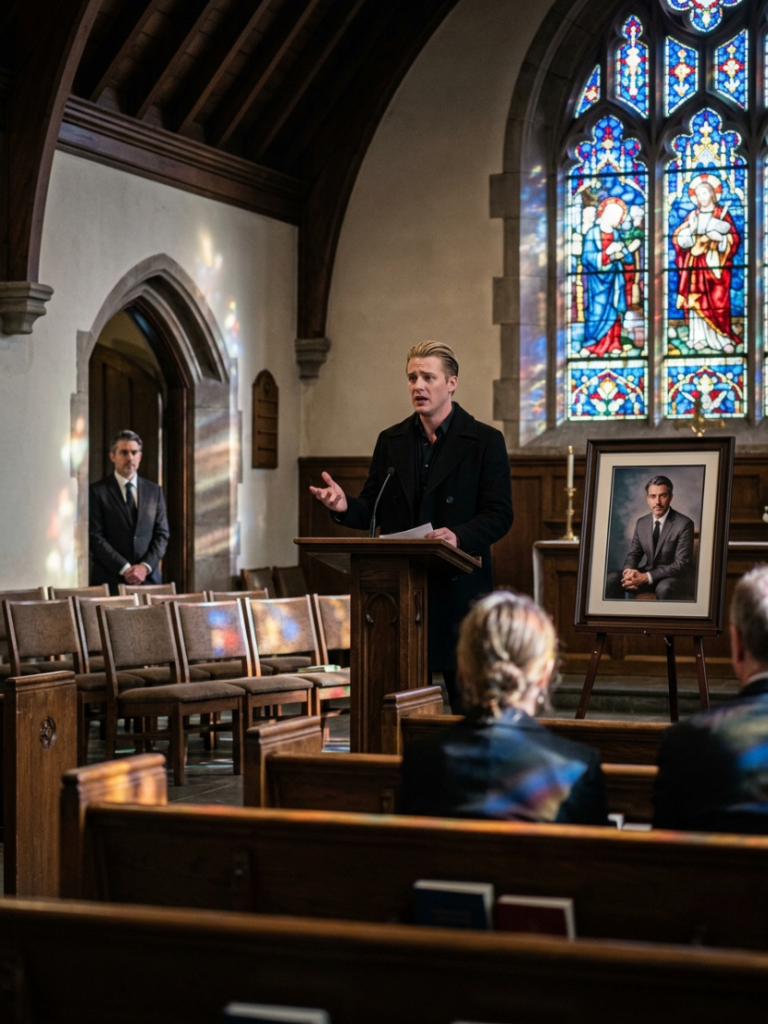
Marcus froze mid-sentence, his hand stopping in the air as he slowly looked toward the back of the chapel. The theatrical tear he had been squeezing out dried instantly on his cheek, his face turning a pasty, unnatural white.
The entire chapel went dead silent. The blue and red light from the high stained glass windows cut across the dark wooden pews, illuminating the dust motes floating in the cold chapel air. Every single board member, relative, and wealthy donor turned in their seats to look at the man who had just cleared his throat at the entrance, whispers rising into shocked gasps that echoed off the high stone ceiling.
My brother’s voice croaked, barely audible through the pulpit’s microphone. “Julian? No… this is impossible. The Coast Guard said… they said the vessel sank with no survivors. We held a memorial search… they found the wreckage of the ship. They said you were gone.”
I stepped out of the shadows of the doorway, walking slowly down the center aisle of St. Jude’s Chapel. The sound of my shoes clicking on the stone floor was the only sound in the room. I wore the black funeral suit I had bought in the first port town I reached, and my dark hair, now streaked with silver at the temples from the stress of survival, made me look like a ghost. My eyes, tired but calm, remained fixed on Marcus.
“The wreckage was real, Marcus,” I said, my voice steady and clear, carrying a quiet authority that resonated through the chapel. “The storm tore the cargo ship apart, and I spent three weeks on a fishing boat with no radio, fighting to survive. But when I finally reached a harbor town and checked our foundation’s accounts, I realized that the real wreckage wasn’t happening in the ocean. It was happening right here in Seattle.”
Marcus stammered, his fingers clutching the sides of the wooden pulpit so hard his knuckles turned white, the cheap wood creaking under his grip. “Julian, you’re… you’re alive! Thank God! I was just… I was trying to honor you. The board and I were just trying to ensure our father’s charity survived the tragedy. We had to make urgent administrative decisions to protect the assets.”
“Administrative decisions?” I stopped at the front of the altar, next to the framed portrait of my face on the easel. I looked at the image, then up at my brother, whose eyes were darting toward the side exit. “You mean the decision to freeze my personal accounts two days after the wreckage was reported? Or the decision to schedule a vote to dissolve the Vance Charity Foundation, transferring its remaining two million dollars of endowment funds into a private holding company in Panama?”
A quiet shockwave of murmurs broke out among the board members in the front rows. Several of our father’s oldest friends, men and women who had helped build this foundation from a small food pantry into a city-wide lifeline, looked at Marcus with expressions of deep disbelief and disgust. They had trusted him, believing his theatrical display of grief, and now the truth was laid bare before them.
This foundation was our father’s legacy, built on a lifetime of quiet devotion to the vulnerable. He spent his weekends serving meals and listening to the stories of people society had forgotten, teaching me that true wealth is measured by what you give. He had warned me that Marcus cared only for the prestige of the Vance name, but I had refused to believe it. I had loved my brother, defending him against our father’s criticisms, hoping that working together would teach him the value of service.
But as I stood in the back of the chapel, listening to him deliver a dramatic eulogy that used my death to justify dismantling everything we had built, I realized my father was right. It was a bittersweet realization, and it was far too late. The brother I had spent my life trying to protect was gone, replaced by a greedy stranger who saw my death as a financial opportunity.
“Marcus,” I said quietly, looking at him not with anger, but with a deep sadness. “I didn’t come here to cause a scene. I wanted to see if you had any real sorrow for me. I wanted to believe that somewhere under that expensive coat, you still remembered the promises we made to our father on his deathbed. I wanted to believe my brother loved me. But you stood at this pulpit and wept fake tears, using my name to cover up your theft.”
“Julian, please, it’s not what it looks like!” Marcus pleaded, stepping down from the pulpit, his face slick with sweat, his theatrical sorrow replaced by raw panic. He approached me with hands raised, trying to project a brotherly concern that felt entirely hollow. “We can talk about this in private. It was a restructure! A strategic move to protect the assets! I did it for the family, Julian. I did it for us!”
“The family assets are safe, Marcus,” I replied, pulling a blue folder from my suit jacket and placing it on the altar. “Before I walked in here, I met with our trust officer, the compliance board, and the district attorney. We have frozen the Panama account, and the board has canceled the dissolution vote. The foundation will remain exactly as our father intended, dedicated to the people who need it. The shelters will stay open, and the funds will go to the soup kitchens, not your lifestyle.”
Two men in dark coats stepped into the chapel, walking down the aisle toward the altar. They were investigators from the district attorney’s office, and their presence made Marcus’s knees buckle. He looked around the chapel, looking for any ally among the donors and board members, but everyone turned away, refusing to meet his eyes. His grand performance was over, and the audience had seen through the act.
“You should leave now, Marcus,” I said, turning my back to him. “The investigators have questions regarding the wire transfers and forged signatures. I won’t be filing personal charges, but the foundation must protect its integrity. The law will take its course, and you will have to answer for what you’ve done.”
Marcus opened his mouth to speak, to offer one last lie or excuse, but the weight of the evidence and the cold, silent condemnation of the room crushed his words. The two investigators gently but firmly took his arms, leading him out of the chapel through the side door. The heavy oak doors closed with a dull thud, echoing through the chapel.
I stood alone at the front, looking at the framed portrait of myself on the easel. I reached out and slowly turned the portrait around, facing it toward the wall. The colorful light washed over the empty pews, casting long shadows. The charity was saved, and my father’s legacy was secure, but the cost was a broken family that could never be mended.
I looked at the empty pulpit, realizing that while I had survived the ocean, I had lost my brother forever.