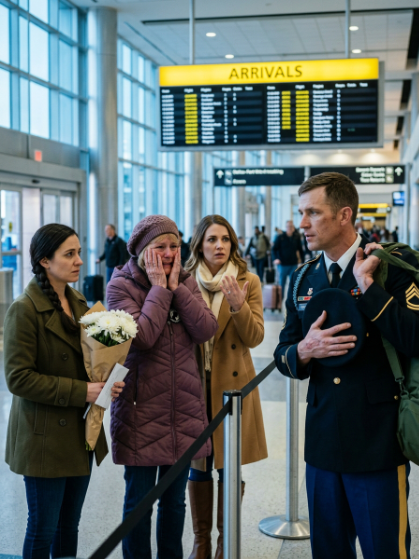
I reached my mother first.
Some things the body decides before the mind gets a vote, and nineteen months of telling myself she was fine had not changed the fact that Ruth Hart was the first person who ever held me. She came off that rail like a woman half her age, and I caught her, duffel and all, and for a long moment neither of us made a sound that was a word.
“I told them,” she finally said into my chest. “I told every single one of them they had the wrong man.”
“You did, Mom.”
“The porch light’s still on.” She laughed and cried at the same time. “Your father said I was wasting electricity. I told him to hush.”
Behind her, Dana still hadn’t moved.
I let go of my mother slowly, and I walked to my wife, and I stopped a respectful arm’s length away, because the ring on her hand had already told me everything about the last year and a half.
“Caleb,” she said. Her voice broke on the second syllable. “There was a service. A flag. I sat in the front row and I—”
“I know.”
“His name is Paul.” It came out in a rush, a confession rehearsed for a man she never expected to confess to. “I waited. I waited so long. And then I stopped, and I hate that I stopped, and now you’re standing here—”
“Dana.” I waited until she looked at me. “You buried me. Nobody buries a husband and then gets told they did it wrong and that it’s their fault. You don’t owe me an apology. You owe yourself a good life. Go and have it.”
She pressed her hand over her mouth. The new ring caught the light.
It hurt. I won’t pretend it didn’t. But grief is just love with nowhere left to go, and I’d done enough of my own in a hospital bed to recognize hers.
And then there was the third woman.
She had waited at the edge of all of it, holding her white flowers, and when I finally turned to her she stepped forward like she’d been holding her breath since the doors opened.
“You don’t know me,” she said. “My name is Mara. Mara Ellison.”
The name landed in my chest like a round.
“Sam,” I said.
“Sam.” She nodded, and her chin trembled, and she steadied it. “My husband. Corporal Sam Ellison. He was in the lead truck with you.”
I knew exactly where Sam Ellison was in that truck. I had thought about it every day for nineteen months. When the vehicle went up, I was pinned and the smoke was already black. And a kid from Beaumont, Texas — twenty-six years old, married eight months — unclipped his own harness, reached back through the fire, and dragged two hundred pounds of me out through a gap that was closing.
Then he went back for the driver.
He didn’t come out.
“I wrote you a letter,” I said. My voice didn’t sound like mine. “From the hospital. The second I could hold a pen. I never knew if it reached you.”
“It reached me.” She drew the folded page from under the ribbon. It was soft at the creases from being opened and refolded a hundred times. “I’ve read it so many times I could recite it. You told me what he did. You said he was the bravest man you ever served beside. You said you were alive because of him.”
“I am.”
“Then I need you to do something for me.” She wasn’t asking. There was steel in her, the same steel I’d heard once when I met Sam at a unit barbecue, holding a beer he never drank because he was on call. “I have a daughter. Hannah. She’s fourteen months old. She has his exact ears.” A wet laugh. “She will never remember him. And one day she’s going to ask me whether her daddy mattered. Whether it counted for anything.”
She pressed the white flowers into my arms.
“I came here because I want the first thing my husband’s daughter learns about that day to be that the man he saved came home. That it counted. That Sam didn’t trade himself for nothing.” She looked up at me. “Will you tell her? When she’s old enough. Will you tell Hannah who her father was?”
I have stood in places most people only see in nightmares. I have never had to gather myself the way I gathered myself in that terminal.
“Every year,” I said. “On his birthday and on mine. I’ll tell her until she’s sick of hearing it.”
My mother was crying. Dana was crying. A man pushing a luggage cart had stopped, cap in his hands, the way men of a certain age do.
I balanced the chrysanthemums in the crook of my scarred arm and unfolded the letter Mara had handed me — my own words, written in a shaking hand in a room that smelled of antiseptic. At the bottom, beneath my signature, she had added one line of her own.
He kept his promise. So will I.
I came home expecting an empty rail.
I left holding my mother’s hand, a fallen man’s white flowers, and a promise to a girl named Hannah.